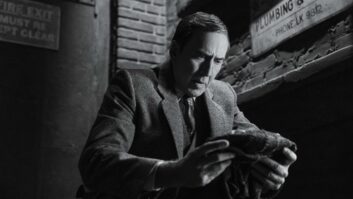
BBC drama series Half Man marks another chapter in Richard Gadd’s body of Scottish storytelling. Following the Emmy winning success of Baby Reindeer, which drew on Gadd’s own experience with a stalker, Half Man moves into fictional territory while continuing to explore dark, emotionally complex themes.
Leaving behind the world of autobiographical dramas, Half Man was created, written, executive produced and stars Gadd. While a fictional narrative it continues to focus on dark and complicated themes with trauma being the engine to the story; an emerging hallmark of Gadd’s work.
For colourist Gareth Bishop of Blazing Griffin, working in DaVinci Resolve Studio gave the team a flexible foundation for developing a look that could support the series’ emotional intensity without overwhelming the performances.
“The visual direction was clear from the get go. Everything from scripts through to costume felt cohesive and really carried the vision forward. Having this already established meant that we could hone in on creating a strong LUT for camera testing,” begins colourist Gareth Bishop.
This was Bishop’s first time collaborating with director Alexandra Brodski and DP Carlos Catalán. “We met long before pre-production started, and after I read the scripts, we exchanged ideas. From there we were always working from the same hymn sheet.”
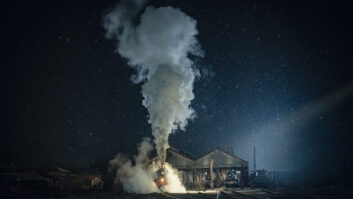
The series moves between two timelines; flashbacks to the main characters childhoods in the 1980s, and present day scenes where the plot unfolds. Finding a way to distinguish those periods, without creating a distracting contrast, became a crucial consideration for the trio.
“Despite there being two timelines, we knew that we wanted the show LUT to carry most of the look, so we spent time researching 1980s references, which were largely shot on film. From there we decided on an independent influence, built using film oxidation, highlight rolloffs and softened blacks. This then became the base for our scenes in the 80s,” explains Bishop.
“We didn’t want the two timelines to look drastically different when other design elements were carrying this. However, some visual tweaks were required to help communicate the tone of the modern day scenes,” he says. “We manually controlled grain levels in Resolve rather than baking it into the LUT, sharpened the image and deepened the blacks. This way the time periods are noticeable but not jarring or distracting.”
Catalán joined Bishop in the grading suite for the duration, while Gadd and Brodski would review periodically. With everything working like a well-oiled machine, the main pressure that Bishop and the team experienced came from the tight turnaround on each episode. “Sometimes we only had three days per episode, so we had to move quickly and commit to our decisions,” Bishop recalls.

Because the show LUT had been established early and the visual direction was carried through so consistently on set, Bishop says the final grade became less about reworking the image and more about targeted refinements.
“Resolve’s Color Warper tool was essential in helping to perfect skin tones, especially in the 80s material where some colours were not quite right,” he notes. “I was able to remap colours and squeeze them into a particular range to make them feel cohesive.”
While most of the look was carefully controlled, Scotland’s unpredictable weather presented its own challenges. “The sky could change quite dramatically between takes,” reveals Bishop. “I needed to create the impression that it was all one continuous scene, but I didn’t want to go down the sky replacement route. Instead, I used the Luma Keying tool and Printer Point adjustments to subtly create a more consistent environment,” he reveals.
Bishop undoubtedly prioritised subtle refinements above overt stylistic changes, honouring Gadd’s desire to keep performance and dialogue central to the story. “At no stage were we ever trying to push the image too hard, favouring instead restraint and supporting the lighting and camera work that Carlos had already established. That’s very much my philosophy as a colourist,” he concludes.
The series is available to watch on BBC iPlayer.