How did Lightwell get involved in the creation of the studio? And when did you start working on the project?
Development of the design was begun by Toby Kalitowski (BK Design Projects Ltd) in early 2025. Aside from realising the design in Unreal Engine, we provided consultancy on the interaction and integration of real and virtual elements from concept through to completion.
The studio is a mix of physical and virtual sets. Can you tell us which bits are which?
The New York location, including the views of Manhattan, Statue of Liberty and the Brooklyn Bridge are of course, real. The physical set is built inside a temporary stage structure that was assembled on the 12th floor of the former Watchtower building, in Brooklyn. On camera, the desks and areas of the floor around them form the physical set. There are two halves to the studio– one is mainly interior, and backed by views of Manhattan, whilst the other is totally exterior and backed by views of the Brooklyn Bridge. A scenic brick column separates the two spaces and has a ‘sports bar’ against it, with a chalkboard for informal notices. Emma Hayes has turned this into an impromptu tactics board, during hydration breaks and really makes the most of the design’s versatility.
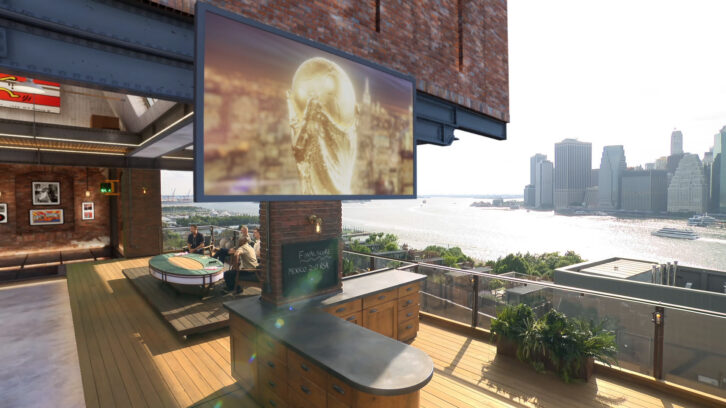
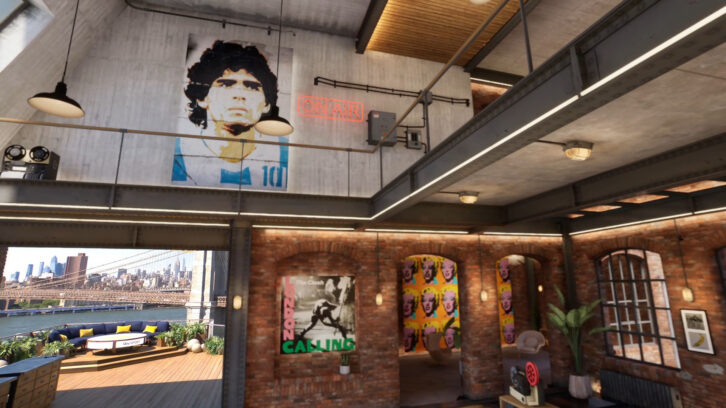
The virtual set is focused mainly around the interior portion of the set, and forms a 360° wraparound interior that enables ITV to do video links using an arrangement of screens. The left of the interior desk is a small area of greenscreen that presenters can utilise for screen-based analysis. Everything else is achieved with masking. The ceiling above the interior desk is 100 per cent virtual and conceals the light grid, as well as the stage construction.
What was Lightwell’s role in the studio design?
We frequently collaborate with Toby Kalitowski of BK Design, with varying combinations of design input, depending on the project, but this was Toby’s design through and through. Conceptually, the design is an idealised New York loft apartment. The artwork and props scattered around the scene lean into that idea and provide cues to classic NY culture of the past 50 years: Scorsese, Blondie, The Ramones, Spike Lee, etc.
Please detail all the technology used in the virtual part of the studio.
The virtual set was built in Unreal Engine by Lightwell, then studio integration was handled by AE Live’s US-based team. Stype was used to power the integration and keying.
How much testing was done prior to the start of the tournament?
We did a preliminary blocking test in November 2025, using a mock-up of the studio footprint in a greenscreen studio in the UK. More comprehensive testing was carried out in January 2026 at Bovingdon Airfield Studios. We had a full mock-up of the studio and were able to test pretty much everything except the effects of natural daylight and sunlight. It was also freezing cold and a world away from the +30° heat and humidity in Brooklyn.
How easy is it to blend such a large physical set with the virtual elements?
This has been the most challenging project of this type that we have undertaken. I’d suggest it’s one of the most challenging scenarios that anyone has undertaken. Key to believability and credibility was developing virtual lighting and materials that closely matched the physical set and conditions.
What was the biggest challenge of the project?
The ambitious physical construction aside, I would say that the variable natural light posed the biggest challenges to the project.
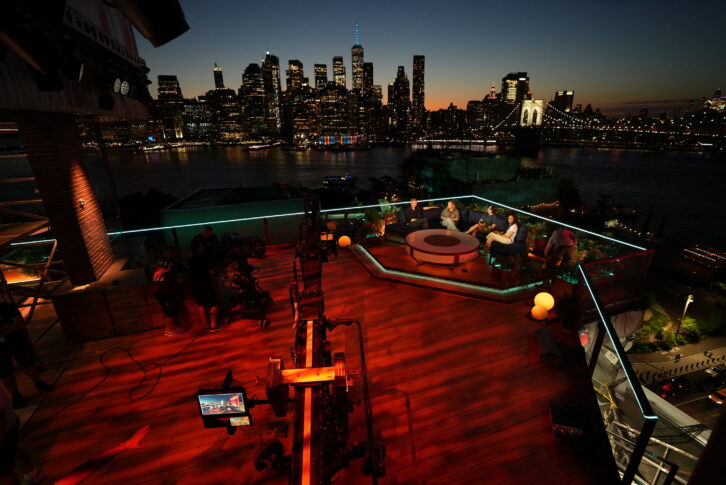
The low sun angles that look so incredible in the evening cast long shadows into the set, and the virtual space had to replicate this. We prepared as much as we could in the UK but really got to work finessing the lighting scenarios once we arrived in NY for technical rehearsals, prior to broadcast.
In parallel to that, there were immense challenges with tracking as the interior/exterior setup and a 17’ Scorpio crane that regularly moves from in to out, and back again meant that the tracking needed to function in direct sunlight one end of a shot, and in an interior setup at the other. The guys from Stype who were on-site for the install were tested to the max.
What’s been the feedback from ITV (and viewers)?
The feedback has been incredible, with high praise for ITV’s ambition and also for Toby’s incredible design. Personally, the most satisfying part is that a lot of feedback has focused on the ITV set being real, but most shots contain substantial portions of the virtual set. That tells me that we got that skilful blend of real and virtual spot-on—we did our job so well, nobody can see we were there.