The 2026 FIFA World Cup represents a significant expansion in scale, spanning three countries (Canada, Mexico and the United States) and 16 host cities. Host Broadcast Services (HBS) will once again bring the images and sound of the tournament’s 104 matches to an expected 5.8 billion viewers around the world.
Planning for this year’s event began as Argentina lifted the trophy in Qatar on 18th December 2022. However, the team at HBS were able to test certain technologies and workflows ahead of time as the US also hosted last summer’s FIFA Club World Cup.
One of the key technologies trialled during last year’s tournament was JPEG XS, and it will be employed again this summer on a much wider scale. “Bandwidth was obviously limited for the FIFA Club World Cup compared to the FIFA World Cup, but it was a great opportunity to test the end-to-end workflow with that technology,” Christophe Barbe, head of broadcast infrastructure at HBS, tells TVBEurope.
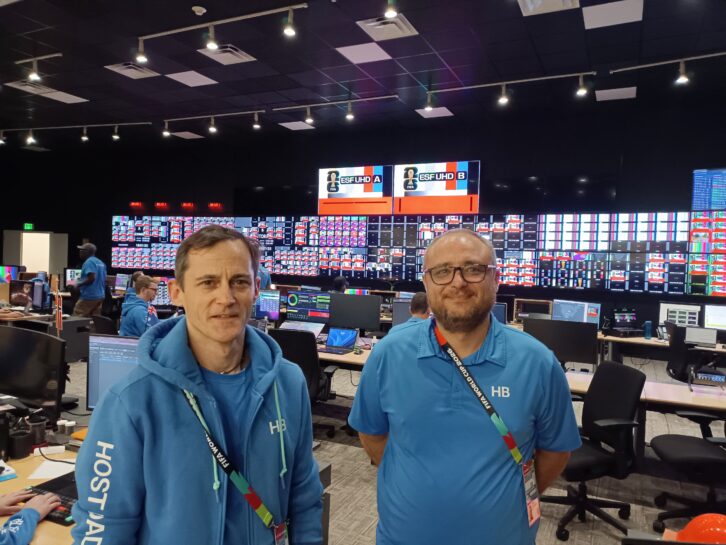
HBS also tested a centralised shading setup and centralised replay system during 2025 which will be will be used again this summer.
“We tested them both at two different stadiums, which were the furthest away from where we were based in New Jersey, to make sure that we were complying with our thresholds,” explains Etienne Godart, head of live broadcast solutions at HBS. “This time, they will be based at the International Broadcast Centre (IBC) in Dallas. We will have all our central operations in Dallas with remote connectivity to the stadiums.”
With an event spread across three countries, the team at HBS has faced multiple challenges, especially around establishing connectivity between the stadiums and IBC. They have been working with Verizon, FIFA’s official telecommunications provider, to establish an overall network.
“On top of that network, we’re adding an ST 2110 layer, and we are using both uncompressed 2110 and compressed 2110 JPEG XS as the backbone of the overall network,” explains Barbe. “We’re using JPEG XS mainly because of latency. But it’s also the compression standard for 2110, so it was a no-brainer.”
Russia 2018 and Brazil 2014 gave the team experience of working on such a large geographical footprint, but they’ve never before worked on a tournament with as many stadiums.
“The challenge that we faced in 2026 was to make sure we could source 16 facilities that were able to produce matches from the stadiums on a consistent level. As you can imagine, cabling those stadiums was also quite a bit of a challenge,” states Godart.
Should there be any problems with connectivity, HBS is employing a satellite backup from each venue that will send a feed to the IBC. “That could even be used for the World Feed if need be,” adds Barbe.
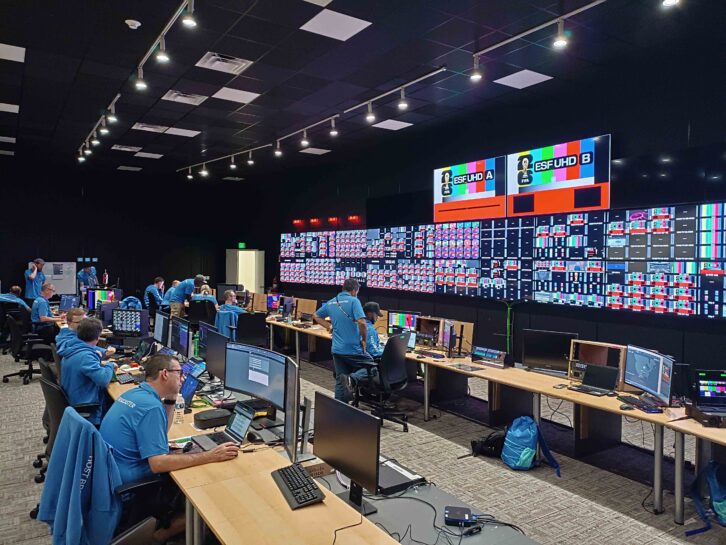
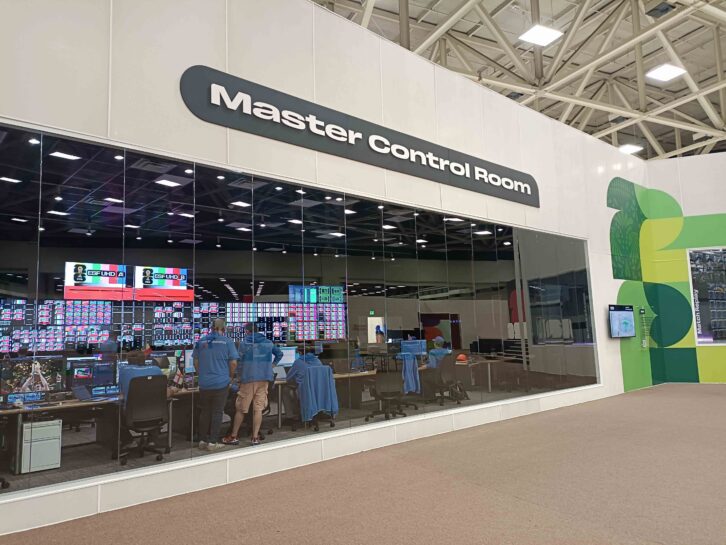
The 45,000 sq metre IBC at the Kay Bailey Hutchison Convention Center in Dallas will be the hub for TV, radio and digital media operations for the 2026 tournament. It’s the second time Dallas has played host to the media operations team, with the city previously serving as host for the IBC at the 1994 FIFA World Cup.
“We will have roughly around 1,000 members of staff in Dallas, working across engineering, production, logistics and so on,” reveals Barbe.
“The interesting part is that, compared to 2022, it’s different, but it’s the same. Different because we’ve centralised a lot of functions like shading, replay and so on, but at the same time, post–production will be done from London. In Qatar, post–production was done at the IBC.
“We have a dedicated link between Dallas and London, where we are using JPEG XS to send the live feeds from the IBC to London. The content is then ingested in London, post produced, and the file-based delivery originates from London, where it’s being sent via the internet.”
Audio, which will be available in both 5.1 and immersive formats, is also being centralised at the IBC in Dallas. All the audio streams and audio content will be sent from the venues via MADI before being added to the main feed. “We still have audio produced locally at the stadiums as backup mixes in case of an IBC issue, but the main content distributed to all broadcasters will be produced centrally from the IBC,” says Barbe.
To cover all the matches during the tournament, HBS has built six galleries at the IBC, enabling it to use one for each match taking place during the knockout stages. The building also includes four centralised audio suites, as well as galleries dedicated to the entertainment happening inside the match venues, which will be fed to the giant screens.
Rights holders will be able to receive content from the IBC in SDI and can choose between 1080p HDR or 1080p SDR. The main match feed will also be delivered in UHD HDR with the associated immersive audio mix.
“In addition to that, we’ve got distribution back at the venues as well, for those who have operations at the stadiums,” adds Godart. “They’ve got the same flavours available to them, still in SDI. We’re also expanding our use of SRT from 2022, so we have the full multi-feed package available as SRT, as well as some extra isos made available by a router mechanism for SRT as well.”
According to Godart and Barbe, the main challenge in preparing for the 2026 FIFA World Cup has been the unprecedented increase in project scale, which has meant a more rigorous approach to crewing. “That’s also the reason why we are centralising those functional areas,” adds Barbe. “There is an element of budget, but it’s also a matter of ensuring consistency, and being able to find teams that are able to produce the FIFA World Cup at the right level.”
EXTRA FACTS AND FIGURES:
- Competition format capture: UHD HDR
- Feeds per match: 12
- Outgoing feeds (total): 1,248
- Cabling across all venues: 1,200 km