The speed at which AI has evolved into an integral tool across industries is staggering. While its ethical implications remain a subject of much debate, one thing is clear: there’s no going back. In the visual effects (VFX) community, generative AI is becoming more readily accepted (whether studios are ready to admit it publicly or not), while agentic AI use cases are on the rise. These shifts are both empowering and pose potential liability for content creators—particularly VFX and animation vendors.

Implemented thoughtfully, AI can accelerate production across the pipeline, elevate creative quality, and inspire new ideas. The challenge lies in figuring out how to do that with security guardrails in place. For VFX studios, safe AI deployments keep footage secure and eliminate exposure vulnerability, block proprietary data from being used to train external models, and ensure each frame has documented provenance. AI orchestration—connecting multiple AI models into repeatable workflows—is crucial to the process. This makes it easier to access the tools and context around what artists are working on at any given moment. With an effective technology framework, studios can harness AI without giving up pipeline control.
Deciding how AI comes in
AI models noted as open have quickly gained popularity among creatives since they are widely accessible and require limited upfront investment. Open source technology in general has been a tremendous boon for VFX, as the community has come together to solve shared problems and support interoperability. However, an open AI model is very different from open formats.
Technically speaking, almost all AI models referred to as ‘open’ are actually open weight, not open source. This distinction matters. With genuinely open source models, all the significant components are public—the model architecture, the weights, the training code, and the training data—and they’re released under a license that allows commercial use and modification. That combination is rare. More commonly, open weight AI models are public, so you can download and run them, but they don’t provide access to the training code or data, and permissions vary. An industry-wide initiative, coordinated by the Visual Effects Society, to establish a classification framework that better describes AI solutions along five dimensions (Data, Model, Infrastructure, Code, and Use) is helping reduce ambiguity in this area.
Open AI models are important for iterating at speed but using them in production requires data protection and licensing consideration. New models are dropping constantly, and artists want to keep pace with the speed of AI, making it challenging for pipeline architects to provide access while preserving pipeline security.
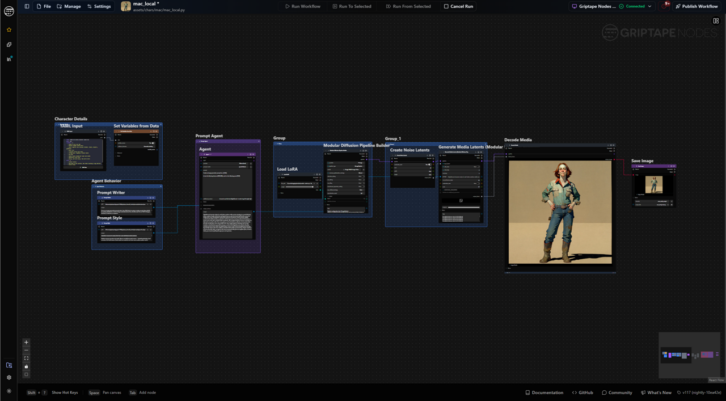
AI orchestration helps studios address the Wild West-like nature of untested AI and is a safe way of using open AI models. In an open orchestration layer, AI models become nodes, and the graph becomes a pipeline step.
Maintaining pipeline control in the AI age
Generative AI may be the obvious play for VFX but it’s worth noting that coding agents have transformed development. Technical Directors (TDs) and artists can now quickly build their own tools to access AI, but unvetted code is a serious pipeline liability. Much like a render job doesn’t get root access to the farm, the same discipline can be applied to everything AI pulls in.
Ideally, you need to sandbox the untrusted code: bound the files it can write and the hosts it can reach, so it touches only its own work and nothing else. It’s also essential to implement automated dependency scanning as you would with the rest of your software, pointed at every model, node, and package coming in. Finally, updates should be age-gated. Compromised releases can usually be caught and pulled fast, so adding a time buffer prevents many problems in the first place.
Securing licensing and pixel provenance
Making sure the code and model are clean is only half of the equation; accessibility is the other. The discipline you already run on data can also be directed at models. Every model pulled needs a license and a paying shot means the license must support commercial use. The license decides everything: whether you can self-host, how long you can keep it running, and if a paying shot is even allowed.
Proving how every frame was made is another crucial step in successful AI adoption, and the approaches are still evolving. Open technical standard C2PA (Coalition for Content Provenance and Authenticity) is one way that studios can record who touched the asset and what AI was involved. Full C2PA documentation is heavy, so you can always start by including metadata as a sidecar, then grow into a more integrated approach as clients require.
Implementing secure AI orchestration
Given the excitement around AI, there are many different options for working with models, whether that’s SaaS solutions, running local, or through a UI. Plenty of tools will connect you to models. Fewer are built for a VFX pipeline, and fewer still carry the vendor accountability a studio needs before a tool touches client footage. One of those options, Foundry’s Griptape, is an open source Python framework and node-based AI orchestration layer that makes it easier to work with AI models in VFX and animation workflows specifically. Ultimately, finding the right approach to AI orchestration for each studio hinges on project security requirements and creative goals.
Open source tooling is incredibly beneficial, even in the context of AI, with the appropriate precautions in place. With an AI orchestration layer, artists can experiment quickly without compromising the studio pipeline or the client’s intellectual property (IP). Frames are safe, compliant, and provable, while creative iteration is accelerated.
Studios that implement AI orchestration recognise it as the practical way to use open models at scale without a TD vetting every one by hand. By automating repetitive tasks and accelerating iteration, it frees artists for more sophisticated creative endeavours, which matters in a world where demand for content has never been stronger.