Somewhere in the dark reaches of the internet, there is a grainy photograph of what appears to be an old cable drum that has been discarded in a field somewhere in Hertfordshire. The picture was apparently taken sometime during the 1980s and closer examination reveals a rather depressing truth. It is, in fact, the last known sighting of the space station model that wheeled majestically in Low Earth Orbit during Stanley Kubrick’s much-lauded classic, 2001: A Space Odyssey. As a symbol of a largely lost art, the forlorn wreckage is hard to beat. Today, depicting a futuristic spacecraft for a TV or film production is a matter of rearranging a collection of 1s and 0s located somewhere in the vastness of the cloud.
I’m trying not to wallow in nostalgia, but those miniatures had – and I’m struggling for the word – a physicality to them, a realness. While I knew they were not really blasting across the cosmos, I also knew that someone had lovingly laboured over them to make the impossible become reality. To borrow a phrase popularised by another TV classic, I wanted to believe.
Not that this is a new phenomenon, of course. I think I’m right in saying that the original Westworld was the first movie to use CGI back in 1973 – and even I’m too young to have seen that one on the big screen. In that instance, and many that followed, the technology added to the experience. There is, however, a rather large irony in that Michael Crichton, who created Westworld and a host of other thrillers, always tried to deliver a crucially important message: don’t let the technology run amok. Anyone see any parallels with the ongoing dialogue over the creative use of AI?
Way to completely miss the message, everyone. Rather than use these innovations sparingly, TV and film productions have become utterly enamoured of them, squeezing digital imagery in at every opportunity. For me, there’s always something slightly off with the way it looks – it’s too smooth, too clinical. It doesn’t feel real any more.
Recently, I was idly watching Roger Moore’s first Bond outing, Live and Let Die on TV (coincidentally released the same year as Westworld). At one point our hero escapes in a vintage double-decker bus, outfoxing his pursuers in a series of death-defying stunts. On a rational level I understood it wasn’t good old Sir Rog at the wheel – I knew it was really a highly-skilled stunt driver that was sliding the old heap around a well-watered Jamaican street – but I was able to suspend my disbelief. Although trickery has been endemic since the very beginning of this business, these old productions at least contained an element of truth.
And there’s something else. I recently watched an episode of Netflix’s Yellowstone on a very high-end TV. It was undoubtedly visually incredible, but it left me feeling cold. In one scene, a close-up of an actor’s face revealed every pore, every blemish in hyper-real detail. It felt as though I was watching an anatomical study, rather than a piece of entertainment.
I used to think this was a ‘me’ problem, part of aging’s inevitable descent into believing everything was better in my day. Lately though, I’m not so sure. More and more, it seems I’m not alone. More and more, it seems storytellers are starting to understand that over-reliance on technology is diluting the tales they want to tell.
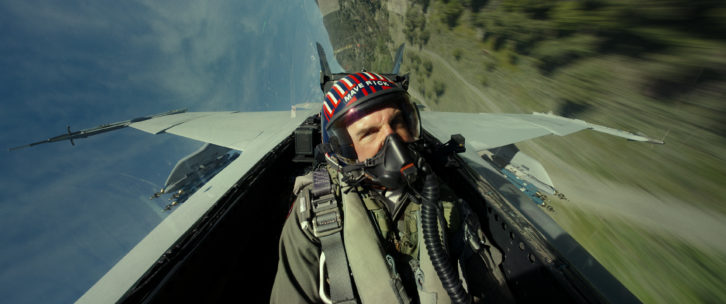
We all loved Top Gun: Maverick because we knew that while it wasn’t really Tom Cruise at the controls of his alter-ego’s FA/18, he was actually filmed while strapped in the back of one. And it showed.
Last year, I covered a story for TVBEurope’s Daily newsletter about a collaboration involving the University of Salford and Danish camera maker Logmar, working with the company’s Magellan 65mm camera. Used by Christopher Nolan in Tenet, it was the first 65mm camera to be manufactured and used on a major motion picture in 30 years. Speaking about the project, Laura Hiliard, film production lecturer at the University, referred to the “magic” feeling the film created. Students are being trained in its use.
Next year marks the 50th anniversary of Star Wars. There was never any chance it was not going to be re-released, but, somewhat unexpectedly, Disney has confirmed it will release the original version – no new titles, no 1990s CGI additions. I guess we’ll soon be able to definitively answer who fired first.
And with Ryan Gosling sci-fi Project Hail Mary showing in cinemas, it was revealed not long ago that the film was made without green screens, that the titular spacecraft was built as a physical set, and that alien character Rocky was a real-life puppet.
Maybe there’s something in nostalgia after all.
This column first appeared in the April issue of TVBEurope, available for download here.