The University of Salford has revealed details of an R&D collaboration with Danish camera manufacturer Logmar to test the company’s 65mm camera.
Over the last six months, film production lecturers Laura Hilliard and Steven Wyatt have been given exclusive access to the camera, one of the few in use worldwide, along with a set of lenses from WhitePoint Optics. First used on Christopher Nolan’s Tenet, the Magellan was the first 65mm camera to be manufactured and used on a major motion picture for three decades.
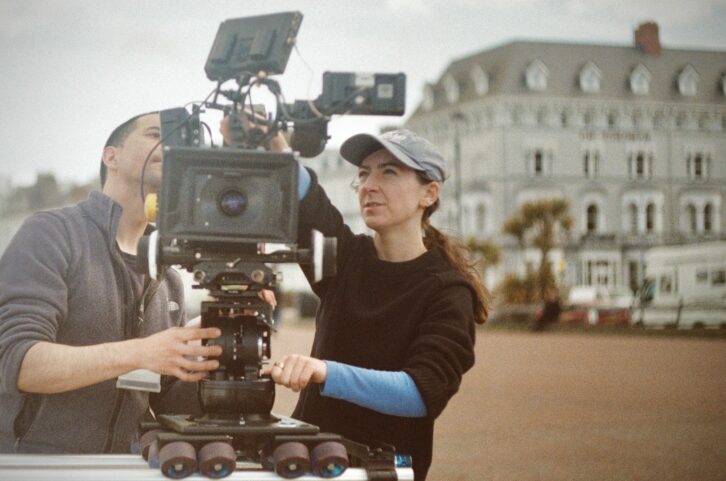
A collaboration involving Kodak Film Lab London, Orchard Film (part of the Digital Orchard Group), Sunbelt Rentals, Provision, MKV and No Drama, the project aims to further the technology’s development through a process of testing in a rigorous environment. Work is taking place at the University of Salford’s Newton Film Hub, which incorporates nine free-standing industry film sets as well as extensive lighting and camera equipment.
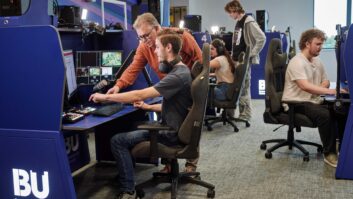
As the only university in the world to currently have access to a 65mm camera, the University’s Film Production course is providing a unique experience for students, with dozens being trained in how to load and use the camera. Training courses are also being developed to show camera operators already in the industry how to work with the rare format.
Once the go-to production format for films, 65mm was showcased in several major films throughout the 1960s, including Ben-Hur and 2001: A Space Odyssey. The costs involved in producing films on the format saw 35mm come to prominence and the advent of digital technology in the 1990s was almost responsible for the demise of 65mm. However, a resurgence of use in the 2010s brought a revival, through the likes ofThe Hateful Eight and Kenneth Branagh’s 2017 remake of Murder on the Orient Express.
Commenting on the project, Hilliard said, “Given the rarity of the format, there is a particular mystique around these cameras. This is because there are very few remaining working 65mm cameras. All are under lock and key for use by only the most prestige Academy Award-winning directors and cinematographers.
“We hope to open access to the 65mm celluloid film format to ensure its future success. We want to train camera assistants and operators on set, work closely with labs and scanning facilities to gain valuable insights about the medium, and then share all of this along with detailed exposure reports, camera notes, and test footage to the wider celluloid film community online.
“When Steven and I first pressed record on the Magellan, it gave us that magic feeling you get with film. The feeling I had shooting my first ever Super 8 film. It’s like waking up on Christmas morning as a kid or finding yourself, a regular driver, at the wheel of a Formula One car.”
The search for a 65mm camera began when UK training body ScreenSkills asked the lecturers to teach a celluloid filmmaking course on Super 8, 16mm, 35mm and 65mm to industry camera professionals. Logmar agreed to provide the camera on loan in return for access to their research, as the company works on a new model.
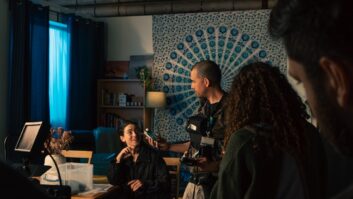
“Logmar were keen to find someone out of the spotlight and away from studio pressures – As lecturers and teachers of our industry, we’ve been the perfect fit,” said Wyatt. “With the facilities we have here at Salford as well, we’ve been able to try a number of things, notably with the support of Richard Evans [Academic Fellow] and Libby Scott [Research Associate], who have been instrumental in planning and assisting on test shoots. We’ve done big studio lighting set ups with 5ks, dolly track, complicated blocking, and multiple monitors and we’ve also shot classic film registration tests.
“With Richard’s help, we’ve even worked with Dean Hall at MKV to rig the camera on a Steadicam and we’ve taken it on location in Wales to shoot sweeping landscape vistas. We extensively document while on set and share everything, which is just what they need.”
Led by Dan Redrup, the Orchard Film scanning team has recently debuted an upgrade to its scanning capabilities, now able to add 8-perf, and 15-perf IMAX across all formats.
Hilliard and Wyatt are hopeful their research will enable further innovations with the Magallan, and that a new generation of filmmakers will be trained on the format. “We take great pride in that no other film school in the world can offer this opportunity right now. But we recognise that this is also about training up those already working in industry and to be able to teach others, could have such a big ripple effect on the popularity of 65mm film.”