Following climbers Jim Morrison and Hilaree Nelson as they set out to climb and ski down Mount Everest’s North Face was always going to be a formidable undertaking. The challenge became even more poignant when tragedy struck: Nelson was killed in an avalanche while skiing down Manaslu in September 2022.
Filmed over more than six years, Everest: The Other Side follows Morrison as he grapples with his grief and determination to fulfil their shared dream, culminating in his successful climb and ski descent of Everest’s North Face in 2025, when he scatters Nelson’s ashes on the summit.
For cinematographer Clair Popkin, capturing the story meant working in some of the most demanding conditions imaginable. At advanced basecamp, approximately 18,000ft (6,000m) above sea level, thin air, extreme temperatures and unpredictable weather tested the crew and its equipment. The camera package needed to deliver big-screen image quality without adding unnecessary weight to the climbing team’s load.
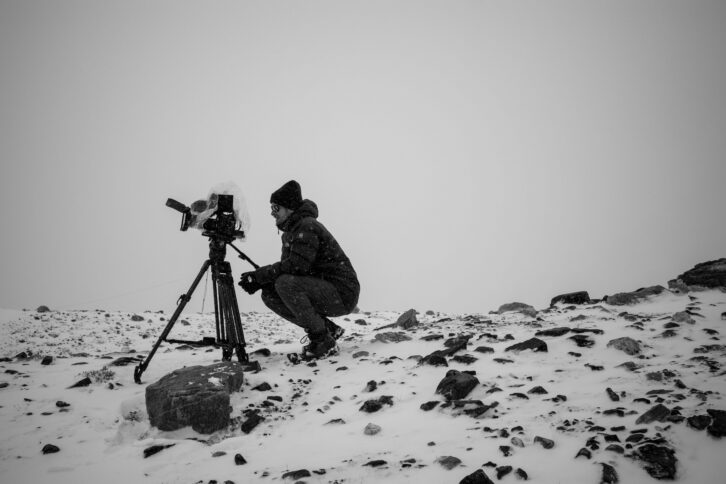
Popkin joined the production for its final four years, having initially been unable to take part because he was recovering from a climbing injury.
For interviews and vérité sequences at advanced basecamp, he used the ARRI Alexa 35 and Mini LF, paired with ARRI Signature primes and Angénieux EZ zooms.
“I love the way ARRI renders skin tones and how the Signature primes look for interviews,” he says. “The dynamic range of the Alexa 35 was also fantastic for this high-contrast environment.”
Canon cameras played a central role in the mountain filming. Popkin used the C400 for handheld work, alongside the C80 and R5C, which became the principal camera for the summit team.
“The combination of quality, resolution, dynamic range and battery life made it an easy choice,” he explains. “It is a tiny camera with a full-frame sensor and shoots 8K RAW in Canon Log. This allowed us to maintain beautiful quality with minimal weight for the summit team. We also used GoPros and DJI drones—the Inspire 3 and the Mavic 4 Pro.”
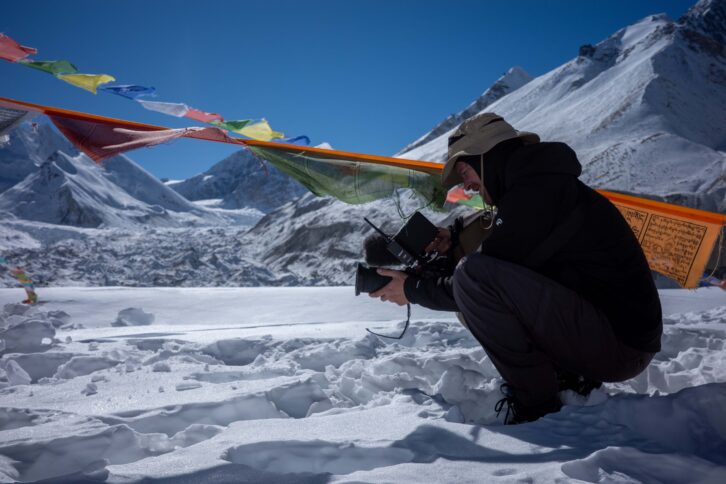
Producer Shannon Dill adds: “We began the project with the goal of screening in IMAX theatres, so we did extensive testing at the onset with various lightweight cameras for filming on the face that could also stand up to both the extreme cold and then the conversion for the larger IMAX screens. The Canon cameras ultimately became our go-to and were very flexible in serving our needs.”
Lighting presented another challenge, particularly inside the expedition tents. Popkin modified inflatable camping lanterns to accommodate Litegear Lite Ribbon, allowing them to serve as both practical sources and controllable lights. He also used Titan tubes to balance the light between the tent interiors and the brighter conditions outside.
For interviews, he employed 8×8 Magic Cloth diffusion, with Intellytech foldable LED panels providing the key light on the mountain. In the US, he used an ARRI SkyPanel and Aputure 1200d, with a LiteMat providing additional frontal fill.
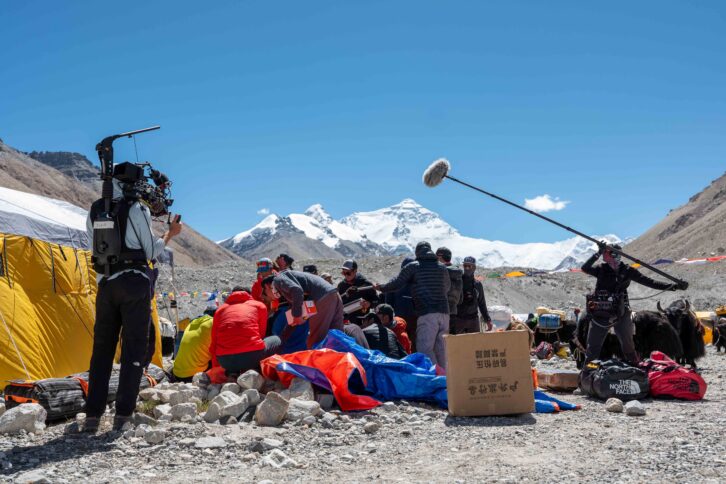
Dill describes the thinking behind Popkin’s approach: “Clair is an expert at vérité lighting and he put a great deal of thought during preproduction into how best to work within the conditions on the mountain, where we would be filming in tents with a lot of yellow. He also knew we would be filming in both absolute darkness and intense sunlight on the mountain, so he developed specialised systems that were portable and lightweight. We could be flexible at Advanced Base Camp, where we would be filming both vérité and sit-down interviews for months at a time.”
Popkin says: “We trained physically for months in advance of every expedition, hiking, cycling and sleeping in altitude tents at night before setting off, so our bodies could start to pre-acclimatise.”
The camera systems were also put through their paces before the crew set off.
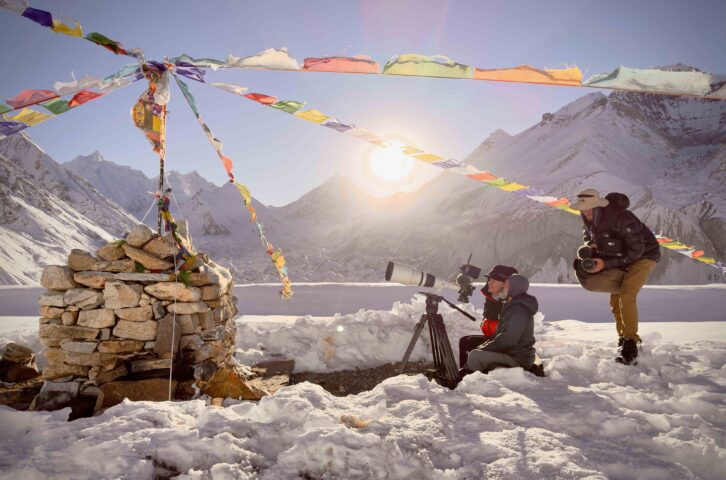
“We shot test footage with each camera in extreme conditions and put it through a full colour session and test screening at IMAX to see how it held up and how far we could push the exposures,” Popkin adds. “We left cameras running overnight in an industrial freezer to make sure they could handle the cold for extended periods. We also developed custom battery cables to keep the cameras running while the batteries stayed warm inside the climbing suits of the high-altitude team. This project required more preparation and testing than any other documentary I have done.”
Despite all that preparation, Popkin says the scale of the operation was unlike anything he had previously experienced.
“Honestly, we were so prepared before the expeditions that there were no major technical learnings for me,” he adds. “Shannon and the production team had everything so dialled in and organised that nothing was overlooked. The camera and climbing teams were supported all the time. This was the most logistically complex job I have been part of. I do not know how they did it. I think the biggest learnings for me were about what I could do physically, filming at high altitude and in extreme cold.”
Making Everest: The Other Side was a huge undertaking, demanding as much from the crew as it did from the equipment. Popkin’s experience was a reminder that, however challenging the conditions, getting the footage could never come before keeping everyone safe.
Everest: The Other Side is in UK cinemas now.