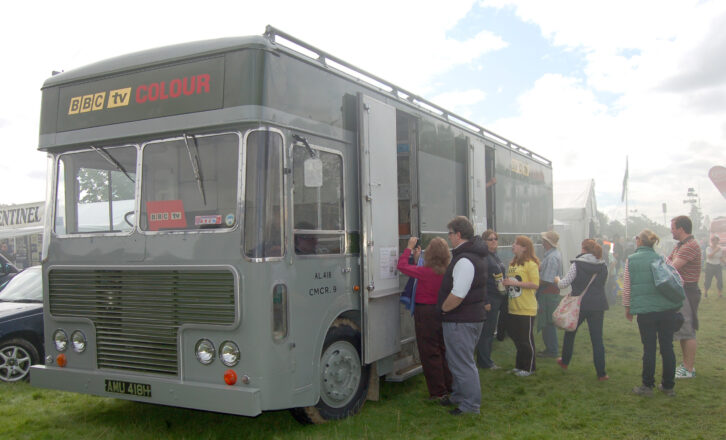
I recently found myself driving along the Welsh equivalent of the Autoroute du Soleil, the A55 North Wales Expressway, when an elderly pantechnicon-style truck emerged from a slip road and joined the stream of traffic heading east at the end of the holiday weekend. Hunched over a forward control cab, its plethora of vented side panels and full-length roof rails made it resemble something that had been conjured from the imagination of Gerry Anderson. All became clear as I moved across to pass the slow-moving behemoth and the legend adorning its bright, silvery paintwork came into view. Printed in a rather retro but instantly recognisable font were the words “BBC TV Colour”. I was sharing the road with a vintage outside broadcast truck.
The van was registered in the early 1970s and it was tempting to imagine that it had somehow torn itself a hole in the space-time continuum while filming Tom Baker on location for Doctor Who. The likely reality, altogether more prosaic, was that the beautifully restored vehicle had been attending a display at one of the numerous resort towns scattered along the Clwyd coast.
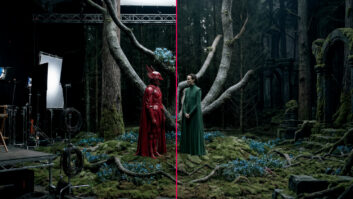
Allowing myself to daydream a while, I wondered what the original production crew would have made of its modern day equivalent, had they suddenly found themselves catapulted fifty years into their future. Last month, I was privileged to see such a vehicle in operation myself, thanks to an invitation from NEP Europe (more of which elsewhere in this issue). The technology aboard was astounding, providing teams with capabilities on a level that would simply not have been possible just five short decades ago.
And that’s the thing about technology – it races. Right across the broadcast arena, advances take place at a pace that is scarcely believable. Most people are probably familiar with the well-worn adage about modern mobile phones being more powerful than the Apollo Guidance Computer used by NASA to put astronauts on the moon, but even the most jaded of industry commentators can’t fail to have been impressed that they were used to film parts of the Paris Olympics Opening Ceremony for its official broadcast last summer.
Of course, it’s not just in broadcast that the pace of development takes the breath away. Throughout history, in all manner of human endeavour, innovation evolves at breakneck speed.
In 1885, for example, Karl Benz produced what was probably the first proper car. Henry Ford refined the manufacturing process just after the turn of the twentieth century and we’ve never looked back. At about the same time old Henry was knocking out Model Ts in any colour you wanted so long as it was black, the Wright Brothers were hopping across the Kittyhawk sands and into the record books as the first to achieve heavier-than-air powered flight. Less than 50 years later, Chuck Yeager became the first human to break the sound barrier. Today, we think nothing of sipping our G&Ts at 500 miles an hour, six miles above the surface of the planet, in thin metal tubes with fires blazing away just inches from thousands of kilograms of aviation fuel.
For every rule, however, there must be an exception. It was as far back as the middle of the 15th century that a German named Johannes Gutenberg produced the first ever printing machine. William Caxton brought the technology to England soon after, becoming this country’s first ever retailer of printed books. And today, some 600 years later, as everyone who has ever found themselves driven to the very edge of sanity by one of the intransigent little grey boxes as they sit there stubbornly refusing to comply can exasperatedly testify, we still haven’t managed to make the blasted things work properly.