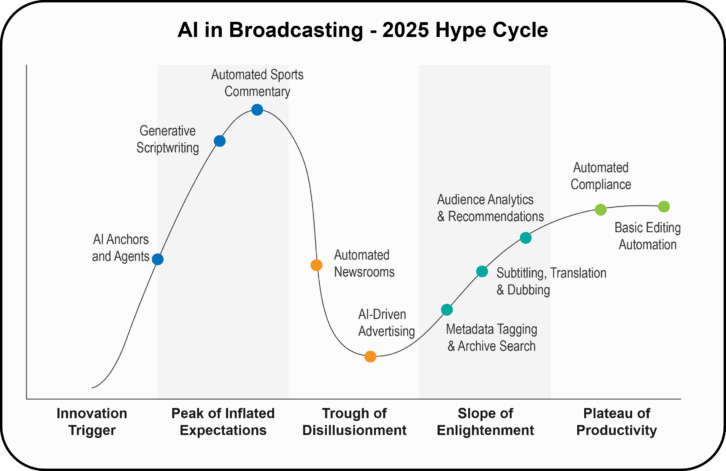
Artificial intelligence continues to dominate the conversation in broadcasting, with promises of automated anchors, smarter advertising, and more efficient production. Yet, as with every major technological breakthrough, AI is progressing along the familiar hype cycle: a surge of high expectations, a phase of reassessment, and eventually a climb toward productive, everyday use.

A survey from September 2024, conducted by Caretta Research for TVBEurope and TV Tech offers timely insights into how broadcasters are engaging with AI. While the survey was not designed to define the hype cycle, its findings help illustrate where different AI applications sit along this journey.
Peak of inflated expectations
At the peak are the use cases that spark imagination and generate the most attention. These technologies demonstrate what is possible, even if large-scale adoption is still some way off.
AI anchors and agents. Virtual presenters and synthetic voices are among the most visible demonstrations of AI in broadcasting. They highlight how far generative technology has advanced and show potential for new formats and cost efficiencies. At the same time, broadcasters are still exploring how audiences respond to this kind of presentation and where it fits best within established workflows.
Generative scriptwriting. AI-driven tools can now draft news copy, story outlines, or even show scripts. For some teams, this means faster brainstorming and a way to explore creative options quickly. Many producers still prefer to keep human oversight central to editorial work, but the technology is maturing and proving useful as an assistant.
Automated sports commentary. From clipping highlights to generating commentary, AI is helping sports producers handle fast-moving content. The September 2024 survey found that 44 per cent of buyers expect automated clip and highlight generation to have a major impact. While not yet ready to replace experienced commentators, these tools are becoming valuable companions in sports production workflows.
Reassessment phase
As with any new technology, some applications are moving through a phase of adjustment, where early enthusiasm is balanced with lessons learned.
Automated newsrooms. Broadcasters have tested how far automation can go in producing and distributing news. These experiments show real value in supporting editorial staff but also confirm that human oversight remains essential. The Caretta survey reflects this balance: while 61 per cent of respondents expect AI to take on routine operational tasks, only 18 per cent believe it will extend to complex creative roles.
AI-Driven Advertising. Personalised ads, voice cloning, and synthetic actors have great potential to open new revenue models. At the same time, questions of regulation, audience trust, and responsible use mean the pace of adoption is measured. Many broadcasters are building governance frameworks before scaling these technologies, a trend the survey also noted.
Slope of enlightenment
This is where AI tools are finding their stride, with clear and proven benefits in daily workflows.
Metadata tagging and archive search. AI-powered transcription and object recognition are unlocking enormous value from archives, making content searchable and reusable in ways that were previously impractical. In the survey, 33 per cent of buyers highlighted summarisation and transcription as highly impactful, underlining the value broadcasters are already seeing.
Subtitling, translation and dubbing. Broadcasters are increasingly using AI to expand accessibility and extend global reach. Automated subtitling, combined with human review, now meets broadcast standards, while AI translation and dubbing help monetise content across markets.
Audience analytics and recommendations. By analysing audience data, AI systems are enabling smarter scheduling, more relevant promotions, and improved engagement. These tools are not only widely deployed but also directly tied to measurable revenue outcomes.
Plateau of productivity
Some AI uses have already become part of the everyday toolkit.
Automated compliance. Tasks such as profanity detection, loudness regulation, and caption verification are handled reliably by AI, reducing both risk and manual workload.
Basic editing automation. Features like colour correction, noise reduction, and background cleanup are embedded in editing suites and quietly improve efficiency across the industry.
Barriers and next steps
The September 2024 survey also highlights what slows adoption. 43 per cent of respondents cited a lack of skilled people, while 41 per cent raised concerns about bias in AI systems. Training, governance, and robust data practices will be key to moving forward responsibly.
Another insight is the preference for integration: 73 per cent of respondents want established vendors to embed AI in their existing products, compared to 39 per cent who prefer entirely new AI-specific tools. This reflects the industry’s focus on practical deployment within trusted workflows.
In conclusion
The hype cycle offers a helpful lens to view AI adoption in broadcast. Some technologies — like AI anchors and automated newsrooms — are in early, exploratory phases, generating interest and testing boundaries. Others, such as metadata, subtitling, and compliance, are already delivering reliable value and becoming essential parts of the broadcast workflow.
The September 2024 Caretta/TVBEurope/TV Tech survey reinforces this picture. Broadcasters are confident in AI’s long-term impact—85 per cent believe it will be significant—but they are directing resources toward areas with immediate, practical benefits.
In the near term, AI in broadcasting is less about replacement and more about partnership: assisting human teams, accelerating repetitive tasks, unlocking archives, and extending reach. By focusing on these strengths, broadcasters can navigate the hype cycle with confidence, turning today’s promise into tomorrow’s productivity.