On 2nd September, TVBEurope is joining forces with sister title Installation on the AV and Broadcast Summit. The special webinar event aims to give attendees a better understanding of how technology is converging between the two sectors.
“The aim of the Summit is to showcase how the two industries can learn from one another,” says TVBEurope content director Jenny Priestley. “We want attendees to come away with a better understanding of how technology is crossing over, and how they can employ ideas and workflows in their working lives.”
Geared towards insight, strategy and real-world experience, the special webinar event will provide a forum for debate, practical learning and peer-to-peer exchange. It will explore subjects including IP and cloud workflows, production, standards and interoperability and virtual production across media, enterprise, and mission-critical infrastructure environments.
“For many years, the AV and broadcast sectors operated in parallel, yet distinct universes,” adds Installation content director, Rob Lane. “This unique event brings together senior professionals from both industries to examine how their traditional boundaries are rapidly converging.”
The overlap
The Summit will kick off by exploring how production technologies are moving beyond broadcast to find new use cases as traditional storytelling tools are adopted by corporate studios, sport, education and live events. Featured panellists include Robert Ambrose, co-founder and CEO of Caretta Research, and Helen Matthews, senior market analyst, Futuresource Consulting.
Both sectors are moving away from traditional hardware infrastructure to software and cloud, says Ambrose, with IP gaining a strong foothold in pro AV via IMPX, some SMPTE ST 2110, NDI and Dante for audio.
“We’re also tracking the increased focus on software within the pro AV environment—like automating the complexity of production processes for teams who only do it occasionally,” he adds. “More importantly, pro AV is frequently at the sharp end of revenue generation, so maximising the ROI from corporate events and announcements, digital signage in quick service restaurants, or immersive video in real environments are all areas where pro AV hardware meets broadcast meets software.”
For Matthews, there are key areas where broadcast can learn from pro AV, particularly in terms of ease of deployment, which she believes is increasingly the deciding factor for end users. “The products that are actually winning in the overlap territory, NDI-enabled switchers, PTZ cameras with simplified IP setup, all-in-one hubs, succeed because they reduce the configuration burden,” she states. “Broadcast’s tradition of relying on specialist engineers to set up complex infrastructure is a genuine commercial disadvantage in a market where the buyer is a corporate facilities manager.
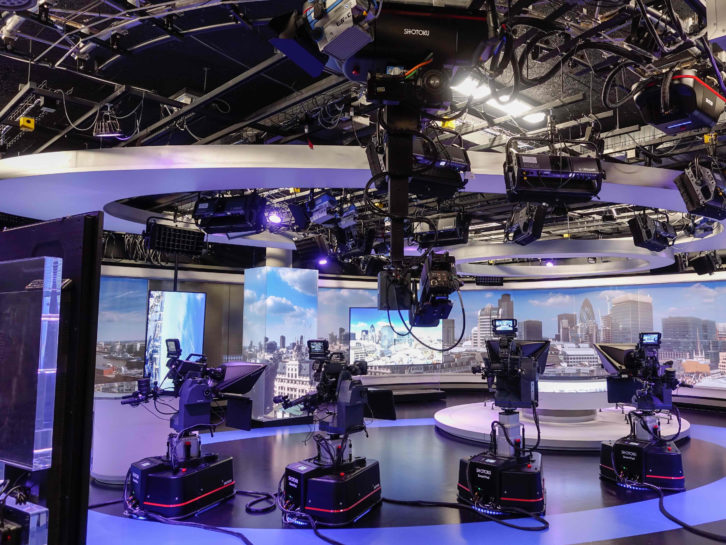
“Commercial agility and IT integration are also genuine pro AV strengths. Pro AV integrators have built natural working relationships with enterprise IT teams. As production workflows move onto shared network infrastructure, that IT-native positioning becomes increasingly valuable.”
Much of what is driving the convergence is shifting end-user expectations. Organisations across both sectors are demanding studio-grade production for both internal and public communications.
“The power of visual storytelling is now open to a much wider market as broadcast production tools become accessible to pro AV users,” says Ambrose. “Some of it is just the same as TV production but in a different setting. And some is distinctly different–like upgrading conference room tech to provide a more professional experience on live streaming, and Teams calls with multi-camera, full audio and immersive graphics.”
Consumer appetite for professional-looking video has grown across both sectors, but not everyone has been able to keep up. “In the broadcast space, end user demand has evolved faster than the vendor response,” adds Matthews. “Corporate clients now expect broadcast-quality production and studio-grade infrastructure, but broadcast vendors have been slow on two simultaneous fronts: simplifying their products for non-specialist buyers, and adapting their go-to-market to reach them.”
Separating technological reality from hype
While IP connectivity, software, cloud computing, and AI are frequently cited as the core drivers of market convergence, there remains a clear distinction between what’s adding value and what’s just hype.
IP networking is without doubt an operational foundation of convergence. However, bandwidth limits create a clear divide between Tier 1 broadcast environments and everyday pro AV deployments.

“IP networking is the genuine engine of convergence, but the bandwidth tier matters enormously,” Matthews states. “The story is largely a 1G one right now. 1G dominates because it works on existing infrastructure without cabling upgrades. 10G is where broadcast-grade workflows become truly viable, but remains a cost barrier outside Tier 1.”
Unlike broadcasters and streaming services with dedicated engineering teams, corporate video is frequently operated by non-specialists. “One of the biggest challenges pro AV users face is gaining skills in the creative processes that established media companies are good at: photography, sound, lighting, production,” notes Ambrose. “There’s potential for more AI and automation to help here, and inevitably that will filter back into the broadcast world too.”
From an integration perspective, shifting from traditional matrix switchers to IT networks requires a significant cultural mindset change. “And it’s a two-way street,” he adds. “As pro AV users up their content game by tapping into broadcast-grade tools, a whole world of cheaper and easier-to-use pro AV tools are finding their way back into broadcast environments where they can help close the gap between new digital workflows and reduced budgets.”
“Understanding the market is vital,” Ambrose concludes. “Don’t assume broadcast and pro AV have the same requirements or same decision-making process, even where they’re using the same tools to do the same processes. Both worlds have a lot to learn from each other as pro AV increases the impact of its video and audio production and distribution, and broadcast pivots to a more agile, digital-first world.”
To register for the AV and Broadcast Summit for free, click here: https://events.futureb2b.com/register-now/3372/av-broadcast-exploring-converging-workflows-and-technologies/?pr=3297