George Orwell’s Animal Farm is a searing political allegory that is regarded as a book for older children as well as adults. It has now been adapted for the screen three times: the 1954 animated version received a universal rating and has a dark tone in its colour palette and some of the character design, although there are Disneyesque touches. The 1999 live action adaptation featured animatronics from Jim Henson’s Creature Shop and was rated PG. The latest take, also PG, is aimed at the family market but still has a satirical edge, swapping the author’s original target of Soviet authoritarianism for corporate greed and mass consumerism.
Reimagining Orwell’s fable has been a long-term project for director Andy Serkis, who originally intended to use the performance (motion) capture technologies he made famous through his roles as Caesar in the 2011 to the present Planet of the Apes films and Gollum in The Lord of the Rings trilogy and The Hobbit: An Unexpected Journey. The finished film was realised through CGI (computer generated imagery) animation by facilities house Cinesite.
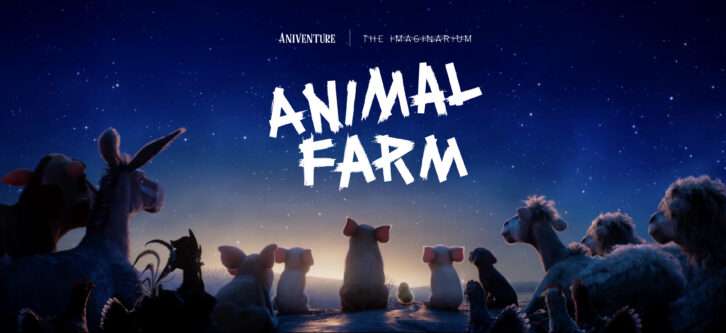
Eamonn Butler, associate director of animation on the film, says that when discussions first began with Serkis, motion capture was one of the techniques considered but this changed when tests were carried out. “We didn’t use motion capture at the time because a test is usually quite a compressed timeframe,” he explains. “We keyframed it instead, which turned out great.” By the time a funding deal was agreed with content creation and IP production company Aniventure, with which Cinesite has a production output deal to deliver a slate of family-oriented films, keyframing was agreed upon as the way forward.
“Going down the more traditional way, I think, worked out fantastic for everybody,” Butler says. “It’s often been said of Andy that he’s an actor’s director and loves giving guidance and performance insights. Where we collectively decided to go was that Andy would work with his animators as the actors in his film—because they’re also closet actors.”
Butler observes that a degree of anthropomorphisation was used to “lean into the characters”, while conveying both the text and subtext. “We were very aware we were making a movie for the whole family but also we really wanted to try to aim it at young kids,” he says. “We went towards a caricatured look and then pulled it back so it didn’t feel too young a design. Subtext plays a big part in this movie and there are big issues to deal with. We didn’t want it to be purely cartoon characters delivering some of these weighty messages, which meant we needed to make the characters feel not necessarily realistic but believable.”
Animal Farm is an entirely CGI animation, which Butler describes as “an artistic process using computer tools.” Production took just over two years at Cinesite’s facilities in London, Vancouver and its main animation and visual effects studio in Montreal. Its “foundation” animation system, Butler says, is Autodesk Maya, augmented by “a variety” of modelling tools, including SideFX Houdini and ZBrush.
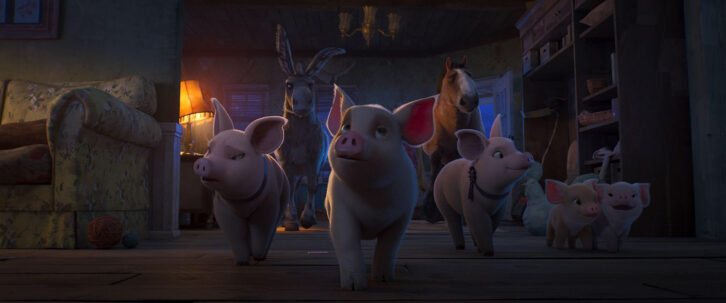
The starry voice cast includes Seth Rogen as Napoleon, who becomes dictator of the farm, Woody Harrelson as the stalwart Boxer the horse, Laverne Cox (Snowball), Glenn Close (new character Freida Pilkington) and Andy Serkis himself as Mr Jones the farmer and Old Major, who inspires the animals’ uprising. All the actors were videoed performing their lines using lipstick cameras, with the recordings taking place at different studios depending on their location. Butler comments that the video footage was passed on to the animators so they got a sense of mouth shapes and the looks in the actors’ eyes.
The sound of the character voices was also important in creating a sense of believability. Supervising sound editor and re-recording mixer Dillon Bennet says actuality of animals specially recorded for the production was often mixed in with the performances. “I was keen to try and get in as many real animal sounds as I could, which makes the performances as rich as possible but also grounds the idea of their natural state,” he explains. “When there are crowd reactions from all the animals, it was mixed between humans voicing them and real sounds of puppies, chicks and cows. As we went on we tried to add more animal sounds into each character, morphing them into the actors’ performances.”
An example of this is when Boxer is falling asleep. Bennett says Woody Harrelson gave “a really funny kind of snore”, which was mixed with recordings of a horse snorting and whinnying. “There’s also a moment when Napoleon is first trying to talk to humans and put on a human voice,” Bennett says. “Seth Rogen had done this very exaggerated speech moment and we modulated in real pig grunts using a sound design and morphing system called Kyma. The result is quite unpleasant and weird – but in a nice way.”
Audio is also used to create the atmosphere of the farm and reinforces how it changes through the film. “Andy wanted to go for the full potential of what the sound design could do,” Bennett comments. “There are funny, silly bits that appeal to the kids but also quite dark moments, both sonically and tonally. At the beginning the farm is lush, with natural, organic sounds, including a watermill made out of bits of wood and junk. By contrast, the human world is futuristic and industrial, almost edging on science fiction, with droney, electronic sounds. They’re two distinct worlds but slowly, as the animals become more corrupted and human-like, the worlds collide.”
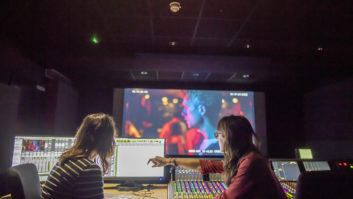
The soundtrack was laid up on Avid Pro Tools, with the final Dolby Atmos mix created at Goldcrest Post Production in London on Avid S6 consoles, with an AMS Neve DFC used to route the various stems and give a warmth to the sound. “Atmos was helpful in making the different worlds of the film feel richer,” Bennett says. “Even during the opening credits, you have the music [by Heitor Pereira] coming in with little sounds of animals and a stream, which is building the world before you see it. And we were able to put those around the audience, immediately putting them in that place.”
Animal Farm is released in UK cinemas from July 24th