David Ayer’s Heart of the Beast arrives in cinemas as a survival thriller. Brad Pitt stars as Special Forces officer James Belmont, who, alongside his retired combat dog Odin, is stranded in the Alaskan wilderness after a plane crash. Although set in the largest US state by land area, principal photography took place in Queenstown, New Zealand, between March and May 2025, with cinematographer Mauro Fiore ASC capturing the locations. François Dumoulin, VFX supervisor at Framestore, worked with the filmmakers throughout production. When he joined the project he identified three key areas of work.
The plane crash sequence was one of the three main areas Dumoulin had to address. In contrast to the more extensive environment and creature work, it required only limited intervention. “The core of the movie VFX-wise is creature work and environment work and a little bit of hard surface animation and FX simulation for the plane crash,” he explains. The simulation was grounded in a practical plane shell propelled into a water tank, serving the narrative jolt of the crash itself rather than becoming a prolonged set-piece. The heavier lifting sat elsewhere.
Bridging the gap
A major environmental challenge was making New Zealand stand in for Alaska without breaking the film’s largely location-based aesthetic. Several sequences were heavily digital, including a swamp at the end of the film and the tree-bridge sequence, which became the most involved example.
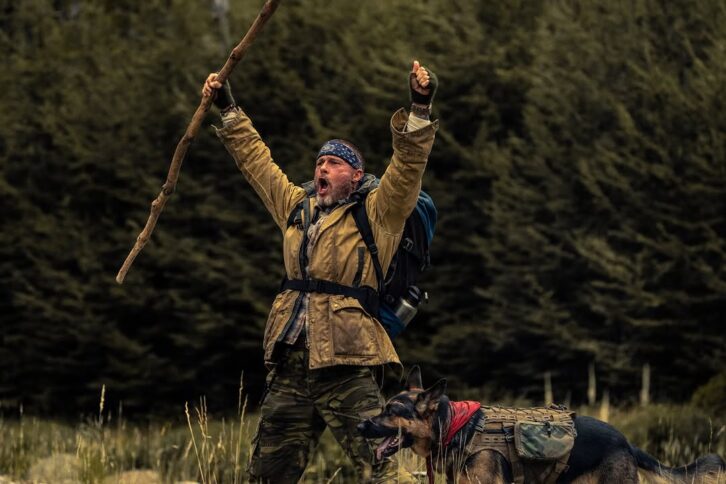
“Even though when you look at the film, the tree bridge doesn’t look like a big visual effects scene—actually, I hope the audience think it’s actually shot on location—it was kind of a challenging sequence to do for different reasons,” Dumoulin continues. “So in that sequence, our characters are crossing a very dangerous river on a log of a giant tree that fell over the river. It’s something that obviously we could not shoot live with our actors. We would not have Brad and the dog crossing a real bridge of a river. That would be too dangerous.”
Initially, the plan was to build the tree bridge on a backlot and “to do the water and everything else” with CGI. However, after his first meetings with Ayer, Dumoulin realised the director preferred everything captured in camera and wanted a solution that matched the gritty, location-shot look of the rest of the film, 80 per cent of which was filmed on location, rather than risk the sequence “suddenly stand out as looking like a digital fantasy”.
The team instead found a remote New Zealand waterway and captured it during prep.
“It’s this really beautiful river that’s very hard to access,” Dumoulin recalls. “You could only fly there with a helicopter and then take a hike with the equipment in your backpack. But we found this really pristine environment, and we went there with the director of photography, the production designer, and we scanned that location using a lidar scan and some photogrammetry and some drone footage to really acquire as much as we could from that environment.”
Based on that lidar scan, the production designer then designed a tree bridge that would fit into the location and the team used the scan to 3D print rocks so the backlot set would match one to one. This approach also allowed the team to photograph rather than generate the river water digitally.
“That sequence is really interesting, even though it doesn’t look complicated, because it’s really a mix of techniques where VFX and production design really work hand in hand and exchange data, exchange 3D data of the location and of the built set on the backlot to achieve a result that is, in my opinion, quite seamless,” he continues. “You really think that this was shot on a location.”
Wolf in digital clothing
Creature work formed the other major strand. The wolf attack at the end of act two required digital animals to interact convincingly with Pitt and with the real dog, Uber, playing Odin.
“That’s a big fight between an A-list actor and some digital characters, and it’s always hard to prep and find the proper methodology to do that and have a convincing result,” Dumoulin says. The team built a full pack of digital wolves alongside an extremely faithful replica of the real dog, since the sequence cuts back to back between the digital and real animals—meaning the digital creatures had to match not just real wolves, but the specific dog playing Odin on screen.
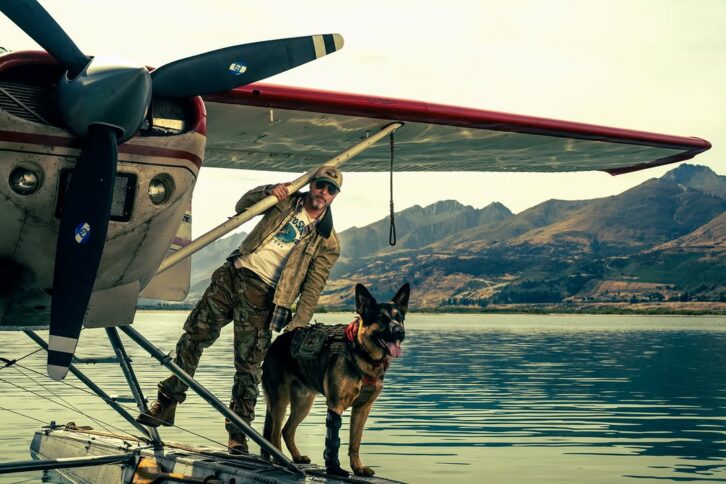
Dumoulin points to Framestore’s long tradition of producing believable, emotive creatures and writing its own code to achieve it. For instance, everything that is muscle simulation and fur and all of those things are proprietary tools called FAT (Framestore Anatomy Toolkit).
“That’s a really powerful tool that really changed the game because instead of doing a lot of painful handwork with trial and error to simulate the muscles, the bones and the fat, it’s something that is grounded in procedural rigging tools that streamline the work of the artist and gets results very, very fast,” Dumoulin says, “but at the end of the day believability is only here to ground a performance and this is the work of a fantastic animation team, led by Meena Ibrahim in Montreal, under the supervision of Nicolas Chevalier”.
The VFX supervisor insisted on using puppets on set, drawing on his experience on Prehistoric Planet: Ice Age. “One thing I really insisted on early on was to use puppets on set—the way we shot Prehistoric Planet was really like a documentary,” he says. Without a physical stand-in, he explains, crews on VFX-heavy shoots can disengage, defaulting to a tennis ball on a stand and leaving the rest to post. A puppeteer on set changed that: “Instead of framing a tennis ball on a stand, when you have someone that is moving with a placeholder for a wolf or a bear, the entire crew start to react as if they were reacting to an actor performing.” Crews pay closer attention to lighting, framing and focus as a result: “It becomes much more organic the way you shoot it.”
The lightweight puppets were built by Practic Creations in the UK. For post-vis the team used Unreal Engine. “Now we’re doing these things with real-time engines like Unreal; you can sit down with a director and explore things in real time. That’s really a game changer.”
Across the three areas—the crash, the environments and the creatures—the objective remained consistent: make the visual effects disappear into a film designed to feel grounded in the wilderness.
Heart of the Beast is in cinemas now.