The BBC’s latest natural history epic Blue Planet III premieres on Sunday 1st November.
The original series debuted 25 years ago and was the first natural history series to give viewers a comprehensive overview of the world’s oceans. Blue Planet II followed in 2017.
Nine years later, Blue Planet III has once again been produced by BBC Natural History Unit and is narrated by Sir David Attenborough. The new series aims to build on legacy of the previous two, redefining the realm of possibility in underwater wildlife filmmaking.
The six-episode series used macro filming, including probe lenses that enabled the production team to take viewers to an animal’s eye level, said executive producer Elizabeth White. “Some of the animals we filmed for this series are the size of a pea, like lumpsucker fish and argonauts,” she added. “[The] amazing macro lenses allowed us to get into the animals’ world. This works well both in, and out of, the water.”
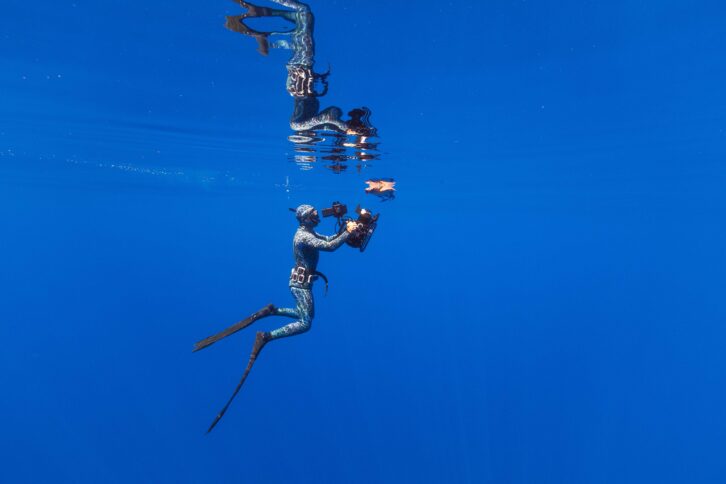
The NHU team also developed new remote camera technology, which was used to help the team when filming underwater. “For this series we developed high-resolution remote cameras we called ‘The Stonefish’ which allowed us to place cameras on the seabed and leave them for 24 hours recording,” explained White. “That was key to capturing some wonderful new behaviour, like for example, the incredible dolphin sponge feeding we feature in [episode one] Tropical Seas. This filming may have solved a 40-year mystery of why dolphins carry sea sponges.”
Remote cameras were also essential for episode five, The Deep. According to White, much of the episode was captured using remotely operated vehicles carrying cameras aka ROVs. “Working with ROVs, there is one big problem… all you get is the view from the ROV. We wanted to be able to show the ROV working in the deep ocean, so series producer James Brickell and producer Eva Spielvogel designed a ‘deep sea selfie stick’. We nicknamed it ‘Little Charlie’. The ROV has little grabbers, so we could launch the ROV, holding onto its little selfie stick and once it reached the seabed, the ROV could position the camera on the substrate to film itself at work.”
Drones were also a key technology used on the series, taking viewers to places that are too inaccessible for the team to work on the ground. They were used on footage of bowhead whales breaking sea ice, which would have been too dangerous for humans to film. “Using drones we were able to capture natural behaviour many miles offshore while the crew sat in safety on solid ground<‘ said White. “Other drones were used as ‘splash-cameras’ or drop-cameras allowing a camera to be dropped into the water, again, in places which were too inaccessible or too dangerous—like into the path of a hunting tiger shark!
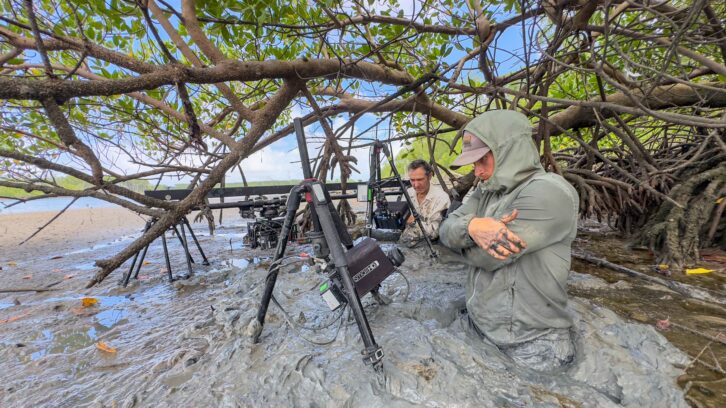
“It’s very rare that we use just one piece of equipment to film a sequence—usually it’s a combination of drone, long lens, and/or macro. Almost every shoot would have two or more different types of equipment, sometimes as many as five different camera types in order to capture a behavioural story in as complete a way as possible.”
The BBC has revealed details of the technology used on the first three episodes.
Episode one: Tropical Seas
Dolphins hunting with sea sponges: The Stonefish was built as an underwater camera system held within a fully waterproof underwater housing with extended battery pack to allow for 24-hour recording. According to the BBC NHU, this is the first time a continuously recording 4K camera and housing has been designed to be used underwater without an external power source.
Coral reefs: The pioneering Flow Motion camera rig allowed Blue Planet III to capture the reef from a resident’s perspective, creating high-speed journeys through coral cities with the sensation of flying underwater.
Green Turtles vs Tiger Sharks: In the waters surrounding Fernando de Noronha, a remote island 220 miles off Brazil’s coast, a new drone system known as the DropCam, developed for Blue Planet III, enabled filmmakers to follow tiger sharks and green turtles from above before seamlessly lowering a camera beneath the surface, capturing the drama of the hunt from the perspective of the animals being filmed.
Episode two: Open Ocean
• Red Raptor: A cinema camera combining an 8K sensor, dynamic range, and high frame rate recording in a compact body. Released at the start of production, the camera became one of the primary filming cameras across the entire series.
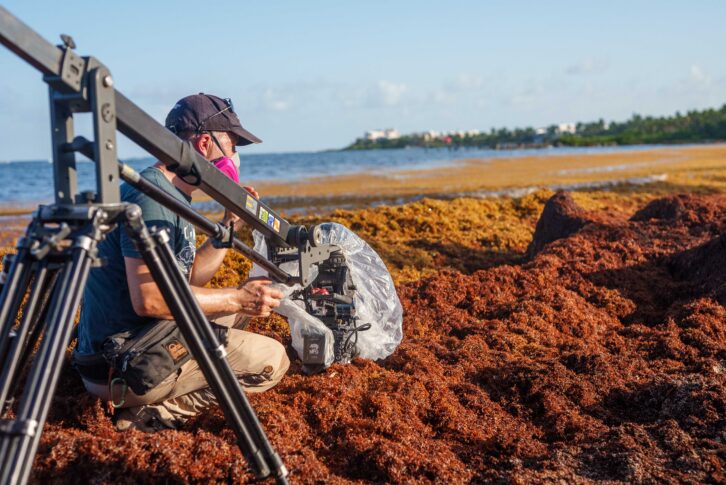
• Macro low-light Z-rig: Employed to film newly hatched green sea turtles as they crawled through dense piles of rotting sargassum, in near-total darkness, high humidity and tropical heat. The custom-built Macro Z-rig was designed specifically for immersive low-light wildlife cinematography and became the primary tool for filming the turtle hatchlings’ journey, allowing audiences to experience the world from the perspective of a creature only a couple of centimetres tall.
• Drones: Inspire 3 and Mavic 3 Pro: Both drones were released in the middle of production, enabling the production team to fly further and zoom in closer to the action; this proved invaluable in filming and following the bait ball action in Mexico, following rough-toothed dolphins in the Atlantic and reacting to and following the unique hunting behaviour of killer whales on blue whales in Mexico.
Episode three: Seasonal Seas
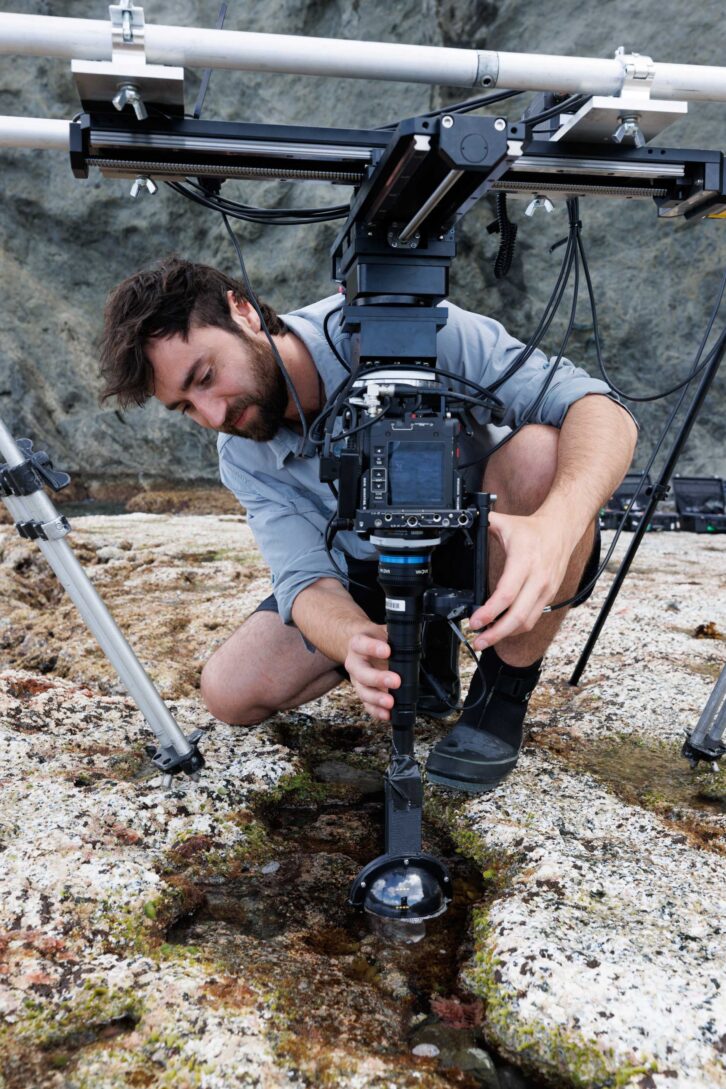
• Octopus hunting on land: BBCS NHU developed the Mini Dome camera system, a world-first piece of technology small enough to fit inside a rockpool while capturing both the underwater and above-water worlds in a single shot. The innovation is believed to have enabled the first-ever macro split shot, providing an immersive octopus-eye view of life at the boundary between sea and shore.
• Iceland and Chile: To take viewers into the heart of towering ocean swells, the production team deployed a custom-built waterproof FPV drone and a pioneering splash drone capable of landing directly on the sea. This combination allowed cameras to get closer than ever to colossal waves battering the coasts of Iceland and Chile, capturing some of the most immersive wave footage ever filmed.