How long have you been planning for the World Cup?
Planning began in January 2025, when the BBC shared their ambitions for the tournament. We quickly formed an expert delivery team to start testing formats, identifying the required investments from a technology perspective, and working with the BBC to ensure we could meet all of their coverage requirements for the World Cup.
How will MediaCity be supporting the BBC’s coverage?
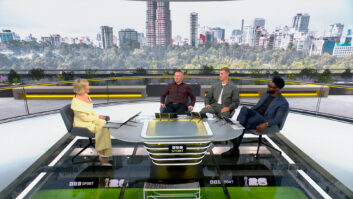
MediaCity is providing the studio, post production facilities and technology hosting for all of the BBC’s coverage of the World Cup. With the broadcaster electing to deliver all its output to national and international markets from Salford, we’re very much involved in every stage of their planning process.
How will signals be sent from the embedded teams across the Americas to the operations base at MediaCity?
BBC Sport has partnered with major events communication solutions provider BMC to deliver a managed service for the data flows and video streams across the Atlantic. All streams are aggregated in the International Broadcast Centre (IBC) in Dallas, before being re-encoded for the transatlantic hop back to MediaCity. Telecoms providers deliver the transatlantic connectivity with a total data bandwidth of 40Gigabits/second.
We will utilise 50x HD and three UHD streams from the IBC to MediaCity and a smaller number in the reverse direction. The video streams are compressed, with each circuit using a bitrate of between 60mbits/sec and 450mbits/sec, depending on the requirement. The fibre connectivity also includes several data circuits.
What latency is expected?
Latency will vary with the compression standard used and we’ll be able to gauge exact rates when the circuits are up and running between Dallas and MediaCity, and once the end-to-end tests are complete. We’re expecting, with the fastest form of compression, JPEG XS, to see figures of 200ms from IBC to MediaCity although other standards used, such as HEVC, could be up to 1.5 seconds.
Will commentary be provided at the stadiums or MediaCity, and how will you handle that?
Commentary will be provided at both the stadiums and MediaCity, with high-profile games being commentated on from the stadium, whereas other games will use commentators based in MediaCity. There is also an off-tube in New York for overseas commentators to use where the logistics of getting to a venue would be difficult.
How do you plan to ensure resilience—what backups are in place in the event of failure?
There are two active paths for video streams from the IBC to come into MediaCity, along with a separate third path at our disposal. When the active paths enter our building, dock10 has resilience for each path of the workflow, including power, network connectivity, video/audio routing and production technology.
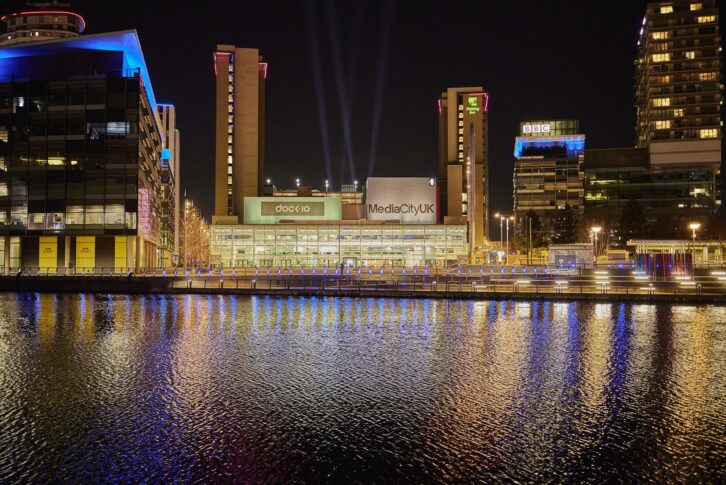
MediaCity is one of the most connected places on the planet—our connectivity is highly resilient and set up for live broadcast, which is the highest requirement in the industry. Our back-up generators are a priority refuelling site and there are no studios that exist with this level of service-level agreement. We also have the world feed for every BBC broadcast game coming via BT Tower, should there be a failure at the IBC.
On a broadly similar note, what steps are being taken to ensure content remains secure?
Content is carried from the IBC to MediaCity on private fibre connections with no encryption on the video streams. The decision not to encrypt video streams is due to the segregation of data from the internet and the additional latency and complexity involved in the process.
All data flowing across the internet is encrypted in flight at all times. Within MediaCity, multifactor authentication is mandatory for all users accessing content, adding another layer of security.
What new technologies are being deployed for the event?
For this event we’re deploying a real-time multi-camera XR (extended reality) studio, comprising a ROE LED wall and floor volume, MoSys Startracker Max camera tracking system, and Pixotope virtual production software. Also, as the World Cup is being produced in HDR 50P, we’re upgrading much of the signal path to accommodate this, along with over 100x LUT boxes running a BBC LUT to give us a standardised picture in each area.
What do you foresee as the biggest challenge the team will face?
Our biggest challenge is going to be ensuring the virtual studio is implemented on time and delivers everything we need to support the HLG HDR deliverable. The virtual studio is cutting-edge technology and we’re having regular meetings with all stakeholders to keep it on track. We’ve currently got two employees over in Norway receiving training on the Pixotope system to ensure we can hit the ground running when the kit arrives.
Finally, what are you/the team most looking forward to?
I’m looking forward to the first game as I know everyone’s incredible hard work will have paid off and we’ll be able to relax (just a little) and settle in for what will be a great tournament. On a personal note, this will be made even better if England make it through to the final.