Telefonica has joined forces with Sony to test 5G millimetre-wave (mmWave) connectivity at the Movistar Arena in Madrid.
The test leveraged the 26 GHz band to demonstrate the network’s capability to support massive public data consumption alongside high-demand professional broadcast applications.
The trial featured a ‘Heavy Uplink’ configuration optimised specifically for data transmission, achieving upload speeds of over 1.8 Gbps, marking the highest uplink speed ever deployed on a commercial 5G network in Spain.
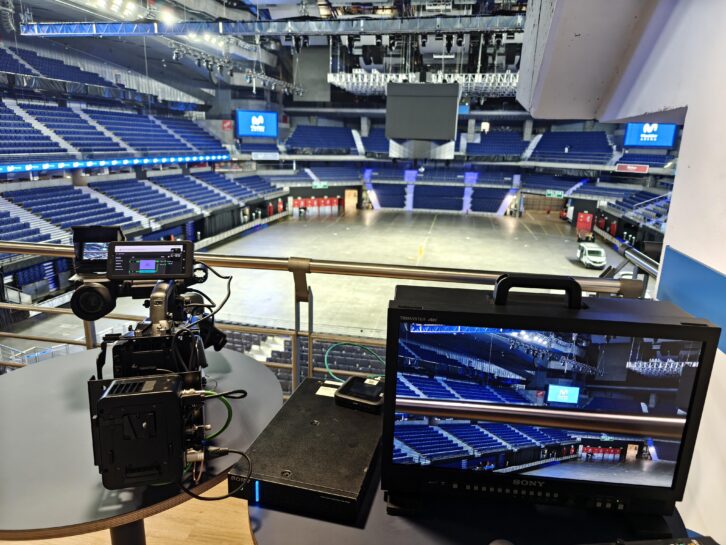
The pilot was carried out in collaboration with Sony, which tested the operation of a 5G audiovisual broadcasting system based on elements such as the CBK-RPU7 remote production unit for ultra-low latency HEVC video encoding.
4K Ultra High Definition images captured by HXC-FZ90 were transmitted after encoding up to 100Mbps to the 5G network via Sony’s PDT-FP1 portable data transmitter and then decoded by an NXL-ME80 media processor.
“This technology enables use cases involving the management of large volumes of data in real time, driving both professional use within the industry and a superior connected experience for the public at mass events such as concerts and major sporting events,” said Leonor Ostos, director of product and service development at Telefonica Spain.
Rob Thorne, category head of Networked Live, Sony Professional Europe, added: “5G promises greater flexibility for production companies, but bandwidth and architecture limitation have held it back until now. By combining the 5G mmWave technology deployed at the Movistar Arena, with Sony’s unique HEVC solution, we’re proving that 5G can meet the high-quality, low-latency