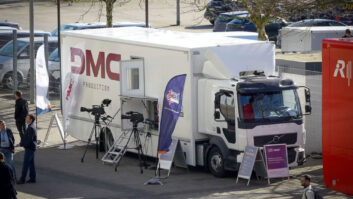
Cloudbass has revealed details of a proof of concept designed to reduce outside broadcast infrastructure and onsite footprint.
The trial took place alongside a conventional outside broadcast (OB) production at Thruxton Circuit during live coverage of the British Touring Car Championship. Cloudbass consolidated core services onto commercial off-the-shelf (COTS) servers, combining onsite video and audio processing with remote control from its Ripley production gallery.

Technical director at Cloudbass, Michael Beaumont, said, “We are looking at new ways to build the outside broadcasts of the future. Traditional hardware takes up a lot of space, consumes significant power and generates heat that then requires extensive cooling. Moving to software-based processing allows us to reduce the machine-room footprint, while remote operation means the production and audio galleries no longer need to be in the truck. That space can be removed or redeployed for other uses.”
Forming part of an initiative spanning multiple production disciplines, Grass Valley’s AMPP provided support for the software-defined video workflow while virtualised audio processing was delivered by SSL’s System T Virtual Tempest Engine running on COTS server hardware.
With processing remaining onsite, full-quality production signals were retained within the local environment. Extending control to Ripley over a public internet connection reduced the need to transport bandwidth-intensive signals to a remote operations centre, allowing engineering support, configuration and fault-finding from either location.
“The industry is under pressure to find more efficient ways of working,” added Beaumont. “Reducing the amount of equipment and the number of people required onsite has clear sustainability and work-life balance benefits. A software-based model also gives us the flexibility to scale resources up or down depending on the size and requirements of each production.”

A 32-fader SSL System T S400 control surface at Ripley enabled remote operation of the Virtual Tempest Engine, aiming to provide the user with a familiar experience despite processing and control being located across disparate sites. At Thruxton, the local control position comprised of SSL’s Tempest Control App and a Desktop Fader Tile Plus. A trackside SSL SB 8.8 stagebox provided remotely controllable analogue I/O for local microphones.
An SSL SB 8.8 stagebox provided remotely controllable analogue I/O for local microphones, with audio feeds brought into the virtualised System T platform for processing. Completed mixes were returned to the ST 2110 network for distribution.
Approximately 50 Mbps of upload bandwidth was used, providing the remote operators with control data and enabling audio and video monitoring. With the main processing remaining onsite, Cloudbass avoided transporting every uncompressed production source to Ripley, reducing connectivity requirements compared with more centralised remote production models, said the company.
Beaumont said, “The bandwidth available at many circuits and venues can make traditional remote production difficult. By retaining the processing onsite, we keep latency down and maintain signal quality, while only remoting the control and monitoring the operators need. That makes this model more deployable in locations where dedicated high-bandwidth connectivity may not be available.”