Live broadcast production has long been built around a familiar model. Large crews, outside broadcast trucks, dedicated transmission infrastructure, and a heavy on-site footprint formed the backbone of live television. That model delivered reliability and quality, but it was designed for a very different media economy.
Today’s broadcasters are being asked to deliver more live content than ever before, across more platforms, to more fragmented audiences, all while operating under intense cost pressure. At the same time, traditional linear viewership continues to decline, while live sports and events remain among the few formats capable of consistently attracting large audiences. The result is a fundamental tension. Demand for live production is growing, but the economics of traditional production no longer scale.
This is where remote production has moved from a niche solution to a strategic necessity.
From emergency response to long-term strategy
Remote production was initially accelerated by necessity. Travel restrictions, health concerns, and staffing limitations forced broadcasters to rethink how live events could be produced when crews could not be physically present. What began as a workaround has since matured into a deliberate operational strategy.
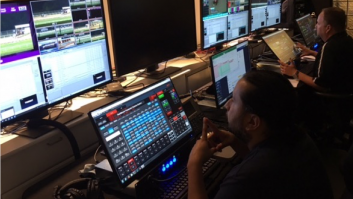
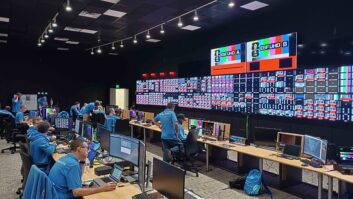
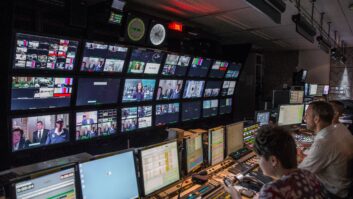
At its core, remote production separates capture from control. Cameras and microphones remain on site, while switching, graphics, replay, commentary, and distribution are handled from a master control room (MCR). This model allows broadcasters to reuse infrastructure, consolidate expertise, and significantly reduce the cost and complexity associated with deploying large teams to every venue.

Crucially, remote production is not about compromising quality. When implemented correctly, the production output is indistinguishable from a traditional OB-based workflow, but with far greater flexibility.
The economic reality of live production
The business case for remote production is difficult to ignore. Traditional on-site production requires significant investment in vehicles, equipment transport, accommodation, and staffing. For tier-two and tier-three events, those costs often outweigh the commercial return.
By contrast, a remote model allows broadcasters to centralise high-value resources such as experienced operators and production tools, and deploy them across multiple events in a single day. One team can support a football match in the afternoon and a concert in the evening, without physically moving between venues. This level of efficiency simply is not possible in a fully on-site model.
This shift is already visible in live sports production environments around the world. In several markets, production companies have moved to MCRs, using small on-site crews focused purely on acquisition. Setup times have been reduced from days to hours, operational consistency has improved, and coverage has expanded without a proportional increase in cost. While the specifics vary by region, the underlying lesson is consistent. Centralisation enables scale.
Managing the technical trade-offs
Remote production introduces its own set of technical considerations. End-to-end latency, often described as glass-to-glass latency, remains one of the most critical factors. Excessive delay can disrupt communication between on-site camera operators and remote production teams, making live direction difficult.
There is also the ongoing transition from SDI to IP-based infrastructure. While IP offers scalability and future-proofing, it introduces complexity for teams accustomed to deterministic, point-to-point workflows. Interoperability, standards adoption, and operational expertise all play a role in determining whether an IP-based remote workflow succeeds or fails.
Importantly, these challenges are not reasons to avoid remote production. They are design considerations. Broadcasters that invest time in understanding their workflows, latency budgets, and operational priorities are better positioned to build systems that evolve with their needs.
The evolving role of cloud in live production
As remote production has evolved, cloud technologies have become an increasingly important part of the live production conversation. Cloud-based services offer elasticity, rapid deployment, and the ability to virtualise functions that were once tied to dedicated hardware. For contribution, routing, monitoring, and collaboration, software-defined approaches can significantly increase flexibility and efficiency.
However, live production continues to place unique demands on latency, predictability, and operational confidence. Bandwidth availability, cost variability, and consistency of performance remain critical considerations, particularly for complex or high-profile events. For many broadcasters, moving entire live workflows into the cloud is still not always the most practical or economical option.
As a result, hybrid architectures are emerging as the dominant model. Increasingly, broadcasters are adopting a hybrid asynchronous model, where media processing, routing, and control are decoupled and distributed across on-premises and cloud environments. This shift places greater emphasis on orchestration and control, enabling media flows and processing resources to be dynamically allocated without redesigning the underlying production infrastructure.
A flexible future
The direction of travel is clear. Live production is no longer defined by where equipment is physically located, but by how efficiently resources are orchestrated across facilities, venues, and distributed environments.
Remote production is not a single technology or deployment model. It is a mindset that prioritises agility, scalability, and long-term sustainability over legacy assumptions. By combining centralised production, software-defined media services, and cloud-enabled workflows, broadcasters can adapt to different event types and scales without constant reinvention.
As audience expectations continue to evolve and economic pressures intensify, hybrid remote production is fast becoming the default approach for live broadcast, not because it is new, but because it provides the flexibility the modern media landscape demands.