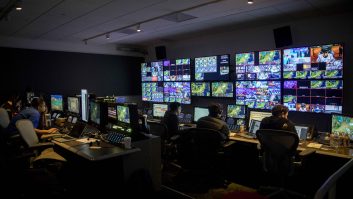
Major sporting events may share the same basic objective—bringing audiences closer to the action—but the production environments behind them can be radically different. A compact multi-sport event in one city, a winter competition spread across mountain venues and a football tournament spanning an entire continent cannot be approached with the same technical template.
The first question should therefore not be: “Which technology should we deploy?” It should be: “What experience are we trying to give the audience, and what operating model will deliver it most effectively?”
That distinction matters because the host broadcaster and individual rights-holding broadcasters often have very different requirements. The host operation must capture every competition and produce consistent international feeds. Rights holders may then add presenters, interviews, analysis, local commentary and digital content. Each can make a different decision about what remains at the venue and what moves to a central production centre.

The Commonwealth Games in Glasgow 2026 provides a useful example. Its ten-sport programme is concentrated within four venues in an eight-mile corridor, creating very different conditions from geographically dispersed events. Publicly announced plans include a managed, fibre- and IP-based connectivity environment linking venues and central operations. Meanwhile, the principal UK rights-holder is adopting a remote production model, with substantial production resources based away from Glasgow, while cameras, microphones, RF systems, presentation teams and essential engineering remain on site.
The Winter Olympics sit at the opposite end of the geographical spectrum. Mountain courses, sliding centres, snow parks and city venues can be separated by considerable distances. Weather, altitude and difficult terrain affect everything from cable placement to equipment access. Some locations justify a traditional outside broadcast truck or a substantial flypack because immediate local control is essential. Others are better suited to sending camera feeds to remote galleries, reducing the number of people and systems that must be deployed in challenging environments. Remote production was a cornerstone of major rights-holder coverage at the 2026 Winter Olympics, but that did not mean removing the venue operation; it meant placing each function where it worked best.
This summer’s World Cup created another challenge: scale. With 104 matches across multiple countries and stadiums with differing connectivity profiles, consistency had to be balanced against local reality. A broadcaster may have used SMPTE ST 2110 and JPEG XS where high-capacity managed networks supported extremely low latency, while selecting HEVC or Secure Reliable Transport over more constrained or variable links. The workflow can remain operationally familiar even when the underlying transport changes from venue to venue.
This illustrates why the debate is no longer simply “truck versus remote broadcast”. Trucks still offer deterministic local control, rapid communication between teams and independence from long-distance contribution links. For high-profile finals, ceremonies or technically demanding venues, those benefits can outweigh the additional travel, space, power and logistics.

Remote production, by contrast, enables teams and specialist operators to work across more events from permanent facilities. It can improve equipment utilisation, provide a consistent working environment and reduce the need to move large crews between venues. However, it places greater emphasis on network diversity, synchronisation, monitoring, communications and reliable return feeds. A remote gallery is only as effective as the infrastructure connecting it to the action.
For many events, the answer is a hybrid architecture. Core acquisition, audio, RF and immediate engineering support stay at the venue, while switching, replay, graphics, commentary or distribution are centralised. Managed fibre may carry premium primary feeds; satellite can provide reach or resilience; SRT can support internet-based contribution, ancillary feeds and remote interviews; and bonded cellular or private 5G can give roaming crews mobility.
The environmental and commercial benefits are closely connected. Fewer trucks, smaller flypacks and denser processing reduce freight, rack space, power and cooling. Equipment that can be reconfigured and redeployed across venues and at the next event also delivers far more value than systems tied to one event or production tier.
There is no universal architecture for major sport and that is precisely the point. The most effective approach begins with the audience, the editorial ambition and the operating constraints, then selects the right combination of on-site, remote and hybrid production. Appear’s focus is to give customers that freedom: supporting different codecs, networks and production scales without forcing every event into the same technical model.