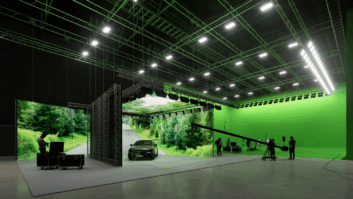
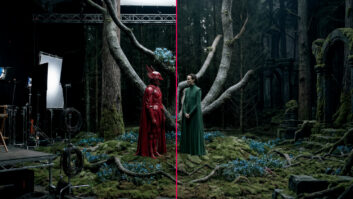
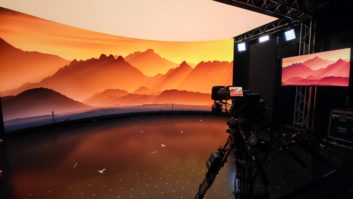
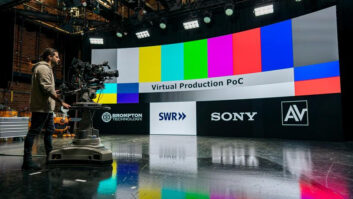
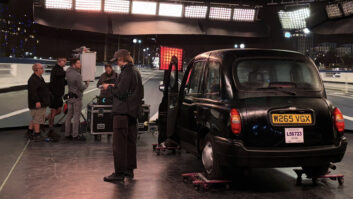
A few months ago, an independent producer stood on our LED volume trying to prove something no deck or mood board could show. Accelerant is Mike Manaserri and FluxCap Films’ project, and our role was to support Mike and his team as a virtual production partner: helping them understand what was technically possible, what made sense for the story, and how stage-based production could help to create a stronger proof-of-concept. The goal was to move beyond a traditional pitch package and create something cinematic, tangible and most importantly, technically credible. A deck can communicate references and intent, but it cannot fully show tone, camera language, performance environment, or production value.
Accelerant had ambitious production goals even by virtual production standards, built around speed, tension, collisions, impacts and sustained vehicle-based action. That kind of material is extremely difficult to stage conventionally, especially at the proof-of-concept stage. Our LED volume gave the team a controlled environment where actors, cinematography, vehicles, lighting and virtual environments could be brought together safely and repeatedly, pursuing the intensity of high-speed action without exposing anyone to the full risk profile of live-road stunt execution.
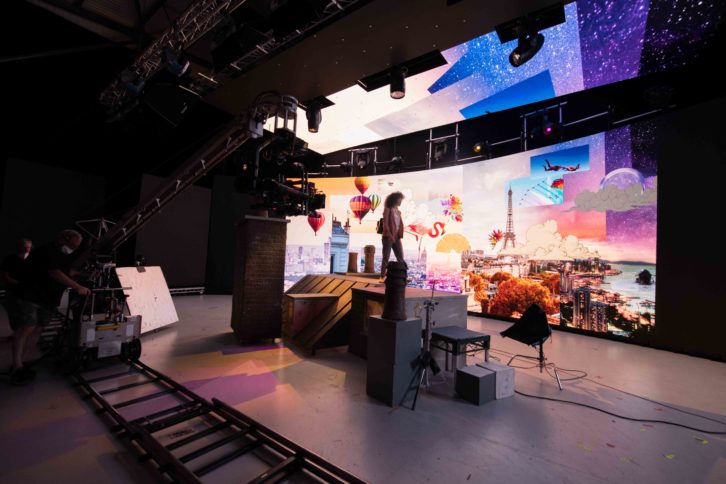
That changes the investor conversation, because it reduces abstraction. Investors can see the world, the image, and the production value that the team is pursuing. It becomes less about saying “trust us, this could work” and more about showing “here is the direction, here is the production method, and here is how this could scale,” and in some cases that happens directly in front of prospective investors, in real time.
I think this points to a significant shift in how projects get made, not just Accelerant. Virtual production has historically been discussed mainly as a tool for projects that are already financed. What we are seeing now is that it can also become a development and financing tool, allowing a production company to prove more of the project earlier, before a full greenlight. That does not replace the traditional business package, but it strengthens it, because investors and commissioners can start evaluating execution rather than just a script and a deck. Over time, that will change what gets funded, not only how it gets pitched.
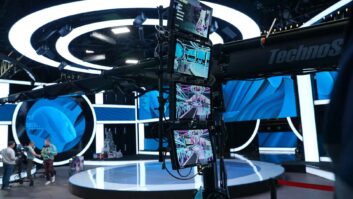
Broadcast is a very natural fit for this kind of thinking. Arguably more natural than film in some ways, because broadcasters already think in terms of repeatability, speed, format development and scalable production value across a series rather than a single asset. The same methodology used for a film proof-of-concept applies just as well to a broadcast one. Instead of a static deck with references, a production team can create a short piece of material that demonstrates the set language, the host environment, graphics integration and camera movement. Our bias is toward tools that move the image closer to final production value as early as possible, which is why a path tracing pipeline like Chaos Arena is so compelling for broadcast work specifically: broadcasters and commissioners are not only buying an idea, they are buying confidence that a format can be produced repeatedly, efficiently and at the right quality level.
There is a larger conversation emerging here too, particularly around AI. I see the stage and LED volume production more broadly, as a natural meeting point between practical set builds, AI-generated CG, real-time environments and final-pixel production for both film and broadcast.
Once those strategies begin to merge properly, producers are no longer choosing between physical production, virtual production and AI-assisted world-building. The stage becomes the bridge: a place where filmmakers, broadcasters and technical teams can meet in one production language, well before anyone has committed a full budget to finding out whether the idea works. Virtual production does not automatically make a project fundable, and it does not replace story, talent, producing discipline or a credible finance plan. But it can help translate ambition into confidence, and it can democratise access, giving smaller or independent teams a stronger way to prove themselves, provided the technology is guided properly rather than used as a gimmick. The question every independent producer, and increasingly every broadcaster, should be asking is what part of their project is hardest for an investor or commissioner to imagine. If that piece can be demonstrated on a stage rather than described in a meeting, it is worth serious consideration, because that is where the industry is heading regardless.