Today marks the 100th birthday of broadcasting icon Sir David Attenborough.
Born on 8th May 1926 in Isleworth, Attenborough is known throughout the world for his work with the BBC Natural History Unit, but he’s also moved with the times and in recent years has fronted shows on streaming services.

The middle of three brothers (older brother Richard was a BAFTA and Oscar-winning actor and director), Attenborough joined the BBC in 1952, despite the fact that he didn’t own a television.
Apparently, he was discouraged from a career in front of the camera because it was thought his teeth were too big! But, after the original presenter fell ill, Attenborough made his on-camera debut in 1954 with Zoo Quest, a programme about an animal-collecting expedition for London Zoo.
In the 1960s, he left the BBC to pursue a postgraduate degree in social anthropology at the London School of Economics, fitting in filming around his studies. However, he failed to finish the course after accepting an invitation to become controller of BBC Two in 1965. Amazingly, he managed to negotiate a clause in his contract that would allow him to still make programmes, travelling to Tanzania later that year to film elephants.
During his time at BBC Two, the channel broadcast some of its most iconic programmes, including The Old Grey Whistle Test and Monty Python’s Flying Circus. It also helped showcase the BBC’s new UHF colour television.
In 1969, Attenborough was promoted to director of programmes, making him responsible for the output of both BBC One and Two. When he was touted as a possible BBC director-general in 1972, he told Richard he had no appetite for the job. Early the following year, he left his role to return to full-time programme-making.
This led to Attenborough’s most prolific time as a natural history presenter, educating the nation with the likes of Life on Earth, The Living Planet and The Life of Birds.
Over the past 10 years, Attenborough has spread his wings, working with the likes of Sky, Netflix and Apple TV.
Technology
As a presenter and producer, Attenborough has never been afraid to embrace new technology to help tell a story. For The Life of Mammals in 2002, low-light and infrared cameras were deployed to reveal the behaviour of nocturnal mammals.
In 2011, he discussed how 3D filmmaking (which was a big thing back then) could help bring “transcendental” images to screens, but tended to take a lot longer to film. “3D works under certain circumstances and depends on how you produce it,” said Attenborough. “Right now the technology is limiting although the results can be liberating. It takes 4-5 people to lift the cameras and 30 minutes to change a lens, which is no way to react to fast moving animal behaviour. The systems are very temperamental which means you could be sitting around for an hour and half while the cameras are aligned.”
Also that year, IBC presented Attenborough with its International Honour for Excellence, celebrating his then 60-year career for its “significant advancements in filming techniques and bringing groundbreaking documentaries to audiences”.
In 2016, the BBC launched its own Attenborough app. The Story of Life app marked his 90th birthday with over 1,000 clips of Attenborough’s most memorable moments. “To keep sharing those stories in a digital age means taking them online, and I hope The Story of Life will reach and inspire a whole new generation,” he said.
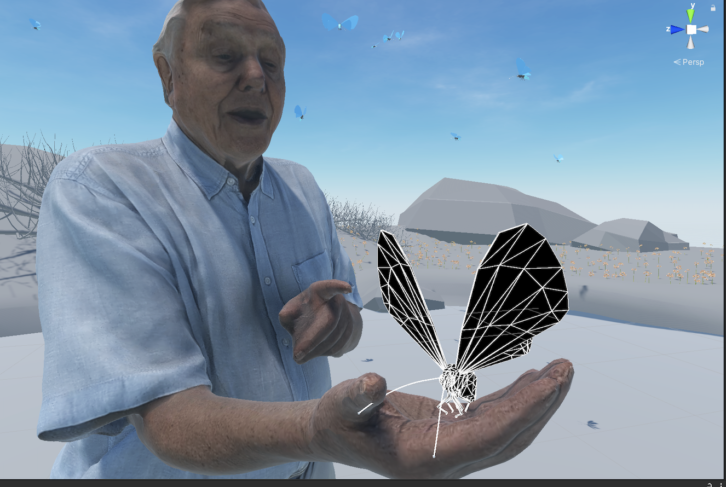
In more recent years, Attenborough has helped lead the move into augmented reality. At an AR experience based on 2022’s The Green Planet in London, visitors were guided through six digitally enhanced worlds—including rainforests, freshwater and saltwater worlds, the changing seasons and desert landscapes—by an AR version of the presenter.
The series itself employed new filming technology to take the audience to the highest branches and the lowest fauna, using a camera rig re-engineered into a field robot christened the Triffid, after John Wyndham’s science fiction book. Using the system, the production team were able to film plants in the field, not only in time lapse, but in real time, exploring their world all the way down to macro scale.
Attenborough has also worked with virtual production, specifically on Dinosaurs: The Final Day with David Attenborough, when producers used the 25.5 x 5m curved screen at MARS’ London facility to recreate the series’ background.
All of this shows that Attenborough is one of the most prolific presenters and producers on British television. In fact, he holds a Guinness World Record for the longest career as a natural historian and presenter in television.
With Wild London and Secret Garden already airing in 2026, and Tiger Island awaiting broadcast, it looks like Attenborough’s 60+ year career on screen and off shows no sign of stopping. Long may it continue!