Please start by giving us some background on Hiway.
We’re young, but we’ve been moving fast. We’ve been building this for over three years (it’s not been easy). Our closed beta went live in February 2026, and we launched publicly on stage at Cannes at the Marché du Film earlier this month.
The team is four founders, all from inside the industry. I came up through Eurosport and QPR, and then spent time as an investor in early-stage media and sports tech. Zach Rothwell, my co-CEO, spent 15 years inside independent film distribution, watching the same bad deal play out a thousand times. Adam Greenwood runs operations, an expert across supply chain, ecommerce and now AI (of course). Alex Walker built the trust layer, with a background in cybersecurity. Engineering, product and support all sit in-house. We’re lucky to have a number of old industry friends who have supported us along the way.
What is Hiway?
Shopify for content. That’s the shortest answer.
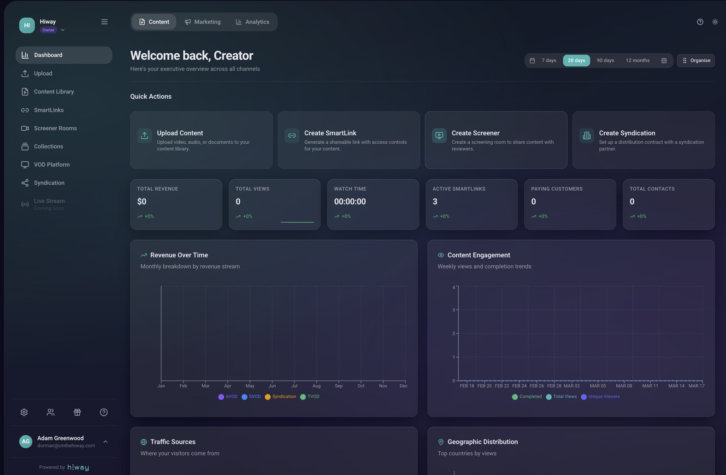
The longer one: Hiway is the infrastructure that lets you run your own streaming business without handing the keys to anyone else. You upload your content to your dashboard only once. You define the strategy. You set the price. You pick the partners. You see every viewer. You receive every penny (after a small Hiway transaction fee).
We built it because the current setup is broken. Most content owners and rights holders pour years into making something brilliant, then watch a platform take the audience, the data and most of the money. We decided to change the paradigm, so we built the toolkit and put control back into the hands of the creators. Taking away all the cost and complexity.

How does it work in terms of TV/film/streaming?
A film studio, sports rights holder or creator uploads their content once, into their own Hiway library. The master file stays with them. They add the metadata, audio, subtitles and artwork, just once.
From there, Hiway layers on access, permissions, payments, markets, analytics and audience data capture. Any partner platform, broadcaster or device pulls the stream straight from the source. No ingest. No transcoding. No CDN bill. We call it ‘syndicated, not shipped’.
You set the rules per partner. Territory, window, price, revenue split, what data flows where, all locked into a digital contract. Distribution happens through SmartLinks (single titles), Screener Rooms (B2B, secure, trackable access) or Collections (subscription libraries and box sets). Monetisation covers TVoD, SVoD, rentals and bundles, with real-time payouts. A feature film can be live to stream to your audience in minutes.
How does it help commercial broadcasters/streamers/production companies etc?
Different seats, same headline: drop the cost, keep the catalogue.
Commercial broadcasters and Smart TV platforms get to carry a full library without the infrastructure cost behind it. No ingest, no storage, no transcoding pipeline, no CDN bill. The stream originates from the content owner’s account, and the platform never has to hold the master. It’s a massive saving.
Streamers and aggregators can launch a new channel in a day, not a quarter. Real-time analytics. Real-time revenue.
Production companies can self-distribute direct-to-fan on their own branded portal. Monetise your back catalogue without big investment. Every viewer email lands in your CRM and stays there. You stop being a supplier. You start being the brand.
Are there other areas where you think Hiway could be adopted (eg content creators)?
Loads. The same infrastructure works for anyone sitting on long and short-form video and a fan base. Just last week we launched two new vertical dramas, with more coming in the next few weeks.
Sport federations are a big one. They sit on rights libraries, fan databases and sponsorship inventory that don’t currently talk to each other. We connect all three. Music and live event rights holders use it for pay-per-view and sponsor-funded events. Education, faith content, brand-owned IP, individual creators with serious catalogues. All the same playbook.
If you own content, you’ve got or want to build your own audience, and you’d like the money to actually land in your account, that’s what we built this for.
What was the motivation behind building Hiway?
Across film, sport and entertainment, the people creating the content end up at the bottom of every payment chain. Platforms take a huge cut. Payments turn up months late, if at all. Your audience is sitting in someone else’s CRM, and you can’t even email them. It’s mad when you say it out loud. This was something we as founders have experienced throughout our careers. It’s the topic for every conference panel. No one fixed it, until now.
We built Hiway to flip it. If you made it, you own it. You own the audience, the data and the commercial relationship. We stripped out the technical barriers that used to make direct-to-fan feel like a five-vendor stitch-up. Now it’s one platform, one login, everything in one place.
How does the platform utilise AI?
Carefully. We use AI where it enhances our team’s operations, but doesn’t infringe on our users’ IP.
We will be launching our first wave of user-facing AI features for marketing and audience discovery. Finding your fans is the single biggest job for any content owner, and traditionally it’s the bit that’s cost the most to do badly. We’re building tools that find them for you, target the right ones, and bring them home.
There’s a lot more coming, but I’d rather show it than spoil it. AI is a game-changer for anyone developing new platforms today. We think we’re ahead of the market right now. We plan to stay there.
How is the metadata created?
Currently this is manual entry, but of course we’ve already started building tech so AI does the heavy lift on upload. Auto-tagging, transcription, subtitles in multiple languages, SEO descriptions, rights conflict flags. All happening in the background while you grab a coffee.
Most importantly, your metadata only needs to be set once. Then everything lives in your Hiway content library. One source of truth for media, metadata, audio, subtitles, artwork.
Every partner who syndicates content via Hiway will share that source of truth. Which means wherever your content is streamed, you can update the metadata, artwork or audio files in your Hiway account, and it’ll update automatically everywhere your content is being streamed.
Can users publish their content to third-party platforms? How does that work?
Yes. And this might be one of the most important innovations we’ve built.
Picture the old way. You want a partner to carry your film, so you ship them a master file, sign a paper contract, chase invoices for six months, and hope they tell you the truth on the numbers. Painful.
We replaced the whole thing with a digital contract. Pick the content. Set the terms (territories, dates, prices, splits, what data flows where) and send it. The platform clicks accept. They publish through our API directly into their platform. Done in minutes. At no cost. The file never moves. The money splits automatically. Both sides see the same dashboard. No spreadsheets. No fight over numbers at the end of the quarter.

I understand Hiway can help content owners with the challenge of discoverability. How does that work?
Discoverability starts with being findable. Sounds obvious, but most content sits buried inside a platform where Google can’t reach it.
Every title on Hiway has its own page on the open internet, with proper metadata. Cast, crew, descriptions, the lot. Search engines and AI search tools can index it. Fans, journalists and partners can link to it. That alone changes the maths.
On top of that, we give you the tools to push content out, not just wait for people to find their way in. Smart sharing. Syndication. Get your stars, fans and influencers to share or embed your content, and be financially rewarded for any revenue they generate, in real time, paid directly to them, on whatever affiliate split you set. This is decentralised distribution. Built so you can find your audience where they already are.
You described Hiway as a ‘Shopify for OTT’ to help content owners retain audience data and revenue. What’s the one big thing content owners really need to change to actually see those savings and make the jump to selling straight to their fans?
Stop seeing yourself as a supplier to platforms. Start running your own brand.
Until that flip happens in your head, none of the rest matters. We’re already seeing producers, creators and sports organisations make the jump, go direct-to-fan, and see the immediate benefits. What used to stop them was cost and complexity. We’ve taken both out of the equation.
The platforms are landlords. We hand the keys back. The owners who win are the ones who use them. Ownership isn’t a button you press. You have to actually unlock the door, walk in, and start running the place.
What’s down the road for Hiway (pun intended)?
Alex (our CTO) tells me to stop adding to the roadmap, so I’ll be careful what I say here. The next two big releases are AVoD (ad-supported streaming with self-serve ads) and our AI marketing layer for finding and buying audiences. Both built around the same idea: help you grow without needing an agency on retainer.
Further out, we’re building the financial plumbing. Automated royalty management. Rights payments. The full money side of content ownership. The endgame is Hiway as the complete operating system for owning, distributing and monetising content. Every release lands on the same brief: less complexity, more revenue, more control.
What haven’t I asked you that our readers should know about?
Two things.
One: starting is easier than you think. £12 a month. The price of two coffees. That’s the entry tier. Independent creator with one film? Same platform a sports federation uses. Same tools. Different scale.
Two, and this is the personal bit. I’m loving building this. Starting a company is brutal. You make a hundred decisions before the kids have even got on the school bus, and most of them are wrong on the first pass. But you’re motivated each day by the feedback you’re getting from your users. The industry has been waiting for this. The conversations at Cannes told us that loud and clear. We’ve built the tools. Now it’s about getting them into the hands of the people who need them.