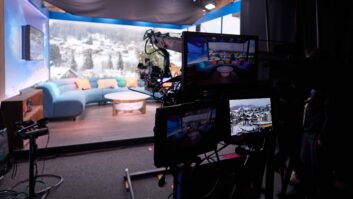
As the Winter Olympics begin in Milano Cortina, Warner Bros Discovery (WBD) Sports will once again bring every slip, slide and jump to viewers across Europe.
Operating in 47 markets and delivering the Games in 21 different languages is no mean feat. The broadcaster will have a large team in Milan, based at both the International Broadcast Centre (IBC) and its own purpose-built studios, to deliver the action across Eurosport and HBO Max in Europe, and TNT Sports and Discovery+ in the UK.
As with previous Games, WBD take the event feeds from Olympic Broadcasting Services (OBS) into its technology hub on site. But 2026 marks a step forward, as WBD has spent the last two years developing a new platform, iBuild.

“It is a very highly advanced piece of tech [that] allows us to import the streams, manipulate and manage all those feeds into the different formats that work across our technology and then distribute those feeds back to London or Paris and separately out into the different markets who are then taking individual streams depending on the sport,” Scott Young, EVP of Warner Bros Discovery Sports Europe tells TVBEurope.
Young describes iBuild as a “true investment” into WBD’s ability to ingest every feed available, thus increasing its ability to offer viewers as many streams as possible. “[In] Paris, we had over 64 concurrent streams. Being able to watch what you want, when you want, where you want is the future of multisport broadcasting. So, this technology will definitely be with us right through to Brisbane 2032 and all the Games in between.”
iBuild will also be deployed across WBD’s wider sports portfolio, including Roland Garros, delivering multiple feeds to different markets. “It’s a fantastic piece of technology to have in our back pocket as a sports broadcaster,” adds Young.
“Putting aside what the team have done with iBuild, which is quite remarkable from a content delivery point of view, it will help us make sure that every moment of the Games is available in long and short form for linear, streaming and digital.”
Asked if WBD will be using artificial intelligence during the Games, Young explains that the technology has existed in WBD’s productions for a while.
“We have not developed any new form of broadcasting or tech with AI. I know that OBS leans a lot on AI, and we rely a lot on those feeds that come from OBS. From our side, we’re yet to see where AI really embellishes the story.”
On-site studios
Rather than using virtual studios, WBD has leaned fully into the real thing for Milano Cortina. The broadcaster has multiple sites across various locations where events will be taking place.
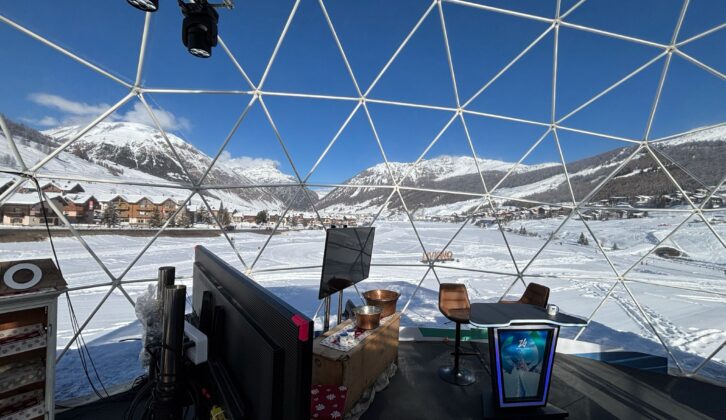
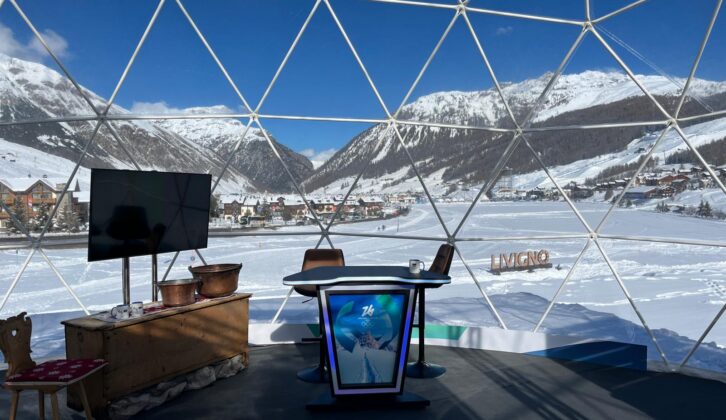
Lavigno is the home of what Young describes as an “igloo-style” snow dome, which he says “leans into” the events that will be taking place in the resort, such as freestyle skiing and snowboarding. “[It] sort of leans into the narrative of those sports, a bit younger, a bit more fun, a bit edgier,” he adds. “We thought hosting inside an igloo would look spectacular. It looks brilliant. The audience is going to love it.
“In Cortina, we’ve gone down the more traditional road. We’ve built a temporary multi-storey building that looks at the slopes of Cortina. There are three studios in that building, which will move around different markets throughout the day. There are also multiple stand-up positions. CNN will broadcast from there, as well as a partner [in Warner Bros Discovery].”


The WBD team has also built their own Mix Zone kits, which are compatible with all of the broadcaster’s technology at the IBC. “The team can connect to any Mix Zone across our entire market, irrespective of who’s standing there. [The] reporters know that they’re working for our entire organisation, not just one market, and every athlete they speak to could be broadcast in any particular market.”
Dealing with the weather
Broadcasting on-site from any winter sports event is always a challenge; you never know what kind of weather you’ll get or how that could impact the technology. However, Young says WBD is used to facing anything Mother Nature throws at it.
“Being a winter sports broadcaster every year, we have the great advantage that from the end of October through to the end of March, [we broadcast] over 500 events. I would say the humans are just as vulnerable as the technology; both need to be appropriately weather-protected. The great thing about sport in Europe is that there are well-tested people and equipment who know exactly what is required to operate throughout winter. We hope it’s cold because it is quite essential to the successful running of Milano Cortina!”
Other than dealing with cold, snow and ice, the biggest challenge of an Olympic Games as a broadcaster is ensuring that viewers get to see major stories as they happen, and that is down to the team working on and off screen, says Young.
“I could go on about technology and the amazing people we have behind the scenes, and the thousands of people that have helped put this together,” he adds. “When we turn up in Milano Cortina, we are there like everybody else, to watch and be spectators and capture that action and make sure that it gets back to the screens of those who love what [they’re] watching.”
Watch the full interview with Scott Young below.