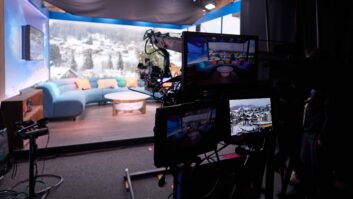
It has long been expected that every successive Olympic Games, whether summer or winter, will incorporate significant new advances in broadcast and media technology. Given the recent rapid developments in areas such as AI and cloud-based broadcasting, however, it comes as no surprise to discover that innovation seems especially plentiful at the XXV Winter Games, also known as Milano Cortina 2026, taking place at sites across Lombardy and Northeast Italy.

According to Olympic Broadcasting Services (OBS)—the host broadcast organisation which produces live television, radio and digital coverage of the Olympic and Paralympic Games—Milano Cortina 2026 will represent its “most immersive and data-rich” Winter Olympics production to date. To this end, more than 6,500 hours of content will be provided to media rights holders (MRHs), including over 900 hours of live competition and ceremonies, captured by more than 810 camera systems and 1,800 microphones across eight sports and 16 disciplines. OBS also expects around 5,000 broadcast professionals from 100-plus nations to be engaged in relaying the drama of the Games to billions of viewers worldwide.
Speaking to TVBEurope a few days before the Games began, OBS head of engineering Isidoro Moreno confirmed that the design of the International Broadcast Centre (IBC) continues to follow the “modular approach that we have been using since Pyeonchang”, the location of the 2018 Winter Olympics in South Korea, but with further refinements to “the inventory, the moving parts, and the whole way that we assemble” the IBC.

Consequently, for Milano Cortina, the set-up was achieved in record time. “In three months, we were able to hand over the first spaces to the users, including ourselves and one of the large broadcasters. To be in a position to start fitting out the equipment and doing the commissioning [in such a short time-frame] is super-important for us and it’s thanks to the continued evolution of the way we have been delivering [the IBC].”
Innovation off-screen…
Whereas previous Games have tended to involve two primary hubs, a policy of decentralisation means that in 2026 there are four other locations—Livigno, Bormio, Cortina and Verona—in use alongside the IBC, which is located at the Allianz MiCo convention centre in Milan. With many broadcasters utilising some degree of remote production, which means they are sending more compact teams to Italy, the latest developments are “in accordance with the sustainability strategy of the IBC”; indeed, Moreno says that the “reduction in space of the IBC is about 30 per cent” in comparison to the last Winter Olympics.
In terms of innovations that will be discernible on-screen, Moreno cites the “expanded use of artificial intelligence”, which includes the creation of automatic metadata descriptions and AI-powered analysis that can support the production of more extensive graphics and immersive replays. “We have a high number of loggers doing real-time descriptions in the field of play, and together with our AI analysis, there is a [huge opportunity] to explain the content so that it is better understood,” he says, alluding to the potential to convey the rules and action of a less well-known sport such as curling.
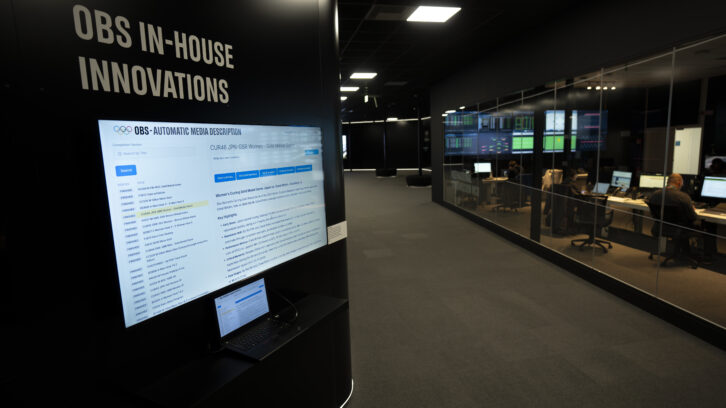
With regard to content delivery, Milano Cortina sees a further maturation of OBS’s cloud broadcasting capabilities. “We started this back in 2020 [at the Summer Olympics, which was delayed by one year due to Covid] with a proof-of-concept. It was the first time that we were doing [live cloud services] for HD, and we also started offering delivery in UHD.” Confidence among broadcasters in the cloud has since progressed to the point that, for the latest Winter Olympics, “the majority of the broadcasters are using the cloud as their main distribution option and are therefore able to receive content immediately.”
The world feed is transported to Frankfurt, with signal cloning conducted in Virginia for the US, Singapore for Asia, and Tokyo for Asia-Pacific. As well as helping to achieve minimal latency for distribution, this configuration also serves the host broadcaster’s Content Plus archive, which allows rights holders to undertake editing on the servers that are most geographically proximate: “So if your premises are in the US, you’re going to do it from Virginia, and that means you’ll have a much-reduced latency.”
…And on
Innovation that serves “enhanced storytelling” is another recurring theme of the conversation with Moreno, who points to the addition of “first-person view” drones that will bring a variety of new dynamic angles to different disciplines. OBS is also deploying 5G-enabled mobile cameras through a partnership with a major telco tech provider that involves the “modification of phones in order to minimise the load and applications that are not required, [meaning they can focus on] capturing views that are unexpected with broadcast cameras that are not so bulky and big.”

Moreno confirms that OBS works to introduce extra services for broadcasters at every successive event, but indicates that the increase is particularly significant this time around – “about 20 per cent more than we used to offer in previous editions”. Personalisation has been a particular beneficiary of innovation at this Winter Olympics, with further opportunities for broadcasters “to be in a venue and have their own camera platforms that allow them to shoot [specific aspects] of a sport that they think will be more interesting for their own audiences. We are also providing virtual backgrounds and offering services that are more geared towards digital content, such as the ability to pick up shots not only in 16×9 but also 9×16 that can be used for social media.”
Ultimately, as with every Olympic Games, it’s a case of assessing which new technologies and techniques can deepen the appeal for a global audience increasingly seeking content in both linear and non-linear modes. As Moreno concludes: “We try to place in the live production as many innovations as we can that help the viewers feel as close to, and immersed in, the action as possible.”