Nearly a decade after its introduction, SMPTE ST 2110 has moved from an emerging standard to become the operational backbone of modern media infrastructure. What was once viewed as a bold departure from SDI is now a proven architecture underpinning new facilities, large-scale live productions, and hybrid environments around the world.

In an industry focused on what comes next, it is easy to overlook technologies that have already become essential. ST 2110 is now – and ready to serve us years into the future. It is the foundation that underpins modern media systems, the result of sustained development and real-world deployments across the globe.
The first core documents – ST 2110-10, ST 2110-20, and ST 2110-30 – were published in 2017 after several years of industry collaboration, and the standard has remained stable. This maturity translates directly into operational advantage: faster deployment timelines, reduced integration complexity, and support for long-term investment decisions.
From IP adoption to new ways of working
With ST 2110 established across modern facilities, the industry has moved beyond initial IP adoption and into fundamentally different ways of operating. Cloud, virtualisation, and software-defined workflows are no longer theoretical constructs, they are being deployed in production environments, built on the deterministic, high-performance IP connectivity that ST 2110 provides.
At the same time, these shifts are expanding what production teams can do. Workflows that were difficult or impractical in SDI environments are becoming routine. Alternative formats such as RGB 4:4:4 are more practical to deploy. As production teams increasingly work with nontraditional formats such as vertical video, unconventional resolutions, and varied pixel structures, ST 2110 supports all these requirements — allowing content to be produced and delivered in ways that align more closely with evolving audience expectations.
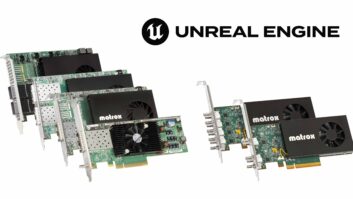
ST 2110 was built to enable software-defined infrastructure. Open-source initiatives including the Open Visual Cloud Media Transport Library (MTL) now enable anybody to download ST 2110 software that can run on COTS hardware using widely available network interface cards (NICs). This reduces reliance on specialised hardware while maintaining the performance and interoperability required for professional media applications.
The result is a more flexible and cost-effective deployment model. High-performance media transport can now be implemented using general-purpose hardware and software, allowing organisations to scale more efficiently and align media infrastructure with broader IT and data centre strategies.
MXL: Not a replacement, but an expansion
As ST 2110 has become widely deployed, industry (and trade press) attention has naturally shifted to newer initiatives including the Media eXchange Layer (MXL). Some will assert the familiar assumption that new technologies always replace what came before.
However, MXL is designed to address a different problem than ST 2110. It focuses on communication between software processes within a shared computing environment, such as a Kubernetes cluster, enabling efficient video exchange between coordinated applications operating inside tightly integrated software systems.
Now at its 1.0 release as an open-source project under the Linux Foundation, MXL is clearly aligned with video interchange inside all-software environments. ST 2110, by comparison, remains the standard for transporting video between physical devices – cameras, production switchers, multiviewers – and for interfacing those systems with compute infrastructure.
In hybrid deployments, that distinction becomes critical. Rather than competing, ST 2110 and MXL operate at different layers of the workflow. MXL enables efficient media exchange within software systems, while ST 2110 ensures reliable, high-performance transport across the boundaries where those systems connect to the physical world.
DMF: Orchestrating modern media facilities
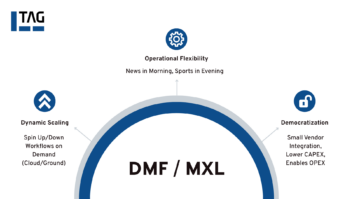
Stepping back, the fundamental objective of media companies is to deliver more content per dollar. Achieving that outcome depends on operational flexibility – more specifically, the ability to dynamically scale the workload of the facility, using a common pool of computing resources to do different jobs over the course of the day/week/month. The recently announced Joint Taskforce on Dynamic Media Facilities (JT-DMF) is taking the lead on defining and developing the important layers above ST 2110 and MXL – planning, resource management, and timing management – to enable this level of operational flexibility.
The JT-DMF concepts are not tied to a single transport technology. Whether infrastructure is based on ST 2110, MXL, or a combination of both, the objective is the same: to support changing production requirements without requiring a complete redesign of the underlying system. What is emerging is a layered ecosystem, where different technologies operate at different levels of the workflow, each addressing a specific set of challenges. Together, they enable a more software-driven model for media production and delivery.
Within that model, the role of ST 2110 is clearly defined. It continues to govern how video moves between physical systems and integrates directly with software-based environments. ST 2110 is already widespread in real-world deployments, and that momentum will continue as software-defined workflows mature and scale.