Like many other broadcast organisations, ITN has been on a journey away from SDI-based workflows towards IP for some time now. In fact, many studios and PCRs (production control rooms) at its site on Gray’s Inn Road, London, have already been upgraded to meet the ST 2110 standards. Now the upgrade initiative has reached PCR6, which is used on a daily basis by Channel 4 News.
“It’s been a very busy three years, during which we’ve essentially re-architected ITN to move from an SDI network to ST 2110 and introduced a new control system,” says James Wickes, lead media engineer at ITN. “We’ve upgraded all of our galleries at this point, and there is just one studio left to do [in 2026].”
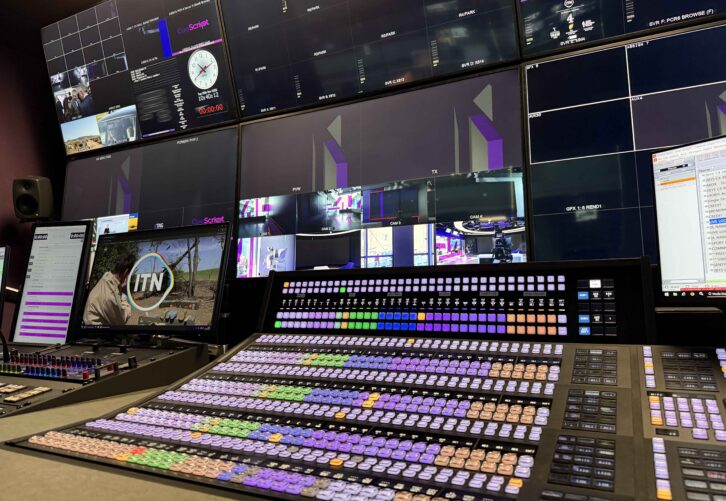
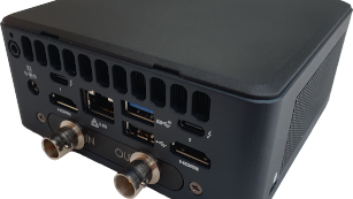
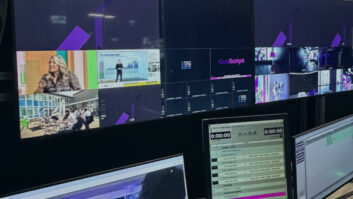
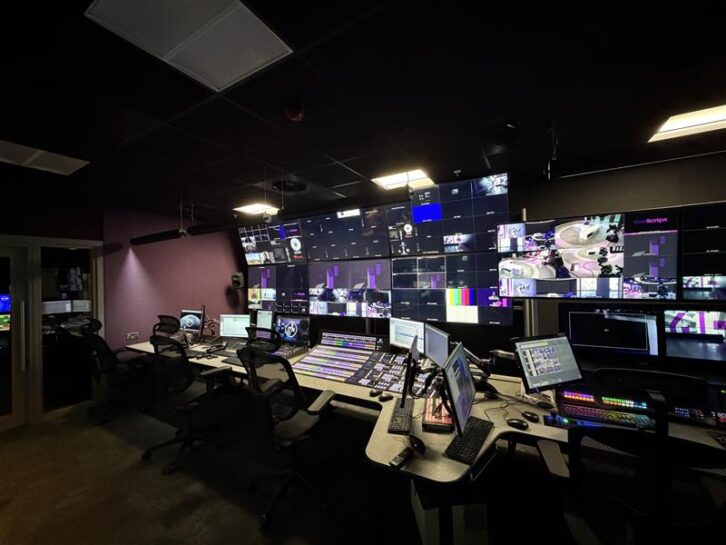
Inevitably, the design of the revamped PCR6 reflects all of the expertise Wickes’ team has gained during the previous fit-outs. Physically based around a Calrec Audio desk, Sony video mixing and 4K display technology, and an EVS Cerebrum control system, the room achieves its seamless IP workflow via the combination of TAG’s Realtime Media Platform – which provides unified probing, monitoring and mosaic generation, with full ST 2110 and JPEG XS support – and Matrox ConvertIP ST 2110-HDMI decoders.
Explaining the choice of IP enablers, Wickes says it’s “TAG for the monitor stack and Matrox to be able to convert the 2110 to HDMI to be received in the actual stack itself.” A hybrid SDI/IP solution, as currently favoured by some broadcasters, was never really on the cards here: “Hybrid does tend to result in trade-offs and the creation of bottlenecks. That’s not to say that there are no bottlenecks [with IP], but it’s all within the same domain and to fully realise its potential it feels much neater to rely on one technology.”
Optimising latency
Working closely with IP and cloud specialist Techex, ITN was keen to achieve ultra-low latency across the display infrastructure – thereby restoring what Techex refers to as the “direction connection feel” for vision mixers. The result is 1-1.5 frame multiviewer latency across ten 4K displays, which represents a level of responsiveness rarely seen in all-IP galleries.
“Latency is key for the gallery, and one thing we had noticed with other 2110 multiviewers in general was that there tends to be a bit of a delay added to them,” says Wickes. “If you’re switching on the desk and it feels like it’s catching up, it’s quite jarring. By choosing TAG we knew that because it’s compute-based it’s breaking away from the norm, and is able to offer very direct cabling into the back of the monitors – resulting in very low latency. Once we were sure that the latency was going to be acceptable – and actually it’s been absolutely fantastic – then we were able to really utilise the other features that TAG offers, such as the telemetry side of things, the flexibility and ease of installation.”
Techex engineering manager Daniel Phillips notes that PCR6 constitutes the latest in a long series of projects for ITN, which has included the extensive deployment of Techex solutions such as tx edge – which handles network and protocol translation of live video at scale – and tx play to facilitate high-quality viewing to Apple TV, Windows, Android, iOS, iPad OS and macOS.
The latest collaboration was fully in line with Techex’s focus on replacing “traditional legacy infrastructure with something more flexible”. Phillips adds: “The great thing about using TAG as a monitoring tool is that it’s quite flexible for the compressed formats as well [as the uncompressed], and monitoring seamlessly between the two. So they chose a solution that is flexible in terms of them moving away from SDI, but also able to take advantage of monitoring things which are coming in in the compressed domain as well.”
Further underlining the “future-ready design” of the new PCR6, Techex notes that the gallery’s layout and multiviewers can be adapted instantly via TAG’s Operator Console, yielding more flexibility for production teams.
Hello, GMB
If the long-term programme of IP upgrades wasn’t enough to be going on with, Wickes’ team has also had to carry out a “major refresh” of Studio 1 to prepare for the arrival of ITV’s Good Morning Britain. Based in Television Centre for the past seven years, GMB went live in its new location on 5 January.
“There has been a lot of physical change in [Studio 1], much of which has focused on altering the direction of technology we’ve been using. There had been quite a reliance on stable but aging hardware, so there were lots of SDI routers around the place and a very old control system. So that has been completely gutted and moved into the 2110 domain.”
Reflecting on the cohesiveness of ITN’s shift to IP, Wickes indicates that a very careful examination of how the organisation expected to benefit from new workflows has been integral to its achievement. “I think there have been some instances where people have gone to 2110 and subsequently wondered why they did it,” he says. “That might be because from a user point of view they don’t immediately see the benefits, or there hasn’t been sufficient planning for how they’re going to use it or the greater flexibility it brings.”
In short, if you’re still working in the same way as you did with SDI then you’re far from making the most of the new infrastructure. “It’s been a learning experience – maybe an evolution as well,” says Wickes. “It’s all very well having the technical skills to understand the underlying architecture of how this fits together, but until you [embark upon the design and planning of a project] I don’t think you appreciate some of the nuances. Then once you are working with IP, you can continue to improve your knowledge; there’s always room to learn more.”
- This article originally featured in the January issue of TVBEurope, available to download here