Austria’s national public broadcaster ORF is undertaking one of Europe’s most ambitious broadcast infrastructure transformations. The large and complex project represents far more than a simple technology upgrade—it’s a complete reimagining of how one of Europe’s most prestigious broadcasters operates, moving from traditional baseband systems to a comprehensive SMPTE ST 2110 IP-based network that will serve Austria for decades to come.
At the heart of monitoring quality in this transformation lies Hitomi’s MatchBox technology, ensuring precise timing and synchronisation across every element of this complex migration. From regional studios scattered across Austria to the state-of-the-art Content Management Centre (CMC) in Vienna, MatchBox provides the critical timing verification that makes this ambitious transition possible.
The scale of transformation
The scope of ORF’s project is remarkable by any measure. The transformation encompasses the CMC in Vienna, regional studios across Austria, radio operations, playout facilities, and a cutting-edge multimedia newsroom. But perhaps most significantly, it represents a fundamental shift in how Austria’s most important cultural broadcasts, including the globally watched Vienna New Year’s Concert, are produced and distributed.
“We are undertaking a complete infrastructure transformation from traditional baseband systems to a comprehensive ST 2110 network,” explains Alexander Frank, responsible for project planning and technical planning for broadcasting technology at ORF. “This involves renewing our entire systems—our master control room, playout facilities, and main studios are all migrating to the new IP-based infrastructure whilst maintaining full broadcast operations.”
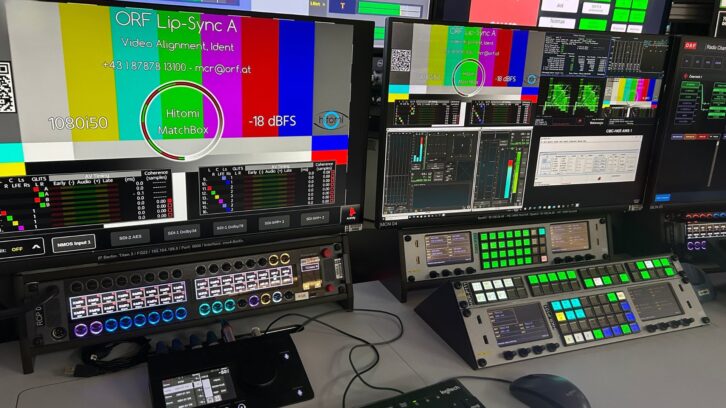
The complexity extends well beyond traditional television operations. ORF’s radio services are also being integrated into the ST 2110 network, creating a unified IP infrastructure that supports all broadcast operations from a single, centralised facility. Even more remarkably, this transformation is happening whilst maintaining full broadcast operations, a testament to the careful planning and execution that has characterised the project.
Why MatchBox for such a critical project?
ORF’s relationship with Hitomi technology began in 2018 when they first encountered MatchBox at IBC. Even then, the broadcaster recognised the potential but made a strategic decision to wait for ST 2110 compatibility before proceeding with deployment.
“We tested it on site at IBC and said yes, this makes sense,” recalls Frank. “We saw it being used for some of the most prestigious global sporting broadcasts, and our colleagues in the master control room in Vienna told us they were getting signals from other broadcasters who were also using Hitomi. We realised it was becoming the international standard for measurement of latency and lip sync.”
The decision to deploy MatchBox wasn’t just about having the latest technology; it was about ensuring compatibility during a complex migration period. ORF needed a solution that could work seamlessly with both their existing SDI infrastructure and their new ST 2110 systems.
“The difference between baseband and ST 2110 operation is marginal with MatchBox – it’s the same operation, the same usage,” Frank explains. “We can use it in both environments, and crucially, we can measure Valid signals on Hitomi Analysers and Hitomi-generated signals on Valid Analysers. This compatibility was essential during our transition period.”
What sets ORF’s implementation apart is not just the scale, but the innovative applications they’ve developed. The broadcaster is pioneering several uses of MatchBox technology that push the boundaries of what’s possible in broadcast timing measurement.
Regional and international sports coverage
ORF’s role as a host broadcaster for major international sporting events has driven some of its most innovative applications. “For our events, we are host broadcasters for major international sporting competitions,” Frank explains. “We have 8, 10, or 20 cameras around the venue, and now we can measure the latency differences from these cameras to the OB van.

“At the moment, timing is managed by the ears and eyes of the operators, the audio masters and video masters. Now we can make this measurement with the Glass licence very comfortably. The event cameras are in sync with the OB van, and then we measure from the OB van on different lines—backup line, main line, via satellite, via fibre cable—and we can make everything on one timeline sync.”
Perfect timing for a global audience
Perhaps ORF’s most ambitious application involves their globally broadcast concerts. The Vienna New Year’s Concert and summer concerts at Schönbrunn are watched by audiences in 160 countries, making timing precision not just a technical requirement but a cultural imperative.
“For the Vienna New Year’s Concert, if you see the violins and you hear them differently, it’s not very nice,” Frank explains with characteristic understatement. “We are now able to measure and not just guess.”
ORF has developed an innovative approach to ensure an optimal viewing experience for its global audience. They purchased eight different consumer television sets representing the most popular models worldwide, then used MatchBox to measure the timing differences between them.
“Some TV panels have different internal processing times for audio and video,” Frank explains. “So we got eight of the most popular TV panels and tested them two or three days before the concert started to get an average delay.”
This represents perhaps the most sophisticated approach to end-to-end timing optimisation in broadcasting today – ensuring that whether viewers are watching in Vienna, London, New York, or Tokyo, they experience the concert with perfect audio-video synchronisation.
Managing multiple feeds with precision
In ORF’s new CMC master control room, MatchBox provides capabilities that were previously impossible. “For the first time, we can measure the latency between different lines,” Frank explains. “From Sydney motor racing coverage, we have the main line, the backup line, our own live view, journalists on set, radio journalists on set—we have four signals and now we can measure the latency of all signals both technologically and for the content itself.”
A partnership built for success
The success of ORF’s implementation reflects not just the technology itself, but the partnership approach taken by all parties involved. Bernd Meinl from VIDI GmbH has been instrumental in managing the complex technical and logistical aspects of the deployment.
“This represents one of the most comprehensive broadcast infrastructure projects we’ve undertaken,” explains Meinl. “The technical complexity and scale of ORF’s transformation encompass radio, television, and news operations. It’s definitely the biggest project I’ve ever had, covering not only volumes and number of boxes, but also different requirements like baseband, ST 2110, Dolby, and Glass licence, it includes almost everything MatchBox can do.”
The collaboration has extended beyond simple equipment supply to include ongoing technical support and feature development. ORF has provided valuable feedback that has influenced MatchBox development, particularly around audio configuration options and user interface improvements.
“We have two feature requests that our colleagues from VIDI told us would be very good,” Frank notes. “They said these would probably be included in the next release. This kind of customer feedback to the development team, and having that feedback taken seriously, is also a good point.”
The technical implementation demonstrates the flexibility and robustness of the system. Working with VIDI GmbH, ORF has deployed MatchBox solutions that integrate seamlessly with their existing monitoring infrastructure, including Skyline DataMiner systems.
“We use it together with DataMiner from Skyline,” Frank notes. “We can read the measurements and make settings, and it works well. Skyline is in contact with Hitomi’s development team about the API to check what can be read or set and in which way.”
Looking to the future
As ORF approaches the final phases of its transformation, with the new CMC master control room scheduled to go live in 2026, the role of MatchBox technology will only become more central to its operations. The testing phase, beginning in August 2025, will put all systems through their paces before the final cutover.
“We now have confidence that our systems are all in sync,” concludes Frank. “If we get any feedback, we can say we’ve checked it, we’ve documented where all the paths are, where the delays are. This gives us the foundation we need for the next decades of broadcasting.”
The project represents more than just a technology upgrade – it’s a foundation for the future of Austrian broadcasting. The IP-based infrastructure will support not just current operations but also emerging technologies and workflows that haven’t yet been imagined.
ORF’s comprehensive deployment serves as a blueprint for other broadcasters undertaking similar migrations. “What ORF has achieved demonstrates exactly how we envisioned MatchBox technology being deployed in complex broadcast environments,” notes Russell Johnson, director at Hitomi. “Their innovative approach to end-to-end timing measurement, from production through to the consumer experience, shows what’s possible when broadcasters think creatively about timing verification.”
The project demonstrates that with careful planning, the right technology partnerships, and innovative thinking about applications, even the most complex broadcast infrastructure transformations can be achieved without compromising quality or reliability. The success reflects not just on ORF’s technical expertise, but on their commitment to maintaining the highest standards for content that represents Austrian culture to the world.
As the broadcast industry continues its evolution towards IP-based infrastructure, ORF’s experience demonstrates that successful transformation requires more than just new equipment—it requires technology that can bridge the gap between old and new, providing certainty and precision throughout the transition. In MatchBox, they found exactly that solution.