On Saturday, the Austrian capital, for centuries synonymous with the very highest tier of the art of music, will once again welcome performers from across the continent and beyond, as Vienna plays host to the Eurovision Song Contest for the third time in the competition’s history.
Earlier this week, as the Eurovision extravaganza descended on the birthplace of Schubert, Strauss, Schoenberg and, er, Falco, I visited the city to experience the building atmosphere and go behind the scenes at the biggest live music event on the planet.
Preparations were well underway ahead of the first semi-final on Tuesday with Vienna gearing up to party. By contrast, an air of calm radiated through the backstage area and out to the multiple OB trucks lined up behind the impressive Wiener Stadthalle, Austria’s largest indoor venue. While the event itself has exposed more than a handful of national rivalries and affinities over its seven decades, the production has evolved to become a benchmark for harmonious cross-border cooperation. This year is no exception, with teams from all over the continent converging in the City of Music to deliver again for an anticipated global audience of between 160 and 170 million viewers.
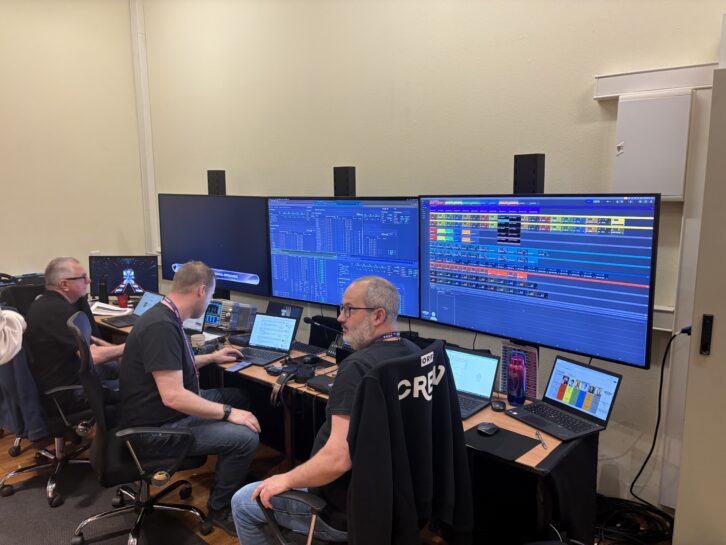
For host broadcaster, ORF—handed responsibility for the production when Austria’s entry took first place in last year’s Contest—the collegiate manner in which vendors, integrators and myriad production specialists combine to ensure a smooth-running operation can only be a source of comfort.
Everything about the Eurovision Song Contest is huge. Around 350 technical staff work on the semi-final and final shows, with a similar number again involved throughout the build-up. In the arena, a total of 28 live cameras will be used. Aiming to drive a cinematic experience, the production will be based around the ARRI Alexa 35 family, with railcams, RF cameras, aerial systems, crane cameras and steadicams adding to the overall effect. More than 38 kilometres of cable are in use across the venue, with 13 kilometres of fibre cable just for communications. There are over 80 network switches and more than 4.2 terabytes of data move through the system every second.
Marking its Eurovision debut and largest deployment to date, Sennheiser’s Spectera system aims to ensure artists and crews benefit from the “extraordinary clarity” it provides, with performers able to use a single belt pack and technicians given access to extensive insights via its enhanced monitoring capabilities.
Perhaps unsurprisingly, the event offers an excellent opportunity to develop and evolve new workflows. “Eurovision is always a playground for us technical people,” Volker Schmitt, manager, technical application engineering, told me ahead of the first semi-final on Tuesday.

Launched at IBC2024 in Amsterdam, Spectera is the world’s first bi-directional wideband digital wireless ecosystem using WMAS (Wireless Multichannel Audio Systems) and was designed with the future of audio production at its heart, evolving to meet changes in demand as new hardware and software comes on stream. “When you’re an engineer at Sennheiser, you have a unique opportunity to design a system from scratch,” said senior development engineer transmission technology at the company, Sebastian Georgi, also confirming the solution performed flawlessly throughout the build-up to the finals.
Returning for a fourth time and underpinning the spirit of international collaboration, Italian rental company Agorà will provide a full service to ORF, supporting teams with PA, RF, show mixing and network technology integration.
“…The best part of the job,” said Valerio Motta, Agorà’s Eurovision project manager, “is to work with teams from so many nations. The ESC is like a very fast and complex festival—we love it!”
Leaving Vienna behind, I was once again impressed by both the professionalism and sheer scale of the Eurovision operation. Quite apart from whatever takes place on stage, the media and entertainment industry has clearly demonstrated its capacity to take on the very biggest of global technological challenges, and win.