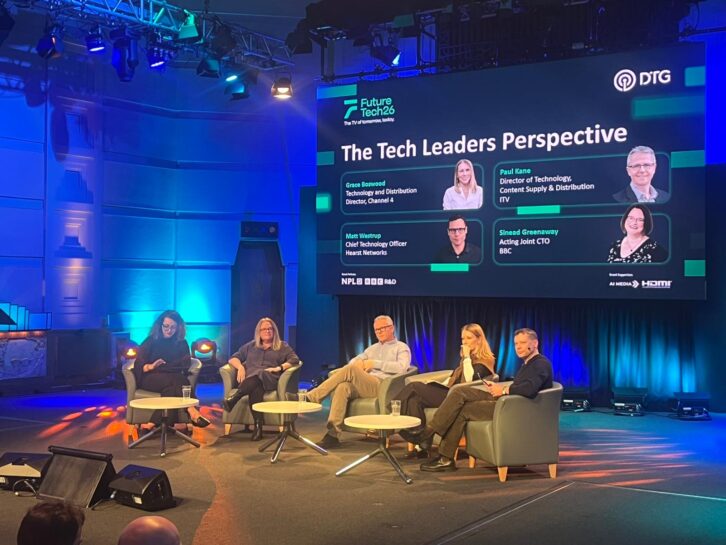
During its annual FutureTech event, the DTG brought together four broadcast technology leaders for a “frank conversation” on the realities of tech innovation at scale.
During their discussion, the panel covered the rise of artificial intelligence and how broadcasters are beginning to bring the technology into their workflows.
Asked what AI means in terms of the human element of broadcast technology, Matt Westrup, chief technology officer at Hearst Networks, told the audience he believes that “AI makes humans more important, not less”.
“If you start from that basis, then [the question is], how are we going to design this to work to our strength? What are the qualities we are looking for in people?”
“I don’t think we should be adapting at lightning speed,” added Westrup, “[but] we should be thinking at lightning speed. What you need today isn’t what you’re going to need tomorrow, and so the human qualities that we’re going to need are going to add to the business value. AI should be doing a lot of things that we find difficult, complex or frankly boring. We’re going to have to take our time to understand what that looks like and how it fits in.”
Westrup cited localisation as an example of where AI has been of benefit for Hearst, adding that the technology is being used as a tool by the human team to enable them to do things they couldn’t do before. “It’s additive, not subtractive. At the moment, getting that blend right has come from a culture of curiosity.”
ITV’s director of technology, content supply and distribution, Paul Kane, said the broadcaster is “quite bullish” about AI, and is looking at implementing and adopting it in a “very responsible way”. Kane revealed that ITV has over 250 ongoing projects exploring AI’s uses.
“We want to make sure that we have a certain amount of control over it,” he added. “Last year, we had a session where we were trying to get developers to try out some new concepts and ideas using AI. It was quite hard to get them up and running because things like tokens need to be set up, and so we don’t have all of that infrastructure in place yet to allow us to really unleash the power of AI into our development community. But I think there are a lot more opportunities in that space to make it easy for our developers and also our end users to adopt AI.”
The panel also discussed UK sovereignty and AI, with Grace Boswood, technology and distribution director at Channel 4, stating that agentic AI for content discovery “terrifies” her.
“Often broadcast CTOs are thinking 5,6,7 years ahead and looking at that long term horizon. I think it comes down to our values and principles, and how do we maintain them? We are going to have to lean on our regulatory friends to support us in that context, because the audience demand is there. The audience don’t want to be flooded by AI slop, they do want UK content. You can see that in our organic viewing figures and our research data.”