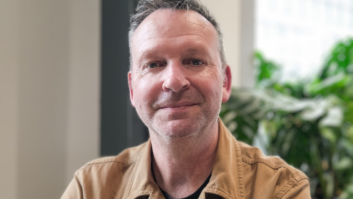
Chris Lynch is the founder of award-winning London production company Diverse Made Media, and inventor of CAERUS, a camera system for cinematic mobility. A successful cinematographer, producer, business leader and technology innovator, his greatest passion is to change the perception of disability to capability.
Raised in Belfast, Northern Ireland, Lynch was born with osteogenesis imperfecta—a genetic disorder that has resulted in over 100 broken bones across his lifetime. “I’ve been a wheelchair user for over 40 years, and I’ve been self-employed for most of my life,” he says.
His career began with a boutique consultancy that grew into a fully-fledged advertising agency before moving into broadcast production, accumulating credits across major broadcast networks, alongside commercial work for a number of leading brands.
Setting up Diverse Made Media in 2022 brought everything together: the production experience, the lived experience of disability, and the technology he’d been developing. “I wanted to build a company that proved inclusive production isn’t a compromise. It’s a creative advantage,” says Lynch.

In September 2025, he launched CAERUS, the world’s first professional camera mounting system that turns a wheelchair into a precision camera platform. The technology emerged from a simple frustration: as a wheelchair user and cinematographer, Lynch faced barriers that had nothing to do with creative vision and everything to do with equipment designed for standing operators. Rather than accepting limitation, CAERUS became the solution.
“As I’ve always said—you need four arms to work as a wheelchair-using camera operator. Two to push yourself and two to hold the camera. That’s the barrier. Not talent, not vision, not experience, just physics. And there was nothing on the market that solved it.”
CAERUS took five years of development and multiple prototypes. It was engineered in partnership with RED, Ronford-Baker, and DJI. “The goal was never to build assistive technology. It was to build a professional camera system that happens to be mounted on a wheelchair, that delivers shots traditional rigs can’t,” says Lynch.
“We launched at IBC last year and the response was incredible. Industry professionals were stopping to see the technology in action, and I was invited to present a fireside chat on the RED Stage about inclusive filmmaking. But what really stood out was the nature of the conversations afterwards. They weren’t about disability. They were about creative capability, shot possibilities, and commercial applications.”
Live production without limitations
CAERUS turns the wheelchair into a precision camera platform with three-stage image stabilisation, wireless control up to 6km, and payload capacity for full broadcast camera packages. “You can do tracking shots, dynamic movement, first-person perspectives—all the creative work that was previously locked behind a physical barrier. It isn’t just solving a problem for disabled operators. It delivers a new creative tool for the entire industry. The shots you get from a wheelchair-mounted system are genuinely different—lower angles, smoother movement at ground level, perspectives that traditional rigs physically can’t achieve. Productions book CAERUS because it delivers shots they want, not because it ticks a diversity box.”
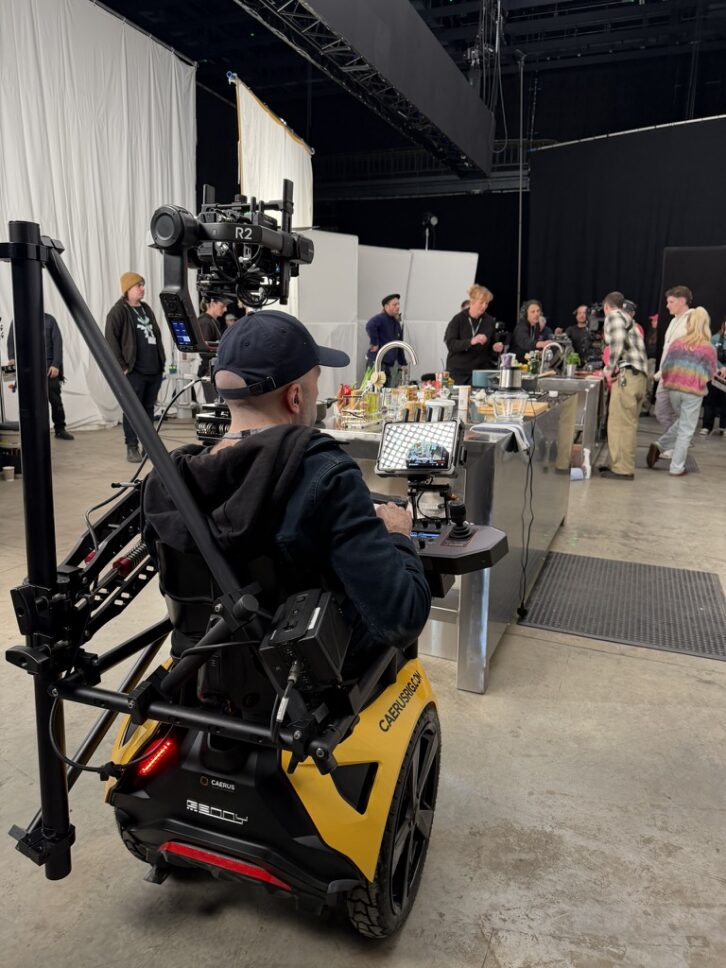
Built on a modular design principle, every system can be configured to match the production environment; there are three CAERUS models: Vista, Studio and Rover. Vista is an all-round platform for indoor and outdoor use, Studio is optimised for controlled studio environments with heavier camera and lens packages, and Rover is the all-in-one mobile studio.
“CAERUS Rover was developed specifically for journalism, news and outside broadcast environments—situations where you need to be live and mobile simultaneously. When we were looking at how to enable real-time broadcasting from a wheelchair-mounted camera system, LiveU was the obvious choice. The LU300S unit is the industry standard for cellular bonded uplinks; it’s what news crews around the world already trust.”
The workflow is straightforward. The LU300S sits integrated into the Rover platform alongside the camera, gimbal, onboard power distribution, and LED lighting. The operator moves freely on location, capturing broadcast-quality footage that’s streamed live back to the gallery or studio via LiveU’s bonded cellular technology.
“With Rover, the LiveU integration is a configurable option rather than a fixed component, because not every production needs live broadcast capability. A documentary crew might want the Rover’s onboard power and lighting setup but doesn’t need a live uplink. A news crew absolutely does. Making the LiveU unit an optional add-on means we can price the system appropriately for each use case and keep it accessible to a wider range of productions.
“For news and current affairs, that means a wheelchair-using journalist or camera operator can be fully mobile on location, delivering broadcast-quality live footage without being anchored to a satellite truck or fixed position. The storytelling possibilities that opens up—being in the crowd, moving through an event, capturing a perspective that’s genuinely different from every other crew on site—that’s where LiveU and CAERUS together become something special.”
CAERUS has been deployed on major UK broadcast productions alongside brand campaigns. A pilot for a major UK broadcaster is imminent, other conversations are underway, and a dedicated workshop at the Disability Journalists Forum and a joint NEP demonstration event will bring CAERUS Rover’s live broadcast capability to a wider broadcast audience later this year. “The big audacious goal is to have one of these on every production worldwide.” To equip the next generation of filmmakers, Diverse Made Media trains operators through the CAERUS Academy so they have the skills to use the system on set.
Breaking down barriers
Lynch says the shift from talking about disability to capability is everything. “If inclusive technology only exists as a charitable gesture or a compliance exercise, it stays on the margins. But when it competes on creative merit—when it wins on the strength of what it produces—that’s when the industry genuinely shifts.
“The wider impact is about showing the industry that inclusive production technology isn’t niche. It’s the future of how we make content. When you design tools that remove barriers, everyone benefits, not just the people the barriers were originally blocking.”