Netflix has revealed almost a third of all viewing on its platform is powered by the AV1 codec.
In a blog post, the streamer’s tech team explained that the H.264/AVC codec still powers the majority of its views, but it expects AV1 to take over the top spot soon.
Netflix first launched support for AV1 on Android in 2020. “By adopting AV1, we were able to deliver noticeably better video quality at lower bitrates,” said the post.
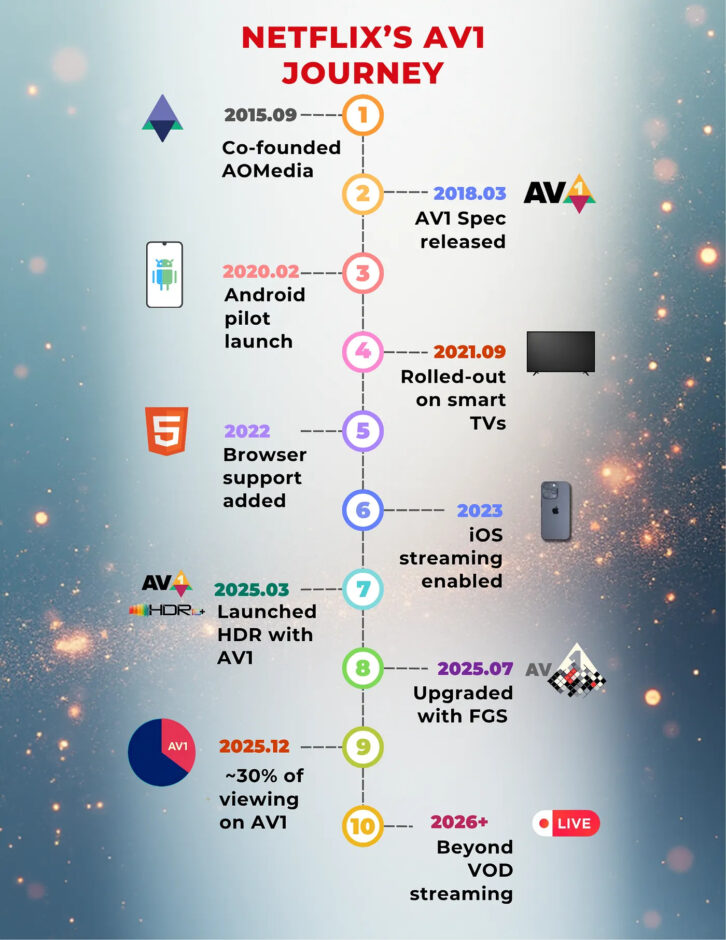
“The success of our AV1 launch on Android proved its value for Netflix streaming, motivating us to expand support to smart TVs and other large-screen devices.”
According to Netflix, on average, AV1 streaming sessions achieve VMAF scores that are 4.3 points higher than AVC and 0.9 points higher than HEVC sessions. “At the same time, AV1 sessions use one-third less bandwidth than both AVC and HEVC, resulting in 45 per cent fewer buffering interruptions.”
Earlier this year, Netflix adopted AV1 HDR streaming. Currently, 85 per cent of the streamer’s HDR catalogue (from the perspective of view-hours) has AV1-HDR10+ coverage, with the number expected to reach 100 per cent in the next couple of months.
The company’s decision to introduce AV1 Film Grain Synthesis (FGS) streams has led to “astonishing results”, according to the post. “AV1 with FGS could deliver videos with cinematic film grain at a bitrate well within the capabilities of typical household internet connections,” it added.
Netflix said it sees “significant opportunities” for AV1 beyond traditional VoD streaming, and it is “currently evaluating” how the codec can hyperscale concurrent viewership while also enabling it to use customisable graphics overlays on live sports events. “Layered coding is supported in AV1’s main profile, allowing encoding the main content in the base layer, and graphics in the enhancement layer, and easily swapping out one version of the enhancement layer with another,” said the post.
Looking ahead Netflix said it is “excited” about the forthcoming release of AV2. “While AV2 represents the future of streaming, AV1 is very much the present—serving as the backbone of our platform and powering exceptional entertainment experiences across a vast and ever-expanding ecosystem of devices,” it added.
The full blog post is available to read here.