For some, the FIFA World Cup of 2026 may be remembered for events that took place off the pitch—in a White House rather than on a green field—but in a tournament offering much controversy and unlikely heroics, what can’t be denied is that viewers did not miss a thing.
Featuring 48 teams for the first time, playing 104 games spread over 16 stadiums in the United States, Canada and Mexico, the tournament was also the most technologically enabled of its kind. Innovation encompassed fully-redundant cloud and networking infrastructure, 3D and advances in broadcast technology. Indeed, the broadcast tech deployed will almost certainly pass from pioneering into standard for sports.
As well as breaking new boundaries in scale, the event offered unprecedented operational challenges to official technology partner Lenovo. The tech firm entered the tournament with the aim of showing how its hardware, end-to-end technology backbone and “big moment” technical expertise could deliver what was required for the organisers, teams and six billion fans engaging across the globe.
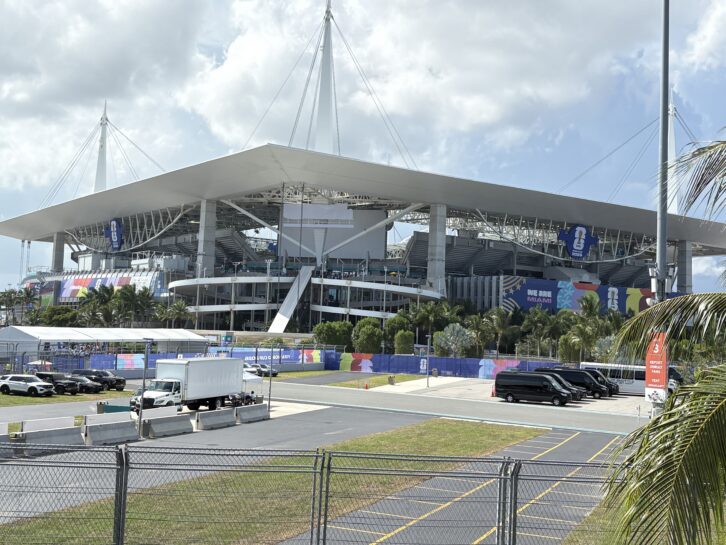
At the heart of the technological infrastructure was an International Broadcast Centre (IBC) in Dallas distributing live match feeds to over 200 countries, working alongside a technical operations centre (TOC) in Miami. In addition to dealing with mission-critical operations, the TOC also took 4K IPTV feeds from the IBC with a direct latency of two seconds from Dallas to Miami.
Transforming data into insight
Before the tournament began, Lenovo expressed confidence that fans would be able to enjoy live football like never before through new experiences powered by AI. Indeed, a central facet of the broadcast operations was making use of capturing billions of pieces of football-related data and representing them as insights for viewers. The technology provider noted that never before had this much data been available and meaningful to so many.
FIFA gave Lenovo unparalleled access to data and analytics through AI Pro, a specialised football interaction tool orchestrating multiple AI agents based on millions of data points. It analysed over 2,000 different metrics and delivered insights via multiple outputs, including immersive animations.
Exclusive 3D digital player avatars were used to provide greater context and understanding to the video assistant referee (VAR), semi-automated offside technology (SOAT) and goal-line technology (GLT) offered by fellow FIFA technical partner Hawk-Eye. The avatars turned split-second referring decisions into easy-to-follow 3D visual explanations for watching fans.
Lenovo’s role was to build and manage the 3D player models with millimetric accuracy, scanning each of the 1248 participating players. It also undertook the process of quality checks and asset management. Creating realistic, scalable 3D content has traditionally been time-consuming and expensive, with existing 3D models lacking the accuracy needed for analytics, simulation and digital experiences. AI was vital in cutting the scanning time down to less than two hours.
Sharing the referee’s perspective
Yet perhaps the most interesting and directly tangible way in which TV broadcasts were boosted by technology was the use of video captured from cameras carried by referees, the Ref Cam. The primary use was to help on-pitch decision-making, but for the World Cup a further aim was to transform footage of the referee’s perspective into a stable, usable viewing experience with high clarity and consistency.
Yet ensuring high-quality broadcast material from such a source presents a number of intrinsic key challenges. Namely, such environments make it difficult to capture clear, usable video while poor video quality can limit situational awareness for broadcast teams.
The new technology was first trialled, says Lenovo director sports vertical Santiago Manso, at the FIFA Club World Cup in 2025, but its genesis hails from the world of Formula One and the cameras attached to cars. “We had a similar challenge with the [on board] cameras where Formula One wanted to use that streaming content from all the cars at the same time. But whenever there were changes in light in the ride—for example, getting into the Monte Carlo tunnel—they had to adjust the colour, contrast, brightness manually. This [new] solution monitors the different kinds of frames, contrasts and all of the different parameters, adjusting automatically.”
Viewing experiences were enhanced through real-time visual intelligence, Al-powered computer vision and network edge inferencing and analytics technology – Referee View Al Stabilizer—which could stabilise and enhance video as it was captured, transforming high-motion footage.
Observations showed that compared with previous Ref Cam technology, Referee View Al Stabilizer produced a 60 per cent reduction in video jitter for content at 60fps transmitted with less than 2-second latency. According to Lenovo, this meant up to 70 per cent smoother video trajectories with zero image quality degradation in both colour and sharpness.

Legendary football referee Pierluigi Collina laid out more basic challenges overcome in the Ref Cam. Collina, now chairman of the FIFA Referees Committee and chief refereeing officer at FIFA, explains that there were concerns around how heavy the camera would be, and this led to the cameras being worn on the referee’s heads, as seen in the TV coverage.
“When you are on the field of play, every gramme matters. I was told that [the weight] would have been 400 grammes; I was a bit worried, so I asked [FIFA] to reduce it as much as possible. Then the other problem was how comfortable the camera was, which was initially linked to the audio system they had. They developed another one, which makes referees look like RoboCop.”
In addition, Collina says having AI-based stabilisation means avoiding the need for extra hardware in the camera, thus cutting down on weight and having a head-mounted device means that viewers follow the eyes of the officials. By contrast, a chest-mounted camera would have resulted in worse content and meant referees wearing a vest, something to be avoided in games played in temperatures of over 30 degrees Celsius.
Lenovo believes that among the fundamental outcomes of the new technology on the Ref Cam have been clearer video, improved situational awareness and faster correction in production, leading to higher-quality broadcasts. Another by-product has been enhanced opportunities for broadcasters. For example, in the middle of the tournament, the BBC hosted clips of Ref Cam footage to complement normal action, offering very personal insights into the reactions between officials and players not possible from standard broadcasts.
In many ways, the FIFA World Cup 2026 saw barriers broken both on the pitch and on screen. Going forward, the AI-based technology will only set new standards for how the game is run and how it is seen. Goals have been met—and scored—everywhere.