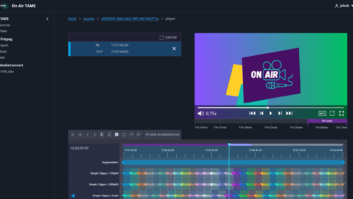
The move towards more open and efficient media workflows is accelerating, with Time Addressable Media Store (TAMS) emerging as a key enabler.
In order to meet both compliance guidelines and to keep their content in the archive, broadcasters are recording everything all the time. But accessing that content can lead to challenges in terms of accessibility and cost. That’s where TAMS comes into play.
During TVBEurope’s webinar, Is it primetime for TAMS?, the panel discussed how the cloud-native, open source API enables users to access short, time-based segments of content, rather than large files. It has already been deployed in a number of use cases, with large broadcasters considering how it could future-proof operations.
TAMS has been created as open source so that it’s not tied to any particular vendor or formats, enabling anyone to build tools or adopt the API for their SDK. “It’s really about trying to give users the choice of the tools they want and make it as easy as possible for them to adopt it,” explained John Biltcliffe, AWS senior solutions architect.
“So if a tool talks to TAMS, [users] should be able to plug into a TAMS store very quickly and easily and share that content with any other tools that also use the TAMS API. It removes the need for lots of of point to point direct integrations and really just enables customers to pick and choose tools, swap them and add them into their workflows much more quickly and easily.”

The industry is always interested in new technologies that “move the needle” when it comes to software workflows that leverage the collaborative potential of cloud, added Dave Mitchinson, solutions director at Techex, and TAMS fits that model precisely.
“As a technology, TAMs can leverage efficiencies in a way which you can’t do by just lifting and shifting traditional, linear files,” he explained.
TAMS works with video, audio and metadata, enabling users to time index segments and find them as needed. “A lot of [broadcasters] want to work with a methodology which is similar to the 2110 essence methodology of keeping video and audio separate so that you can access them independently, and you can absolutely do that,” added Mitchinson.
Speed and operational efficiency
For broadcasters, TAMS offers a fundamental shift in how live and recorded content is handled. James Elliott, managing director of Elliott Media, highlighted its importance as “a potential agnostic handoff point for live and recorded content.” This eliminates the need for constant, redundant recording. “With TAMS, broadcasters no longer need to record everything,” he explained.
“This is particularly important with procedural content. Being able to access content from a TAMS store systematically without human intervention means that you can obtain access to content quickly and easily.
The advantages of TAMS span speed, scale, and operational efficiency. Sky’s group head of content management and quality control – content technology and innovation, Rebecca Light detailed some of the practical benefits for broadcasters such as “the potential for real scale, no longer being tied to port recordings or other physical constraints.” This scalability, she added, leads to faster production. “Whether that’s editors, compliance, localisation, everyone [is] able to start work straight away and simultaneously because the content is instantly accessible. “I think it has the potential to open new doors for linear, giving it perhaps more of the agility of a streaming platform.”
“What interests me the most from what I’ve seen is that it would give us a really strong foundation for more smart automation and AI. It aligns with our cloud strategy, and it is in line with simplifying the technology estate as well, instead of constantly adding to it.”
However, implementing TAMS is not without its challenges. Kevin Morris, product manager at the BBC, pointed to several complexities that are currently being worked through. “Ownership is one. Having a great big data lake is great, but, if you’re news and you want to protect some content and not have it accessible to other people, how do you create some authentication or authorisation?”
Other issues involve content organisation, the question of “monoessence versus multiessence”, and how different domains find source IDs within the TAMS store, added Morris.
When all is said and done, the underlying technology of TAMS aligns perfectly with modern, cloud-based media operations. Mitchinson explained that TAMS “fits that model precisely” by leveraging efficiencies that are not possible with traditional file-based workflows. “[TAMS] embraces the challenges that the IT industry has already solved,” such as utilising standard techniques like HTTP and OAuth 2.0 for authentication. This low barrier to integration means TAMS can be used in “pretty much any application where you want to store content, manipulate metadata, and run a very efficient operation, and if you implement it in the cloud, it can be highly scalable as well.”
The full webinar is available to watch on demand here.