For longer than many in the industry care to remember, there has been a desire for a more even spread of production across the UK. Ever since the idea of regional television first took hold, with the introduction of the Television Act in 1954, successive governments have expressed their support for devolution, implementing a range of strategies aimed at extending the reach of UKPLC’s vitally important media and entertainment business beyond its traditional London home.
There have, of course, been some high profile successes. Last year, Channel 4 confirmed plans to expand its footprint across the UK with a commitment to support 600 roles outside the capital. One initiative offered opportunities for capital-based employees to relocate to the company’s offices in Leeds, Bristol, Manchester or Glasgow, and all of its roles are now advertised across all locations.
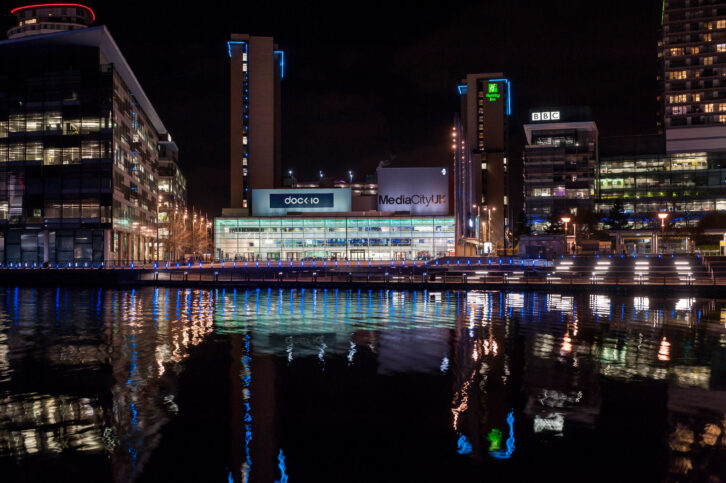
The BBC has also set out a comprehensive five year strategy, BBC Across the UK (ATUK), which aims to transfer power and decision-making to the regions with a series of projects including investment in local creative economies and moving jobs across the country. In 2011, the corporation famously moved a substantial part of its operations to Salford, in the county of Greater Manchester, establishing a large presence at what has grown to become MediaCityUK, on the site of the former Manchester Ship Canal docks.
MediaCityUK has not so much repurposed the area as transformed it. The ships that once kept the heart of the Industrial Revolution beating may no longer line up along the quaysides, but the decaying industrial hinterland has been reborn to help meet the demands of the burgeoning broadcast revolution, its 81 hectares providing a home for more than 250 enterprises, from established parts of the UK’s national fabric to brand new enterprises at the cutting edge of technological change.
The location’s rich history was the inspiration behind the name for one of MediaCityUK’s best-known residents, TV production facility, dock10. Officially opened by Her Late Majesty Queen Elizabeth II in 2012, the company has built an enviable roster of productions and provides a home for some of the biggest and best-loved shows in the country including Who Wants to be a Millionaire, Countdown and The 1% Club. The facility’s ten studios combine to equal a staggering 43,395 square feet of floor space, making dock10 the largest purpose-built TV studio complex in the UK.
Impressive figures form a continuous thread throughout the dock10 story, as visitors to the facility quickly begin to understand. There are 10 studios with 10 sets of galleries, with everything networked across the entirety of the site. Every studio has its own Master Control Room (MCR) with each one able to control any of the studios as required. A single control room—almost a Master Master Control Room—provides a complete operational overview.
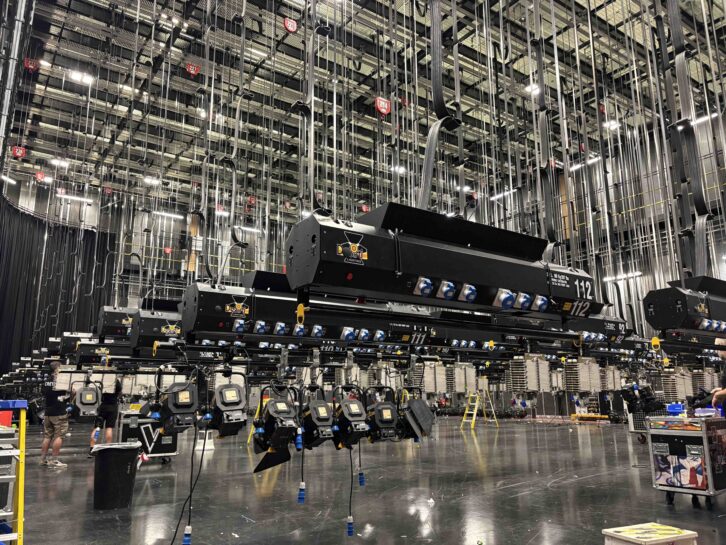
At 12,540 square feet, HQ1 is the largest soundstage in the complex and the largest multi-camera studio anywhere in the UK. The space is big enough to fit Shakespeare’s Globe Theatre entirely within its cavernous walls. In sheer size terms, HQ1 bears an immediate comparison with an aircraft hangar—indeed, it would be possible to park a Boeing 737-100 airliner inside.
Slightly smaller—this one only able to accommodate a World War Two-era B-17 Flying Fortress bomber (the aircraft featured in Masters of the Air)—HQ2 has recently undergone an extensive modification. All of the lights in its 11.5 metre ceiling have been converted to LED units, a programme that will eventually be extended throughout the whole of the facility. The project marks the first time a studio has been completely refitted with LEDs and all of the accompanying infrastructure, and one of the many benefits it will bring is a significant impact on dock10’s electricity costs, which currently stand at a staggering £1.3 million every year. In a win/win for dock10 and the wider environment, the transition will also deliver in sustainability terms.
Across the site, all studios have been designed to enable both traditional and virtual production and the boundaries of what is possible are frequently pushed. Indeed, dock10 seems to relish a challenge. Filming episodes of ITV’s game show, The 1% Club, requires mics for 100 competitors as well as the programme’s host, Lee Mack, a complex logistical feat that entails highly intricate orchestration to ensure everything runs as it should.
Designed with sports production in mind, dock10’s remote gallery solution provides complete control for production teams, whether live from stadiums around the country or at major international events. The innovative facility enables simultaneous management of concurrent feeds from multiple locations, as well as playing-in content.
Last year, dock10 launched an industry-first real-time virtual lighting solution to enable simultaneous control of both virtual and physical lighting via a single DMX console in the gallery. Virtual lighting can be fully integrated directly into sets either before, after or even during filming, handing productions complete creative control over a vast array of lighting options.
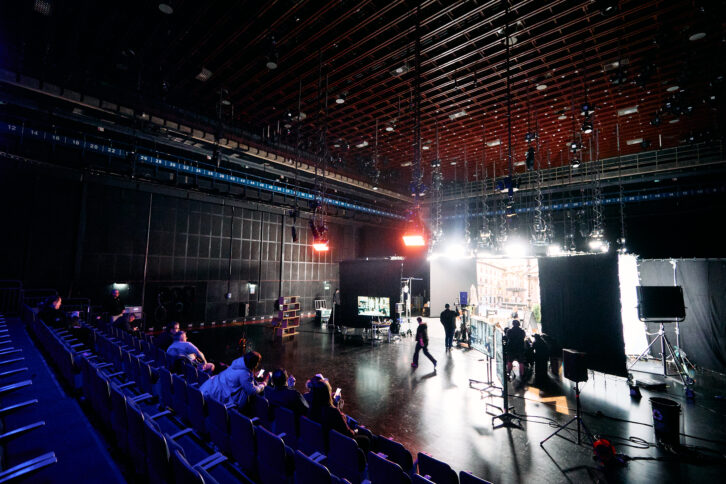
Testing is also currently underway on a multi-camera UHD HDR project for a major UK broadcaster, and the company is constantly looking for new and innovative ways to drive efficiencies in filmmaking. Inevitably, AI is making inroads into dock10’s workflows and some remarkable new capabilities are currently being evaluated.
Each year, more than 3,000 shows are made at dock10, and the site plays host to an annual 200,000 audience visitors. In its decade and a half at MediaCityUK, dock10 has developed a reputation as one of the leading lights in television production, not only in the region, but on the national and international stage.
However, as everyone at dock10 understands, studios cannot exist in a vacuum. In order for them to succeed, there needs to be an established network of support services to fuel the creative process. MediaCityUK, with its open spaces and enviable transport links, was designed to enable the necessary infrastructure to grow. The idea of creating a similar facility in the middle of a major city should be almost unthinkable, but the team at Versa Studios dared to dream.
A few miles away from MediaCityUK, the River Irwell marks the historic boundary between the cities of Salford and Manchester. For decades, a giant of British television occupied a huge concrete edifice by its eastern bank, its broadcasting tower and giant red sign becoming almost as famous as the creations for which it was responsible. Between 1956 and 2013, Granada Studios served as the headquarters of Granada Television. Predating the BBC’s Television Centre by five years, the Quay Street facility housed the oldest purpose-built TV studios in the UK.
The complex was steeped in history. In 1962, it hosted the first ever televised performance by The Beatles and the UK’s first ever general election debate was held there in 2010. However, by 2013 the studios were past their sell-by date. In part a victim of MediaCityUK’s success, production was transferred there and the site was sold and earmarked for residential development. The Mancunian real estate boom was well underway, the city’s skyline changing rapidly and beyond recognition. All expectations pointed towards another giant glass and steel tower.
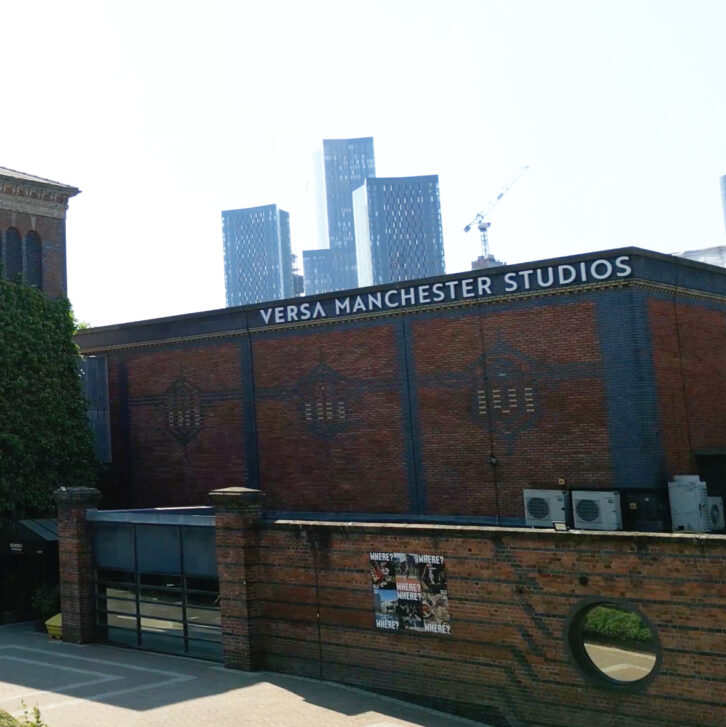
Versa, however, had a very different vision. With remarkable foresight, the company saw the potential in refreshing the entire site. Reopened as an entire film and TV production campus, its city centre location makes it uniquely attractive as a one-stop centre – a self-contained network of amenities and services situated within metres of hotels, restaurants and onward transport links.
In February this year, Versa Studios Manchester opened for business. Blending the latest in cutting-edge technology with some of the studios responsible for such iconic programmes as Brideshead Revisited, Coronation Street, University Challenge and The Jewel in the Crown, its more than 200,000 square feet of production space is “designed to handle any size and type of TV production,” says Versa’s studio and strategy manager, Edward Harvey.
The sleeping giant has not just been awakened, it has been revitalised and repurposed to meet the rapidly evolving demands of a changing industry. The company has returned studios 4, 5, 8 and 12 to use alongside new capabilities in a project that is still ongoing. “All of the galleries were gutted and updated for 4K,” explains Harvey, adding that the entire site, including buildings beyond the original footprint, has been fibre-linked, ensuring robust connectivity throughout the campus and onwards to external networks.
A curious mix of new and old is evident throughout. Studios 12 and 8 retain monopole lighting, with 220 and 140 monopoles, respectively. Trusses can be added as required. Traditional resin floors allow cameras to seamlessly track, although, as Harvey says, “There’s not so much traditional TV as there once was, with focus turned towards a more diverse production slate.” Evidence of the contrast can be found in the 4,300 square foot Studio 6, which handles voice and motion capture as the largest mocap studio in the UK.
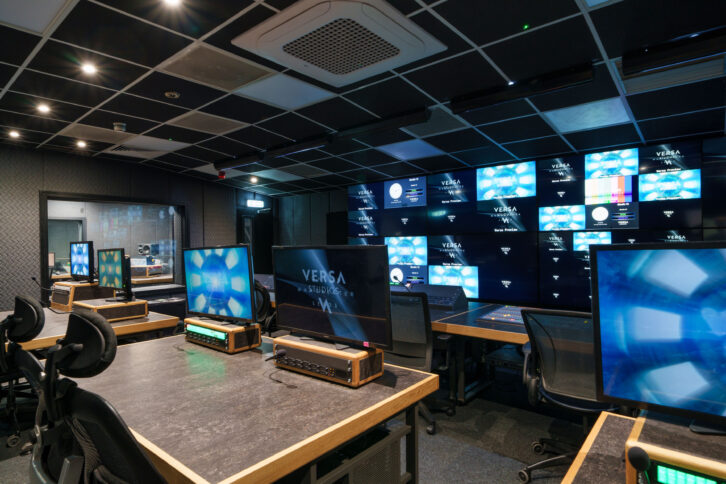
In the galleries, production control is managed by Sony 7000 X Vision Mixers with varying multi-function positions with windows through to sound and lighting control. A combination of Calrec Artemis 48 channel and Brio mixers handle sound control.
Versa Manchester is already creating breakthroughs. Earlier this year, the facility enabled the first virtual production for CBeebies. In collaboration with BBC Studios Kids & Family Productions and virtual production provider Immersion Science, The Great Ice Cream Hunt blended physical filmmaking with digital environments. Synchronising camera movements with the on-screen environment, the production allowed performers to interact directly with the world on-set, creating seamless dynamic shots in real-time. Across the campus, the BBC’s Morning Live programme is based in Versa’s ABC Building and its Campfield Facility is also providing a new home for Blue Peter in a studio created to enable natural lighting.
Sitting at the heart of the St Johns district redevelopment, Versa Studio Manchester’s campus serves as a model for what can be achieved. Once a forlorn derelict due for demolition, the Granada site has returned to the forefront of media and entertainment, with Manchester once again at the centre of a technological revolution.