What impact have the current global uncertainties had on the company’s R&D and product development in recent months?
Broadly, very little. Appear’s development roadmap is deliberately long-horizon: the fundamental engineering we do on our X Platform, including our forthcoming X5 encoder/decoder, and our VX software stack and is measured in years, not quarters. That means short-term geopolitical or macro-economic turbulence does not deflect the team; if anything, it sharpens our focus on resiliency, supply-chain diversity and security-by-design. We have continued to ship new hardware modules, develop our VX software and expand our new UK development hub exactly as planned, because the underlying demand for low-latency, energy-efficient live production technology remains undiminished.
What do you forsee as the biggest challenges in R&D and product development in the coming years?
- Hybrid production at scale. Customers want to move seamlessly between on-prem hardware, private data centre compute and public cloud. Providing this securely and with ultra-low latency across all three estates is a non-trivial but exciting challenge.
- End-to-end timing and latency discipline. The industry still lacks a universally adopted, workflow-wide timing architecture. One of my personal crusades is to make sub-frame, deterministic timing “just work” from camera to consumer, whatever the processing chain.
- Security everywhere. As more Tier-1 live sport travels over public or semi-trusted IP, broadcast needs the same zero-trust mentality IT adopted a decade ago. Embedding encryption, authentication and observability deep in the data and control-planes is becoming table-stakes.
- Sustainable performance. Power budgets are tightening faster than bit-rates are falling. Our job is to keep pushing channel density per watt while giving customers credible lifecycle CO₂ data.
Where do you see the most opportune areas for innovation, and what tech/solutions will drive that development?
- Open, software-centric live production. Broadcasters increasingly ask for best-of-breed micro-services they can orchestrate themselves. VX is our answer: a modular framework where transport protection, transcoding and production tools can be spun up as required, on-prem or in the cloud. Industry efforts such as EBU’s Media eXchange Layer (MXL) will enable and accelerate that shift.
- Location-agnostic remote and distributed production. With high-density edge encoding (our X-series) feeding software production back-ends (including our VX software platform), a single centralised production team can cover multiple events in a day, slashing truck miles and energy use. Compression efficiency (HEVC, JPEG-XS) plus private-5G/LEO back-haul are key enablers.
- Flexible commercial models. Event-driven workflows need event-driven licensing. Our solution portfolio marries perpetual hardware with elastic VX licences so customers “pay for what they use” without sacrificing broadcast-grade reliability.
What are you working on right now that excites you, and what can we expect to see at IBC 2025?
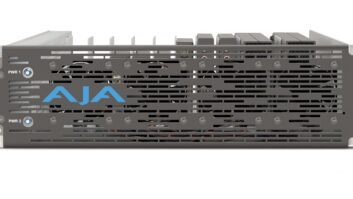
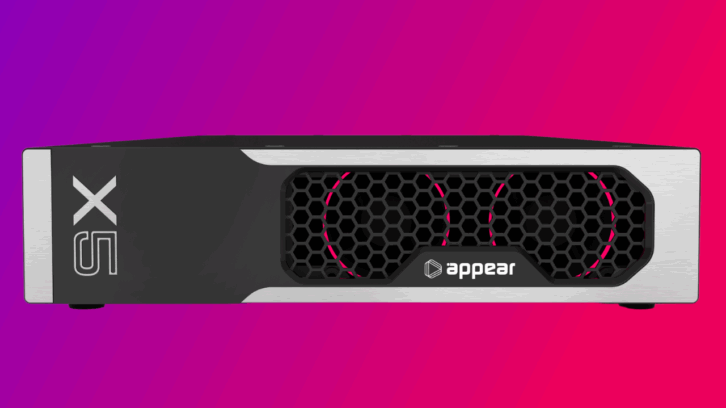
- X5 — small-form-factor, half-rack encode/decode. Built on the same silicon as X20 but optimised for the ~four-channel remote-production sites, X5 brings ultra-low-latency HEVC/JPEG-XS, integrated SRT, genlock and BISS-CA decrypt into a backpack-sized unit. It’s the perfect “every day carry” for tier-2/3 sport, esports and VAR where density and price are as critical as picture quality.
- VX Media Gateway Phase 1. First VX release delivers protected multi-gigabit transport with seamless switching and accelerated SRT in software and we’re developing a full future roadmap with transcoding, colour-space/frame-rate conversion and AI-enabled monitoring all running as containerised VX apps.
- Estate-wide orchestration and timing. Behind the scenes, we’re integrating estate-management and precise timing tools across X and VX so operators can deploy, licence, monitor and time-align hundreds of devices from a single pane of glass.