I was fortunate to join Elemental Technologies as a software engineer in 2008, helping our customers integrate our GPU-based encoding technology into their applications. We had a North Star goal of Elemental software powering 90% of the video on the internet. That may seem like a lofty ambition today given the pervasiveness of internet-delivered content, but video streaming was still in its infancy then.
We had an idea of where trends and technologies were headed and did our best to create solutions that would support those initiatives. Now, I’m proud to say AWS Elemental Media Services, in some capacity, power many of the world’s most important live, large-scale streaming events globally, including the Super Bowl, World Cup, Olympics, Formula 1 (F1) races, and Wimbledon.

Our ability to continually innovate and deliver at scale is directly tied to Amazon Web Services (AWS), which acquired Elemental in September 2015. Heading into IBC 2025, we’re marking ten years of AWS Elemental, and in recognition of that milestone, I was inspired to look back on what we’ve achieved and how the industry has evolved in that time.
Right vision at the right time
When Elemental was founded in 2006 by Sam Blackman, Jesse Rosenzweig, and Brian Lewis, streaming video to the internet was just starting to become important. Then, smartphones came onto the scene, closely followed by the iPad (and other smart tablets). All of a sudden, there was tremendous demand to deliver content to mobile devices. Elemental’s GPU-based encoding appliances and software were particularly well-suited to creating adaptative bit rate (ABR) streams.
I remember Jesse handing me the first iPad right off the delivery truck, and within minutes I was running a full 1080p ABR live stream to it from the camera sitting on my desk, to the delight of all my co-workers seeing the future of TV. Within a couple of years, we also realised the cloud would be crucial for scaling these workflows.
Better together
Leading up to the 2015 acquisition, we had in-depth discussions with AWS about what we could accomplish as a unified team that would otherwise be unfeasible. We brainstormed and envisioned the next evolution of video streaming supercharged by the cloud, and a lot of those ideas have become realities in the last ten years. One of our main goals from the beginning was to enable personalised ad insertion for large streaming audiences. Ten years ago, content owners would try to do this with on-premises hardware and quickly run into networking and compute bottlenecks. They needed access to infrastructure to support millions of viewers, but only a few times each year, so it didn’t make sense for them to buy infrastructure for maximum capacity.
We launched AWS Elemental MediaTailor as the solution to this scalability problem, combining the video format expertise of Elemental with the scalability of AWS. Now, AWS Elemental MediaTailor supports personalised ad insertion for the biggest live events, even with upwards of 60 million concurrent viewers. Another key goal we discussed and executed on was to facilitate the global transport of video feeds on the AWS network.
Video transport had largely been handled by dedicated circuits, satellites, or terrestrial transmission. We envisioned using the robust global IP network of AWS to help our customers move video in and out of the cloud and easily share with distribution partners. Today, IP delivery of video streams is quickly becoming the de facto video transport mechanism, opening new possibilities for content providers.
When Elemental and AWS joined forces, it was a natural cultural fit for our teams. We found our core values to be very closely aligned. Going the extra mile for customers is inherent in AWS culture and that maps perfectly to the Elemental focus on customer centrism, as well as innovation and integrity. We’ve also been able to celebrate our legacy in community investment. Elemental always made time and space for employees to volunteer with organisations that make a difference in our local communities, and we’re proud that Amazon has scaled these practices to our worldwide workforce.
Major milestones
Post-acquisition, our first order of business was to accelerate our development plans and build cloud-native tools. In 2017, we launched the first AWS Elemental Media Services, which included AWS Elemental MediaConvert, MediaLive, MediaPackage, MediaStore, and MediaTailor. Instead of doing a lift-and-shift of appliance-based software into the cloud, we went back to first principles of video processing and cloud software development to make a purpose-built suite of services that were easy for customer to manage, scale, and right-size their cost to their exact workload.
The following year, we debuted AWS Elemental MediaConnect for transporting live video. It reliably transports video into, around, and out of AWS with low latency, and elastic costs that beat fixed infrastructure like satellite or fibre. Collectively, these tools enable customers to easily scale channel counts and event hours to reach hundreds of millions of people, without infrastructure overhead. We built resiliency straight into the platform so that our customers can achieve hot redundancy as part of as the standard mode of operation. As a result, media companies have fundamentally changed how they create, produce, deliver, and monetise content with these tools.
In 2020, we made it easier to connect live video to the cloud with AWS Elemental Link, which provides an SDI on-ramp to the cloud. It allows customers to send signals from cameras into the cloud for processing and distribution. Later, we launched a UHD version of Link, making pristine UHD streaming accessible to anyone with a dramatically lower up-front cost. We also released AWS Cloud Digital Interface (CDI) in 2020, enabling the lossless transport of uncompressed video inside AWS, unlocking more production workflows.
Over the years, we’ve added many features designed to help content providers deliver the best possible viewing experience. Notably, this includes Quality-Defined Variable Bitrate (QVBR) encoding, which dynamically optimises bitrate based on content complexity to deliver the highest video quality while limiting per-byte distribution cost. In 2024, we became one of the first cloud providers with live AV1 encoding. This video codec requires lower bandwidth and storage than other codecs that offer similar video quality and supports advanced formats. It helps customers reduce bandwidth and content delivery network (CDN) costs, while providing unmatched video quality for viewers with low-bandwidth internet connections.
Exciting customer moments
Seeing what our customers achieve with our technology remains one of the most rewarding aspects of my work. Executing the first 4K UHD stream of the UEFA Champions League final with BT Sport in 2017 is definitely memorable. I spent many long hours with the BT Sport team making sure everything worked, and they were able to deliver a new immersive experience for a world-class streaming event. We also supported the UEFA Euro Finals in 2020 with BBC, which was watched by 25 million people, as well as many other high stakes international events.
Supporting Prime Video to broadcast Thursday Night Football (TNF) for the National Football League (NFL) is another key highlight from the past decade. Prime Video started streaming TNF in 2017 as an extension of the primary over-the-air broadcast feed. Based on that successful engagement, Prime Video earned exclusive rights for TNF and began managing the whole production and broadcast in 2022. The NFL is one of the premier television properties in the United States, and the fact that we were able to build a video delivery platform with enough resiliency that the league was willing to move to exclusively streaming is a massive accomplishment, not to mention a vote of confidence in the cloud.
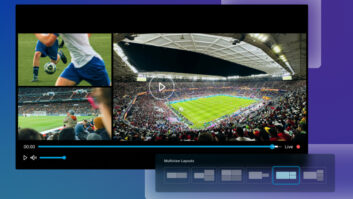
Most recently, F1 launched its new F1 TV Premium streaming service built on AWS Elemental Media Services. Fans can fully immerse themselves in racing and watch every F1 Grand Prix, F1 Sprint, and Qualifying and practice session live in 4K Ultra HD/HDR. We’ve helped them build a new multiview experience with unique user-driven camera angles and viewing selection.
Coming full circle at IBC
As one of the core places we’re able to meet with a wide range of customers in one spot, IBC has been an important event for us since the beginning. We’re able to hear firsthand about our customers’ business challenges and discuss aspirations, and these interactions inform our roadmaps. In many ways, the evolution of our IBC stand reflects our AWS journey.

Looking to the future
Consumer behaviour is vastly different than just a decade ago, in part thanks to video streaming. Content providers are diversifying from traditional broadcast or linear TV and are looking to experiences that enhance the traditional picture, whether in the form of a second-screen app, alternate broadcasts, or personalised feeds. Technology underpins these advancements and AWS Elemental is focused on making it broadly accessible. Combined with AWS services and solutions, AWS Elemental technology is already powering next generation broadcast experiences, enabling content owners to monetise while engaging viewers with meaningful content.
I imagine the next decade of AWS Elemental will also entail the continued advancement of live cloud production. Many distribution workloads are already done in the cloud, but production largely remains tethered to specialised on-premises equipment. As that gear ages out, production professionals will find that the cloud is not only a viable solution for key workflow aspects, but that it also drives new efficiencies. AWS CDI is one important step for this, as is Network Device Interface (NDI) support, which we launched in AWS Elemental MediaConnect earlier this year. This enables customers to ingest live video to AWS and convert it to NDI for use in a virtual private cloud. The cloud also provides easy access to AI-enhanced workflows, which are rapidly reshaping workflows across industries, including video streaming.
As part of our celebration of ten years of AWS Elemental, we’ve put together a fun timeline that will be featured in the AWS IBC stand (5.C90). Come visit us in the stand and talk to our experts. We’d love to hear what you have been working on and what you want to build next with AWS Elemental.