The Video Services Forum has released the specification for RIST Satellite-Hybrid: In band method.
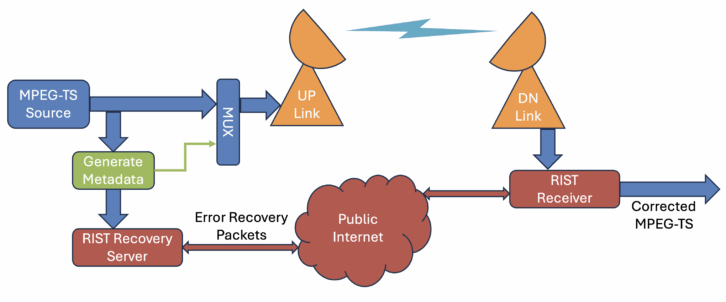
Updating its Reliable Internet Streaming Transport (RIST) Protocol, the Video Services Forum (VSF) has added a new feature. RIST Satellite-Hybrid: In band method can augment satellite distribution, using the internet as a mechanism to recover data either lost or corrupted in the space segment.
The feature creates a mechanism to use the satellite (or similar unidirectional one-way MPEG-2 transmission methods, such as DVB-T) as the primary distribution channel with RIST as backup recovering data lost or corrupted between the satellite and receiver. Recovered data is retransmitted over the internet to the locations that need it. Backward-compatible with legacy technology, the method requires the insertion of a small metadata stream into the transmission before it is uplinked to the satellite. Full details are available in TR-06-4 Part 7.
Commenting, Rick Ackermans, chair video services forum – RIST activity group, said, “With its wide reach, satellite, and most commonly C-band, is widely used by broadcasters to send the same content to many receivers at different locations. Yet, as a result of the recent US legislation authorising the FCC to reallocate more of the remaining C-band frequencies to non-television applications, many broadcasters will be forced to use an alternative band, namely Ku-band, which is highly susceptible to rain fade. The RIST Satellite-Hybrid: In Band Method addresses this problem by providing broadcasters with a method to recover lost data over the Internet using RIST.”
The RIST protocol provides an open, interoperable and robust solution for low latency video contribution delivering reliable transport over unmanaged networks such as the internet, with technical recommendations freely available from the VSF website for all to download and use.