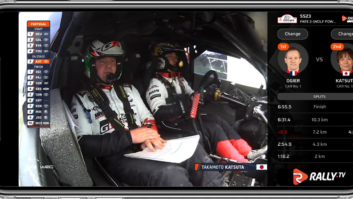
Viewing habits are constantly changing, and while some trends come and go, sports fans are increasingly engaging with multiview: the ability to watch multiple live events or camera angles simultaneously on a single video. Whether it’s parallel matches at a tournament or different camera angles of the same event, multiview has evolved from a novelty feature to a viewer expectation.
The trend is firmly established, with industry research suggesting that around 80 per cent of people watching live TV also engage with a second screen. During the Paris Olympics, for example, more than a quarter of viewers on Peacock watched via multiview, with half of that time spent on the featured live events and the other half on a quad box configuration. Whether it’s features such as alternate camera angles, onboard footage, body cameras, live statistics or interactive viewing experiences, among others, the options are compelling for broadcasters seeking to retain engagement.
Consider events such as Wimbledon, which align perfectly with the multiview concept, as numerous matches take place concurrently each day. Indeed, there is barely a major event out there that isn’t embracing multiview in some form in order to meet audience expectations, with broadcasters focused on keeping viewers engaged on their own platforms for longer.
The battle for eyeballs
And herein lies a major part of the challenge. At present, viewers frequently leave the primary live feed to access third-party apps, social media platforms, watchalongs, or simply to keep track of parallel events occurring at the same time. This represents lost engagement and eroded value from rights investments. The challenge becomes delivering multiview consistently, at the scale and quality viewers expect, across events that vary wildly in size and audience.
The good news is that the enabling technology driving multiview experiences has advanced considerably in recent years. For instance, traditional broadcast infrastructure was not always well suited to highly dynamic multiview environments, particularly during major live sporting events, where the number and combinations of simultaneous matches can change rapidly.
The solution lies in infrastructure engineered to cloud-native principles. Broadcasters need systems that deliver both agility and precision: the flexibility to deploy dynamic multiview configurations on demand, paired with broadcast-grade reliability.” The use of software environments enables multiview services to be deployed dynamically for live events on-prem or in the cloud, rather than relying on permanently allocated infrastructure.

This is particularly relevant for sports tournaments where the number of simultaneous matches, viewing combinations and audience priorities can change rapidly. In these circumstances, broadcasters can deploy additional multiview configurations only when required, rather than maintaining dedicated infrastructure continuously and, by definition, incurring unnecessary cost.
That same kind of operational flexibility also supports more regionalised or audience-specific viewing combinations during international tournaments. This is increasingly important as broadcasters look to balance the pressing need to deliver more immersive experiences with operational efficiency.
In some events, for example, viewer engagement can vary dramatically depending on how well national fan favourites or international superstars are progressing. If certain participants exit a tournament early, the broadcaster may not subsequently require the same multiview resources as in a situation where the same athletes progress to the latter stages.
Whichever way you look at it, multiview is here to stay. The broadcasters who give viewers richer, more engaging ways to watch will earn their loyalty, and those who can deliver these experiences efficiently, scaling on their own terms, will be best placed to keep them coming back.