Established in 1916 as the Society of Motion Picture and Television Engineers, SMPTE has published more than 800 technical standards and related documents for broadcast, filmmaking, digital cinema, audio recording, information technology (IT), and medical imaging over the past 100+ years.
Appointed as the organisation’s president in January, Richard Welsh is the latest in a long line of media technologists tasked with guiding SMPTE as it navigates the ongoing changes within the industry, including the move from hardware to software, and the rise of artificial intelligence.
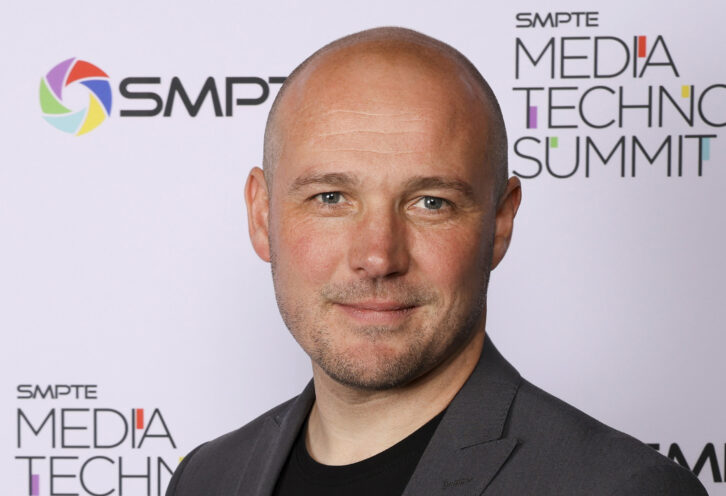
“We’re still very much an international standards development organisation, which is how we started,” explains Welsh, “but what I think is really cool about SMPTE is that over and above that we’re a really amazing technology community, and it’s all about developing talent and bringing the community together to learn from each other across all the different areas of technology that we’re touching in media.”
Welsh describes SMPTE’s membership as a “very broad umbrella” open to broadcasters and vendors alike. “A transport protocol like SMPTE ST 2110 is implemented by vendors, but it has to be architected by broadcasters,” he explains. “Both parties have to work together to do that because you don’t use one piece of hardware that does everything.”
Even before being appointed president, Welsh was involved in engaging new members not just in the United States or UK but around the world. One of SMPTE’s biggest areas of expansion currently is in India, which Welsh hopes will become its own section within the SMPTE membership. “Similarly, with the UK and Europe, we are seeing an increase in membership,” he adds.
In the UK, currently the fastest-growing region in SMPTE, there’s been a push to reach out to members outside of London with meetings and events taking place in Manchester and Leeds. This has been driven by members of SMPTE who volunteer to run the events. “In each region, you have to find people who are enthused and active and can give time to it, and nurture that local community to bring it together,” states Welsh.
He cites the events being held outside London as a good example of members who want to bring their local media technology community together, under the wider umbrella and resources of SMPTE. “On a global level, the network is amazing. I want to see us build on that, and take advantage of the fact that we have these incredibly dedicated individuals who are putting their time and energy into SMPTE for the good of SMPTE and the good of the community. We need to recognise it and build on it. That’s how we will increase our international activity and also make us feel more global. That’s not to say we’re not a global organisation. We absolutely are, but it can feel US-centric.”
The future of 2110
SMPTE officially ratified 2110, its standard for video, audio and metadata over IP networks, in 2017. But, like any standard, it hasn’t stood still since ratification. Not only is 2110 seeing adoption in traditional broadcast workflows, but the AV industry is finding uses for the standard as well. Welsh cites the Sphere in Las Vegas, which is using 2110 to sync all the servers for its 16K x 16K screen. “It’s the only protocol they could make work for such a complex and critical environment. You can’t have any slip there, because it’s going to immediately be a problem for the audience.”
But while some broadcasters and venues are embracing 2110, full adoption across the broadcast industry remains slow. “Adoption is always one of the challenges. You can write a standard, but it doesn’t always go the way that everyone just starts using it,” he admits. “I guess the nervousness covers some real concerns around reliability, robustness and security effectively.”
Asked what his message would be to broadcasters who are nervous about adopting IP, Welsh says he wanted to encourage them to get more involved with SMPTE and help make the standard fit their needs. “If there are gaps, then help us make the standard better. If it’s something more than that and there’s a bigger conversation, again, SMPTE is a great place to have that, because we bring together all these different members of the community, the vendors, the content owners, even the creatives.”
Another challenge for SMPTE is moving to a more modern way of developing, publishing and maintaining standards. 2110 is in what Welsh describes as a “maintenance and development phase” where it can be used but also evolve along with the industry. “Any standard is going to keep developing. I think the way in which we develop them will also keep evolving.”
It’s not just standards that are evolving, the way viewers consume content is undergoing fundamental change, and then there’s the rise of immersive technologies such as extended reality and virtual reality. With the likes of IPMX emerging as a standard for the AV industry, Welsh says there are opportunities where it and 2110 can exist side by side. “They have 2110 embedded in there as a timing protocol along with PTP. I think evolving it towards these next-generation formats that effectively will become more common for the consumer is absolutely a place that we’ll see it move towards.”
The AI space race
No conversation about the current state of the media tech industry can fail to mention artificial intelligence. With the proliferation of software technology, the adoption of AI into workflows is becoming much easier. Welsh describes the current state of AI as a “space race” with almost every vendor using or experimenting with the technology. “Often we’re using AI without really thinking about it in some areas. This is caveating that AI is a very broad term, including machine learning, deep learning and so on,” he adds.

“The point is, how do we get hold of some of these things and make them practically useful? Where are the use cases that actually make things better for us? Where do we genuinely get efficiency, time savings, quality improvement, cost savings? It feels like we’re in that phase right now. Everyone’s figuring out what they can really do, what are the limits, what do we do to actually improve the models in ways that help us get what we want out of them?”
Narrowing down that focus on AI to establish how it can be useful to the broadcast industry could also lead to standardisation, as both vendors and content creators look for a single way of training models, which Welsh sees as an opportunity for SMPTE. “The other area, which is one of our big parts of SMPTE, is education. We have people who, like myself, when we’re not doing SMPTE, are working on AI all day, every day. I can’t imagine a space where I’m not thinking about it, to be honest, and I am not unique. There are absolutely hundreds and hundreds of SMPTE members who are actively spending most of their time working on AI, and thousands of SMPTE members who are affected by it every day. So it’s a great forum for education, and it’s a good place for people to come, not only to figure out their own challenges but as an industry to do it together. We don’t want to do anything in a vacuum.”
The future
Asked to gaze into his crystal ball and predict where SMPTE and the adoption of 2110 will be at the end of his presidency in late 2026, Welsh says he hopes many more broadcasters will have made the move. “It’s a bit like the cloud in that it’s not a slam dunk,” he admits. “You can’t just lift and shift all of your operations into the cloud without thinking about it, but I think it’s going to become just another technology tool, and the same with IP.”
He also hopes the SMPTE membership will be more diverse, with companies from the AV sector finding a home within the organisation. “We briefly touched on IPMX, and that’s very big in AV. We have companies that cross over AV and broadcast as members, but we’re not huge in the AV community. I think we have a lot to offer that community.”
Another key area Welsh wants to focus on is education and the skills shortage within the industry. SMPTE already works with organisations such as Rise Academy to help inspire the next generation of talent. “I’d like to see a younger, more diverse membership, giving us that next generation of talent, and taking SMPTE forward in the way that it needs to so it can be around for the next 100 years. Because realistically, they’re the ones who, at some point, will be the leaders and take it all forward.
“They’re the ones who deal with these practical technology challenges every day and I’d rather have them in the conversation driving what we do with the technology standards than someone who used to do it but has been elevated, like myself, out of that level. So a younger, more diverse, broader membership and a bigger membership would be great.”