Is SDI dead? That was the first question of TVBEurope’s webinar exploring the broadcast industry’s move from SDI-based systems to IP-driven production environments.
According to the panellists, SDI isn’t completely dead, as it is still a large part of many broadcasters’ facilities. However, the industry is seeing new building favour the move to IP. “There is so much SDI infrastructure out there in the world right now that it’s easy, it’s cheap, it’s not going anywhere,” said Ben Ratner, global sales solutions specialist at LiveU.
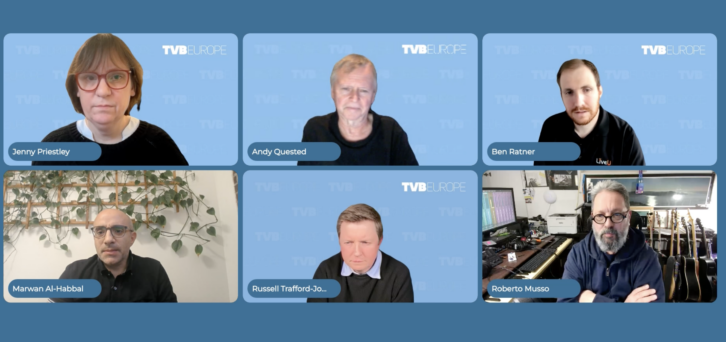
“There’s a million benefits to IP, which is what this [webinar] is about. But SDI is such a backbone of how video works right now that I cannot imagine it going anywhere.”
How IP reduces costs
Asked where they think the adoption of IP is having the biggest impact, the panel all agreed it’s live production. Roberto Musso, NDI’s technical director, discussed how software-defined live production significantly reduces the economic cost of creating new outputs compared to expensive hardware-based workflows. “Every time I want to create something new and create a new output, I need to consider the cost,” he explained. “So if I want to create a new output with a hardware-based workflow, it’s going to [cost] many times more than a software-based solution. This is where the combination of IP production and software-defined has real value.”
As broadcasters utilise software both in the cloud and on local servers for efficiency and scalability, gaps are emerging, said Russell Trafford-Jones, Techex’s industry engagement manager, and the Media eXchange Layer is designed to bridge those gaps: “Simply put, MXL is the SDI of the IP world,” he added.
“We shouldn’t have to worry about who’s got MXL. If they’ve got it, then it works just like SDI.”
Once a broadcaster or facility has made the move to IP, they’re “immediately scalable,” said Ratner. “More people can work with your content. Your producers, editors, anchors and marketing team—everyone has access to the content now, and they can do with it as they need.”
Taking a newsroom as an example, Ratner said broadcasters can use the same feed for their 6pm broadcast and livestream it. “So when that two-minute package is over, you still have that entire stream available for your viewers online.
“In theory, you could have done that with an SDI workflow and baseband, but it’s just so much easier once those feeds are in the IP world.”
Synchronous/asynchronous interconnects
The webinar also took a deep dive into the architectural differences between traditional broadcast engineering and IT frameworks. Marwan Al-Habbal, senior manager, product management and applications at Matrox Video, explained how traditional broadcast chains (SDI, ST 2110, NDI, SRT) operate in a real-time, synchronous “drumbeat” locked to a master reference clock, with every hop representing a fixed frame of latency, providing complete determinism but high rigidity. However, enterprise IT networks operate asynchronously, with sources and destinations exchanging data packets as fast as possible without rigid frame-locking.
The industry’s challenge, said Al-Habbal is to harmonise these IT-native asynchronous efficiencies with the strict real-time monitoring and predictable outcomes required by live broadcasters and live audiences.
The panel also discussed how a live production facility will look in five years’ time. According to Andy Quested, international production and accessible media standards consultant, there won’t be a huge change from now: “If you said ten years, it would be totally different, but I think the time scale is quite important here. It’s a progression. We’re not going to track everything out at once.”
The full webinar is available to watch on demand here.
Thank you to our sponsors LiveU, Matrox Video, NDI and Techex.