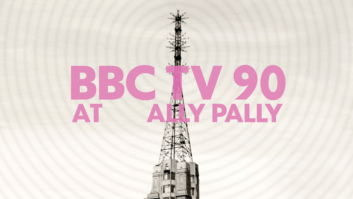
Television has produced and inspired many enduring images over its 100-year history, many of which continue to define the technology today. A classic example is the transmitter tower at Alexandra Palace (aka Ally Pally) in north London, from where the BBC began broadcasting the world’s first regular high definition TV service in 1936.
To mark this, Alexandra Park and Palace Charitable Trust is holding a season of events under the umbrella of BBC TV 90 at Ally Pally. This began in September and runs until 18th November. Among the highlights are the unveiling of a World Origin Site Plaque to commemorate the start of BBC TV transmissions and a talk about John Logie Baird and the Baird Television Company at Alexandra Palace (both 2nd November), presented by his grandson Iain Baird, former curator of television at the National Media Museum in Bradford.
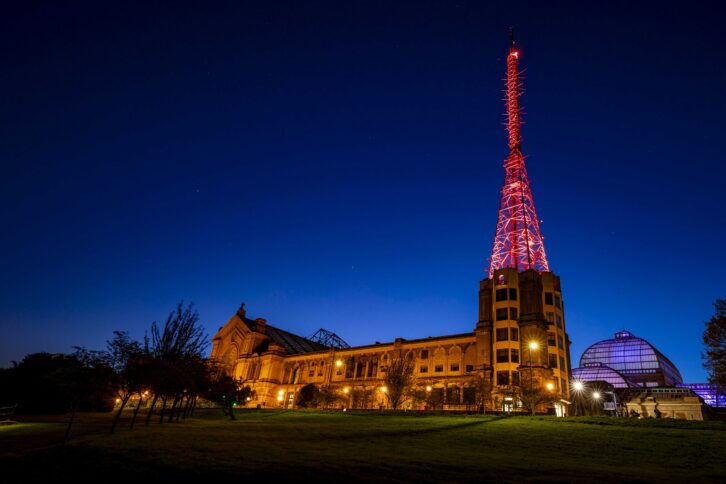
Kirsten Forrest, curatorial and interpretation manager of Alexandra Park and Palace Charitable Trust, says that the aim is to illustrate how the site gave the first TV producers, presenters, performers and engineers the right environment to create programming styles, production techniques and technology that can still be seen today. “There was no playbook, they were making it up as they went along,” she adds.
Alexandra Palace opened in 1873 and is named after Alexandra of Denmark, wife of the then Prince of Wales, later King Edward VII. The intention was to create a “Palace of the People” but this was short-lived when fire broke out 16 days after the inauguration, destroying the building and killing three staff. A newly designed Palace reopened in 1875, housing a theatre, concert hall, art galleries and what Forrest describes as “first, second and third class” dining areas.
By the time the BBC was looking for somewhere to house its TV operation and test the competing systems developed by Baird and Marconi-EMI, the Palace was severely dilapidated. After inspecting the premises in 1935, Baird technician Desmond Campbell—later the BBC’s head of television lighting at Ally Pally—said he found “an old tyre, no roof, no doors and I could see the sky”. He added that the smell of cat in the old banqueting rooms “nearly made me sick” and the whole place “looked the most dreadful mess”.
Forrest comments that the Palace had “always suffered from a boom-and-bust economy”, with the decrease in the amount of leisure time available to people from the late 19th century into the early 20th affecting business. “By the 1920s the dining rooms fell into disuse and when the BBC came the trustees were desperate for someone to lease them to,” she says.
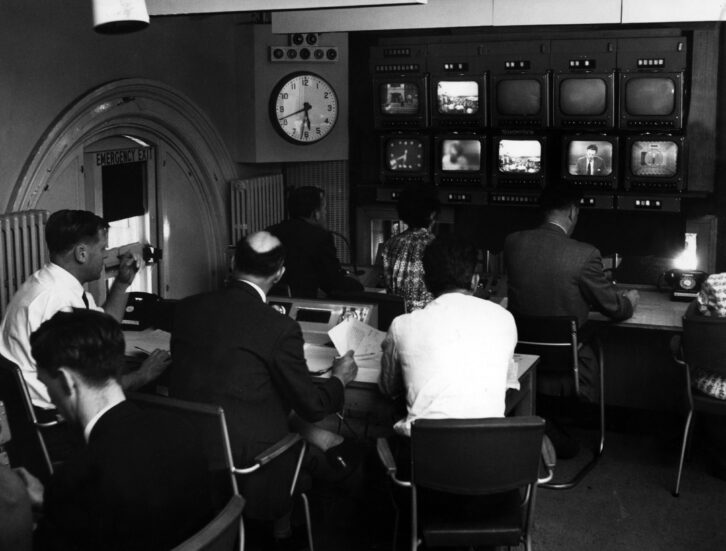
The BBC carried out early TV broadcasts from Broadcasting House when it opened in 1932, utilising Logie Baird’s 30-line mechanical system based on the Nipkow spinning disc. Baird had demonstrated live TV pictures in 1926 and founded Baird Television Ltd in 1930, transmitting from various sites, including Crystal Palace.
Electronics engineer John Thompson, who grew up near Ally Pally and is chairman of the Alexandra Palace Television Group (APTG), says Baird and his mechanical approach “did a superb job” in establishing a TV system but when Marconi-EMI developed its electronic alternative, with a mighty 405 lines, it became clear the older technology “was probably not going to be the long-term future.”
Thompson explains that the Selsdon Television Advisory Committee, set up by the Postmaster General in 1934 to determine the future of HDTV services, eventually set 240 lines as the minimum requirement. “A site was looked for to house two different television systems [Baird and Marconi-EMI] because, for the first few months, there was going to be a technical and operational trial of the two technologies,” he says, “so it could be shown to be a competitive environment and that the contract wasn’t awarded just to Marconi-EMI”.
Various locations were considered, including Crystal Palace and Hampstead Heath, but Alexandra Palace was selected, because, Thompson says, its position and elevation would give “a better spread and pick up the best coverage of the population.” It also, he adds, had the advantage of enough space to accommodate the two systems, which were set up in the southeast wing that had housed the banqueting halls, and tea and coffee rooms.
Alexandra Palace was announced as the base for the ‘London Television Station’ on 3rd April 1935. Work then began to build the control rooms and studios for Baird Television and Marconi-EMI, which were completely self-contained so that neither side knew what the other was doing. By early spring 1936, the two teams—with Marconi-EMI’s led by Isaac Schoenberg and also including Alan Blumlein, the inventor of stereo sound—had begun their respective tests in preparation for both a demonstration transmission to the Radiolympia exhibition in August and the start of services proper on 2nd November…
View the rest of this article in the October/November issue of TVBEurope, available to download here.