Sennheiser has revealed details of its work to support the 70th Eurovision Song Contest, which included the largest deployment of its Spectera solution to date.
Working in collaboration with host broadcaster ORF and technical production company, Agorà, Sennheiser’s technical application enginering (TAE) team arrived at the Vienna Stadthalle to support the wideband systems deployment and its workflows.
Commenting, Valerio Motta, Eurovision Song Contest (ESC) project lead, said, “Eurovision is a fast-paced, dynamic, and highly demanding production. Everything feels calm as long as everything works, and having Sennheiser involved in such a delicate project made the entire audio team feel supported and confident. We all knew that even if any issues had come up, which they didn’t, the manufacturer’s support would have been there to help resolve them in the best possible way.”
The Stadthalle’s sound room handled mic audio, IEM audio, artist audio preparation and audio distribution to the OB vans parked at the rear. Failsafe was key to the event, with the sound room accommodating two independent mixing desks, each with an operator. The failsafe ethos drove the deployment of six Spectera Base Stations. Four were active for audio and control data working on a single RF channel each while another was exclusively dedicated to 24/7 spectrum scanning. The last unit was held in reserve as a spare.
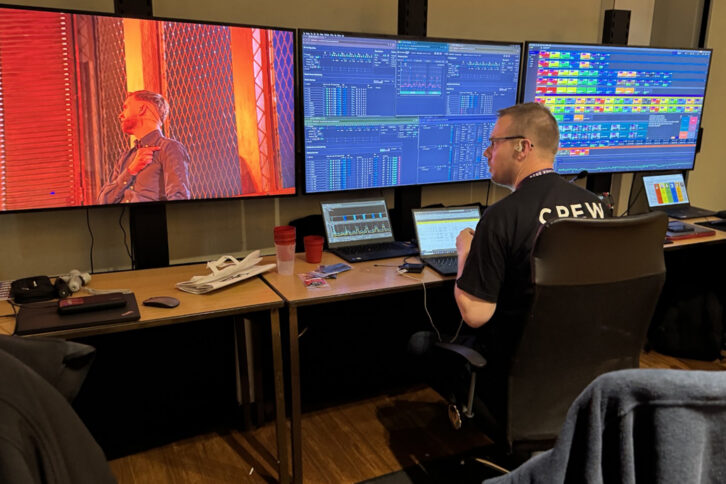
“The requirement of ORF was nicely simple and short: ‘We need coverage in the entire venue.’,” explained Volker Schmitt, manager technical application engineering at Sennheiser. “We started out with two Spectera DAD antennas at stage right and green room left for each Base Station, and that gave us full transmit and receive power for the hall. For extra reliability, we then added another two antennas per Base Station. Also, a firmware variant especially for the event had given us a preview of upcoming functionalities that were needed on site, such as a level recorder.”
A full overview of the current status of the Spectera wireless microphones and in-ears was provided by an RF control centre in the sound room, via Spectera WebUI and the Sonoros app.
A fibre run from the sound room to FOH was employed, converting back to copper using standard IT converters. The cabling ensure full performance from the remote antennas, without the compromise of RF-over-fibre systems associated with conventional wireless. Additionally, Spectera DAD antennas were placed behind the stage, ensuring coverage when artists entered the stage from behind the video wall.
A new handheld solution
With just 42 seconds to change over between acts and a maximum of six people on stage per act, the team provided a mic rotation of six Spectera handhelds, an in-ear rotation of six Spectera SEK bodypacks working as in-ears only, and an ‘all-in’ rotation of six Spectera bodypacks with headsets mics and in-ear monitors.
Sennheiser’s Jonas Naesby commented, “For the artists who opted for a hands-free solution, we used the bidirectional Spectera bodypack with a cardioid Headmic 4. This mic contributed prominently to the overall sound quality, performing extremely well in front of the PA and wind machines. For those who preferred a Spectera handheld mic, we had brought the soon to be released Neumann KK 105 A capsules. This is a super-cardioid model to get less pick-up from adjacent sound sources and the room.
“Really, the only two things, where a dual set-up doesn’t work, are the artist, and the microphone in their hand, making it the single most important piece of equipment in the signal chain. The Spectera handheld SKM quickly proved to be the perfect solution. The unmatched RF stability of wideband transmission, combined with multi-antenna capabilities instantly provided confidence to the production that ORF had made the right choice of bringing these pre-production samples to a show of this calibre.”
Full circle
The event marked something of a full circle for Spectera, as WMAS developer at Sennheiser Jan Watermann explained, “It was actually at the ESC in Copenhagen in 2014 when fading problems required me to develop some software fixes for Digital 9000. A former shipyard had been chosen as the ESC venue, measuring 160 metres by 160 metres, everything made of metal. No RF would work in that environment. No comms radio, no police radio, no radio networks of any public authorities. We got Digital 9000 to work by employing special filters and optimising antenna positions.
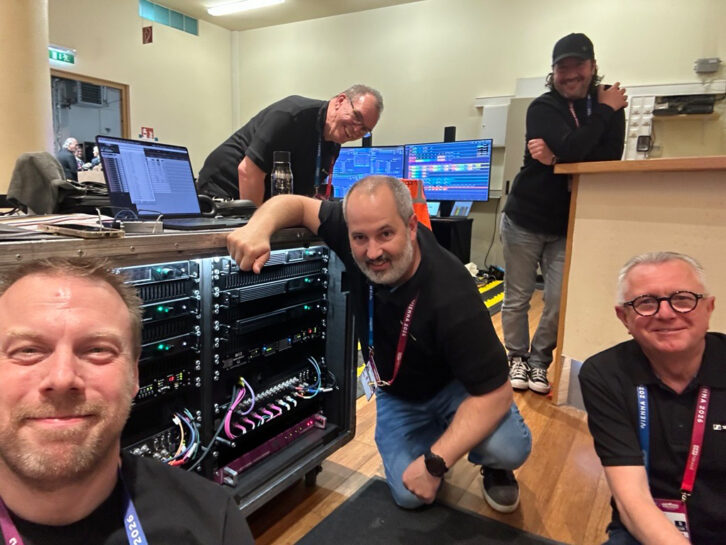
“You can actually say that the ESC was the birth of Spectera, because it was there and then that we decided to address the fading issues from a totally new angle. With standard wireless, you can set up more antennas, but that does not solve the underlying problem: the fading notches and cancellations. We wanted to eliminate those at the root.”
Spectera’s development also resolved the issue of clock synchronisation of digital systems. Watermann continued, “Standard digital microphones have an internal clock, which simply starts transmitting. Even though the sample rate of the mics is the same, they aren’t perfectly in sync. To be able to output them together, I would have to convert them all individually, because I can’t tell the microphone to go slightly faster or a little bit slower; it just transmits, and you have to process the signals as they arrive.”
Eliminating the problem, Spectera enables the internal clock of the mics to be synchronised, streamlining workflows and allowing exceptional audio performance for artists and audiences.
“Spectera made life easier for everybody,” said Schmitt. “For the talent, who were impressed by its fantastically clear, spatial in-ear sound and who had just one bodypack to hide in their costumes when using a headset mic. For the dressing/undressing team, who were happy that there was just one bodypack to fit into the costume, and last but not least for us, as Spectera is providing us with essential health data.”
The Spectera Eurovision 2026 deployment featured:
- 4 x active Spectera Base Stations, using one RF channel each
- 1 x Spectera Base Station for scanning
- 46 x Spectera SKM handheld microphones with Neumann KK 105 A super-cardioid capsules
- 101 x Spectera SEK bidirectional bodypacks
- Headmics 4 (cardioid)
- IE 100 PRO in-ears and EK 2000 IEM bodypacks for the orchestra and dancers (openings and intervals)
Main image courtesy ORF