As virtualisation and content requirements have advanced and expanded, it was surely inevitable that the concept of a cloud-based Master Control Room (MCR) would begin to gain traction. In 2025, it was the subject of an IBC Accelerator project that yielded a series of important findings (of which more shortly) as well as some high-profile live deployments, including for several UEFA Europa League qualifier matches.
In terms of the potential benefits of virtualised MCRs, there is a general consensus neatly summarised by Michael Demb, vice-president of product strategy at TAG Video Systems: “Cost efficiency and the ability to spin up capacity quickly are certainly major advantages of a cloud-based MCR approach, particularly for events or workflows that require short-term scale. However, other benefits are just as important, including geographic flexibility, easier collaboration across distributed teams, improved disaster recovery, and the ability to dynamically allocate resources based on demand.”
But although there have been some notable projects already, significant challenges remain to be addressed if a virtualised MCR model is to be widely implemented—especially around the additional complexity introduced by shifting away from a more traditional, on-prem approach.
Smart followers
The aforementioned IBC Accelerator, entitled Master Control Cloud, seems likely to inform the direction this model takes over the next few years. With champions including RTÉ, BBC and ITV, and participants such as Zixi and InSync, the project set itself the goal of “reimagining the master control room for the cloud era […exploring] how the essential functions of a broadcast master control room can be achieved natively in the cloud, with full interoperability between multiple vendors”.
Invited to consider why RTÉ wanted to be part of the project, Rostam Kilgour, the broadcaster’s manager first line response, explains: “We’re a small organisation and we don’t have our own sort of R&D department, but equally we’re keen to see how broadcast technology is developing and functionality is changing. We like to call ourselves ‘smart followers’, and [one of the benefits of our size] is that we are perhaps a bit more nimble when it comes to testing and proof of concept.”
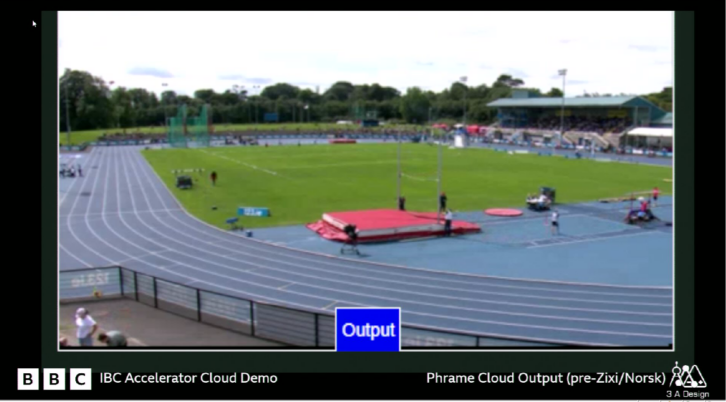
Hence RTÉ’s participation in the Accelerator’s PoC at the Irish National Senior Track and Field Championships in Dublin. SRT was used for programme feeds over public internet, with WebRTC employed to capture commentary; the output was ultimately provided both to RTÉ Player for public viewing and to ground-based MCRs in a number of formats.
In general, the Accelerator struck an upbeat tone about the potential of cloud MCRs, but it did highlight several key areas for attention. In particular, the move to the cloud introduces new complexities, such as the orchestration of different vendor solutions. Without a unified orchestration layer and single operational interface, and the ability of production teams to retain switching control, there is a risk of creating latency and synchronisation issues. Concluding that a single universal API for MCR functions is “not practical or desirable”, the Accelerator instead calls for a template-based API model that supports interoperability while still allowing vendors to innovate individually.
RTÉ has recently gone through its own significant infrastructural upgrade—to SMPTE ST 2110—meaning its MCR operations are now based around an IP router. That’s “probably not going to change anytime soon, but I think some of the learnings are very valuable for us to understand where the pain points are and how we might develop things operationally in the future,” says Kilgour.
Cost-conscious
Meanwhile, a recent deployment of cloud-based MCR at a UEFA Europa League qualifier match makes a strong case that, at least initially, the greatest potential of this approach is for events where there are specific circumstantial and/or cost pressures. Working in close cooperation with Cerberus Tech, Open Broadcast Systems played a critical role in delivering the transmission of a match between Ukraine’s Shakhtar Donetsk and Turkey’s Besiktas, which was held in Krakow. Rather than a more conventional blend of fibre and satellite delivery, the match was transmitted from site using public internet and 5G, and managed entirely within the cloud (visit Open Broadcast Systems’ website for a more detailed case study on the project).
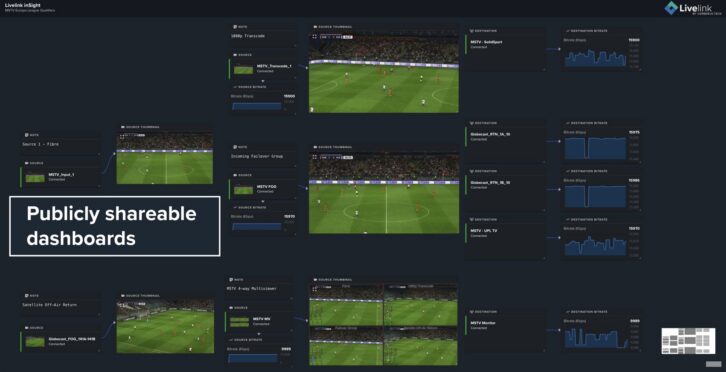
“In this case the host broadcaster was Shakhtar Donetsk, and given the current situation [in Ukraine] the budget did not cover a traditional workflow by quite a long way,” says Kieran Kunhya, founder and CEO of Open Broadcast Systems, which supported first path venue international usage with its low-latency encoders, and also provided its 5G Flyaway product in case of any problems with the primary route. Hosted in AWS, the Cerberus Tech Livelink platform managed the two flows and ensured automatic failover if the main internet-based path went down.
With 17 takers there was no small amount of pressure, but the reception was very positive. Ultimately, says Kunhya, it was “a really top-class feed considering the budgets that Ukrainian TV has, [and had the added benefit] of being able to show that you can deliver a great feed to millions of people using more interesting cloud MCR workflows”.
There is also general agreement that keeping workflows as clear and concise will be essential to further adoption of cloud MCR; it may also be that hybrid architectures offer another valid pathway.
As opposed to comprehensive cloud-based MCR deployment, Demb notes that “what we’re seeing instead is a steady rise in hybrid workflows where cloud resources are used selectively, only where they make technical and commercial sense, rather than a wholesale migration away from traditional infrastructure.
“[Therefore] in the coming years, I expect continued growth in hybrid architectures that combine on-premise infrastructure with cloud and virtualised environments. Emerging technologies such as MXL will play an important role by simplifying interoperability between vendors and systems in cloud and VM-based workflows, helping reduce integration complexity and accelerating adoption.”
- This article appears in the April 2026 issue of TVBEurope, available to download free here