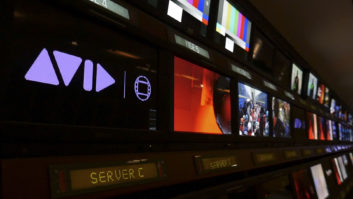
The modern newsroom never stops. With the shift from traditional broadcasts to digital and social platforms, the demand for immediacy has intensified, requiring journalists to file updates from anywhere, editors to collaborate remotely, and production teams to adapt in real time.

Legacy, siloed workflows can’t keep up with this new reality. And yet, in many operations, core processes like ingest, editing, archiving, playout and distribution still sit in separate systems. Even as technologies like AI are introduced, they’re often layered on top rather than built into the workflow itself.
This fragmentation leads to islands of data, duplicated assets, and wasted time spent searching through unstructured archives. The result is not only inefficiency but also missed opportunities to reuse, repurpose, and monetise what’s already been created.
Cloud and AI as enablers of a convergent media fabric
Across the industry, forward-looking broadcasters are moving beyond isolated systems recognising cloud and AI not as optional add-ons, but as enablers of a convergent media fabric, one where all systems, assets, and teams are connected and work in sync in a single environment.
The real transformation doesn’t come from simply adopting innovation for its own sake, but from how it tangibly improves everyday operations and optimises business value. Cloud deployments should provide scalability and flexibility to handle peak demands and support remote workflows, while AI should be used to drive efficiencies and transform raw data into usable insight.
A flexible, cloud-enabled architecture allows every system to communicate in real time and drives faster modular innovation. Metadata and media flow freely across teams, ensuring efficiency, transparency, and speed.
Cloud-enabled media asset platforms in action
EVS’s VIA MAP media asset platform exemplifies this by bringing together ingest, content management, logging, editing, playout, distribution, publishing, and NRCS integration within a single interface, regardless of whether the environment is on-premises, cloud-based, or hybrid.
This balanced computing strategy gives broadcasters the flexibility to deploy and scale workflows across different infrastructures without disrupting existing operations. It ensures predictable performance, resource optimisation, and consistent user experiences, wherever teams are located.
Within VIA MAP’s architecture, AI continuously enriches content through speech-to-text transcription, face and object recognition, and contextual tagging. This transforms raw footage into structured, searchable media, enabling teams to easily find content, build their stories faster, and ensure that valuable assets are never lost in the archive.
How does it all come together? Picture a breaking news event. Footage is uploaded from the journalist’s mobile device directly to the cloud, where AI immediately tags key moments as they happen. While the story still unfolds, journalists back at HQ can instantly search for quotes, build timelines, and begin editing with proxy files, without waiting for transfers or approvals. By the time the story is published and is ready to be aired, it’s already archived with rich metadata, ready for reuse or redistribution.
With this kind of connected workflow, the impact is felt everywhere across the organisation: journalists are able to focus on developing compelling stories, editorial teams save precious hours every day, IT gains predictability in cost and infrastructure, and leadership gains actionable analytics and performance visibility, enabling business value control.
The road ahead: faster because it’s smarter
The newsroom of the future will move faster – not because of industry hype or new trends, but by operating more intelligently, efficiently, and collaboratively. This evolution allows users to focus on creativity and immediacy while technology removes friction from the production process.
With balanced cloud strategies and practical AI applications in place, executives are able to choose the right deployment model that aligns with their strategy – driving economic efficiencies, without hampering creativity.
Real progress will come from leveraging a robust, balanced, and flexible media asset platform that connects teams, systems, and content in a single environment. Because the most important question isn’t about if part of the workflow will be supported by cloud deployed components or if AI Chatbots will be used. It’s the way organisations will implement efficiency-centric tools to unlock lasting performance optimisation and real business value.