The European Broadcasting Union (EBU) has introduced a model IP-based media production facility housed in two flight racks that can travel to Member broadcasters to assist them with the transition to IP.
Developed by the EBU’s Technology and Innovation department, it aims to provide practical experience beyond theoretical training, targeting smaller EBU Members.
“The job of the EBU’s Technology and Innovation department is to help EBU Members with new technology. We understand that we’re at the stage with SMPTE ST 2110 where the early adopters are already on air, but the larger part of EBU Members are starting on the journey to IP, and we want to help them,” Pavlo Kondratenko, project manager in media production over IP at the EBU, tells TVBEurope.
While the EBU has been offering training to Members for several years, Kondratenko realised that many broadcast engineers have little basic networking knowledge, making it hard for them to “digest” an IP masterclass. Working alongside EBU Academy, the organisation created Live IP Essentials, a basic networking course.
However, as Kondratenko points out, for many engineers, it’s important to understand the practicalities of IP as well as the theory. “We realised we could help EBU Members by giving them an actual kit, a real thing, and let them get their hands on it.
“The ideal situation is that people go through the two training courses, and the next step is to give them hands-on learning and knowledge,” he explains. “That was the main goal when we created the Live IP Sandbox. The second goal is, each broadcaster IP project starts with a PoC, and for smaller EBU Members, it can be a big undertaking. So we basically built a PoC that they can further adapt to their needs and actually try out things before investing in technology.”
That PoC takes the form of two rather large flight racks (weighing around 500 kg), which goes against the usual trend of using a compact kit that can travel around in someone’s suitcase. “Small kit is good for training and showing people things, but for an actual PoC, I thought it would be a bit limited,” states Kondratenko.
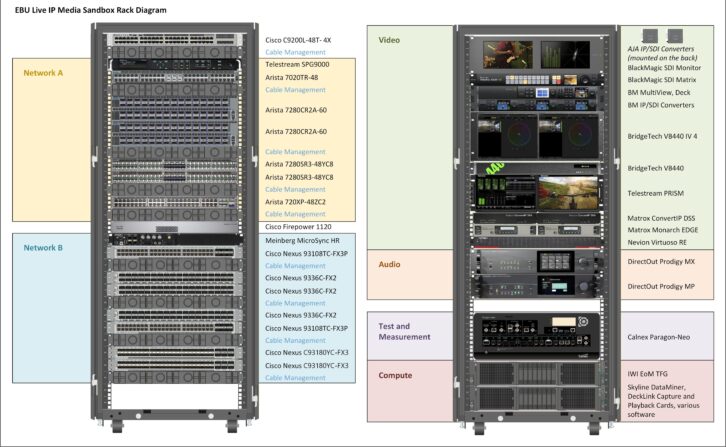
“I basically built two networks, A and B. I decided to have two alternatives for each component in the setup. For example, network A is from Arista, and B is from Cisco. That means each EBU Member has an opportunity to try both networks and choose which one works for them.”
This was key to all of the technology choices made for both racks, he continues: “One of my principles was that I didn’t want to force any specific vendor onto EBU Members. As a PoC, I thought it would be a great idea to let them try different things and choose what’s best for them.”
The Sandbox has a Spine-leaf topology, with each network comprising five switches, and an extra switch if Members want to test the scenario of scaling the network. It also includes PTP, which again is two master clocks from two different vendors, as well as a management switch.
Last year, the Sandbox travelled from its base at the EBU’s HQ in Switzerland to Bonn, Germany where it was used by the team at Deutsche Welle for a three-day workshop for 12 of the broadcaster’s engineers. “They were just about to begin an IP project, so it was quite valuable, says Kondratenko. “I did a workshop knowledge transfer session where I walked them through all the pieces of the kit and told them how to use it.”
Currently, the Sandbox is only available for use by EBU Members, explains Kondratenko: “Our job is to help EBU members, maybe once we’ve done that, we can think about expanding it. It was discussed internally, but it’s not part of our agreement with vendors. The kit is all rather expensive; some of it was donated, some was loaned and we purchased a small part.”
The EBU Live IP Media Sandbox will be on show at the EBU’s Production Technology Seminar in Geneva on January 27th. To find out more, contact Pavlo Kondratenko at [email protected].