If you wanted to gain an insight into the last 40 years of broadcast technology evolution, you would be hard-pressed to find anyone with greater expertise than Mike J Strein. Across multiple roles at ABC News, and latterly as the broadcaster’s director of engineering and technology, he has been integral to every major technical milestone—including the migration from analogue to digital, the introduction of video-over-IP, and the launch of streaming services.
Most recently, he has been one of the key architects of the technical infrastructure underpinning ABC News’ 400,000+ sq ft new home at 7 Hudson Square—a huge, 22-story purpose-built facility in Manhattan that serves as the East Coast headquarters of The Walt Disney Company as well as other broadcast subsidiaries such as ESPN and WABC-TV. A powerful IP-based workflow is central to the ABC News studios, which were developed by a team led by Strein, who is also a SMPTE Fellow, an AMWA board member, and has 57 US patents to his name.
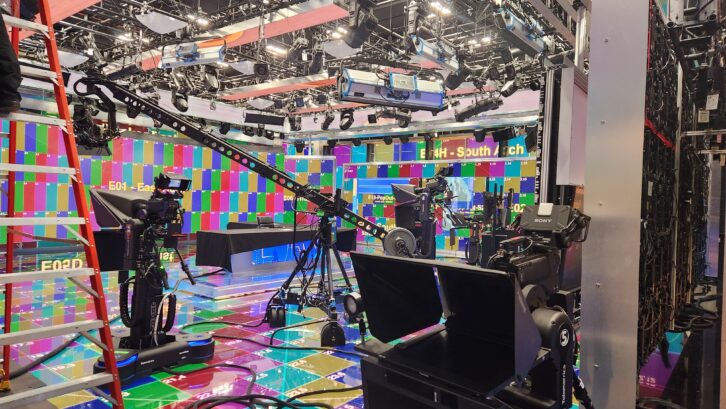
Speaking to TVBEurope shortly before his retirement from ABC News, Strein reflected on the challenges of planning a relocation from the historic Lincoln Square site; the technical advances that his team wanted to achieve with the new studios; and the impact of the Covid-19 pandemic, which began shortly after the project commenced.
One-campus model
The impetus for the relocation was the 2018 decision by The Walt Disney Company to “fold up all of the campuses in New York City, because all of the rents, utilities and everything else we pay was pretty much scattered all over the city. So the decision was taken to move everything to the address at 7 Hudson Square” where the new facility was designed by architects SOM, whose other credits include the world’s tallest building, the Burj Khalifa in Dubai.
Work on the design of the new ABC News studios began in earnest in 2019. “It was essentially greenfield-built for us, so we tried to take all the lessons learned in the construction and destruction of the old building and put that into the new facility,” recalls Strein. In particular, he was determined to move away from an infrastructure “where there were limitations on router size and the ability to, for example, send a signal from one edit room in one building to another control room in another building” in favour of an IP-based “single media fabric with everything on it, and which was completely resilient and redundant. We also wanted to create pools of resources that allowed us to be much more efficient, because there was definitely inefficiency in the old uptown facility; for example, there was a studio that was only used on a Sunday morning.”
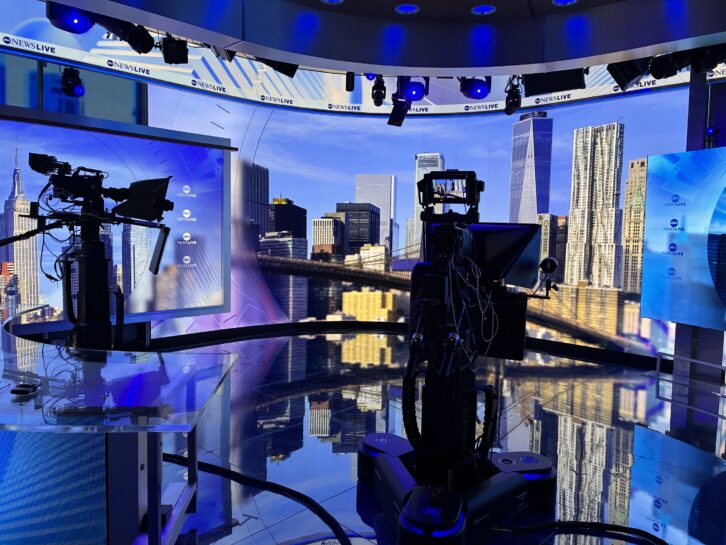
As the pandemic took hold in early 2020, there was—not unreasonably—an increased awareness of the need for resilience and redundancy. This included the ability to rapidly move people out of the building and support remote working in the event of future crises. “We did have to come up with solutions [for our old facility] at the time, and in retrospect that proved to be a benefit as we had to figure out ways for people to be located elsewhere and still access the infrastructure securely.”
There was also a recognition that, whilst the primary data centre capacity would be situated in the new building, there also had to be an ability to access data centres in other sites owned by The Walt Disney Company. “There is a danger you limit your disaster recovery strategy when you put everything in one building,” says Strein. “So we were aware of this, but realised that what we needed to do first was build the most resilient, redundant facility possible, and then look at how we could move [elements of] infrastructure out at some point.”
Throughout the design and development process, Strein and his team worked closely with integrator Diversified Systems, who built the broadcast infrastructure part of the new facility. Further reducing the risk of “any rinse and repeat – we only wanted new concepts”, ABC News also engaged a company called Intoto Systems to work on “a PoC about how we would accomplish everything”.
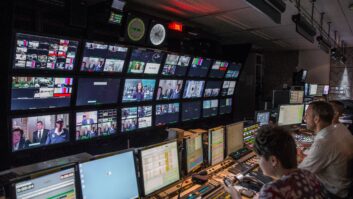
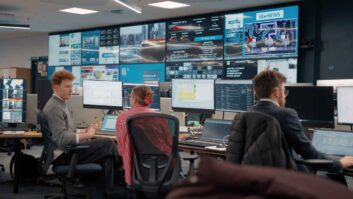
Ultimately, it was determined that the studios would feature an architecture based around ST 2110, including SMPTE 2110-30 for audio (otherwise known as the AES67 interoperability standard), although there is still a capacity to use SDI if needed. “We didn’t want to have lots of [proprietary technologies] involved; the intention was always to utilise a small group of well-known standards,” confirms Strein, who notes that the new ABC News facility includes 70 edit suites (as well as many more desktop editing spaces), 3 large audience rated studios (6500 sq ft), 4 medium studios (2500-3500 sq ft), multiple flex spaces, along with 11 production control rooms and associated audio control and music mix rooms.
VDI Vision
Also bringing uniformity to ABC News’ new premises is an operator design philosophy that means “pretty much every position is identical – the panels, the control system and the interfaces”. It’s based upon a VDI (Virtual Desktop Infrastructure) approach that eliminates desktop computers in favour of thin clients, with operating systems accessed via centralised servers in virtual farms.
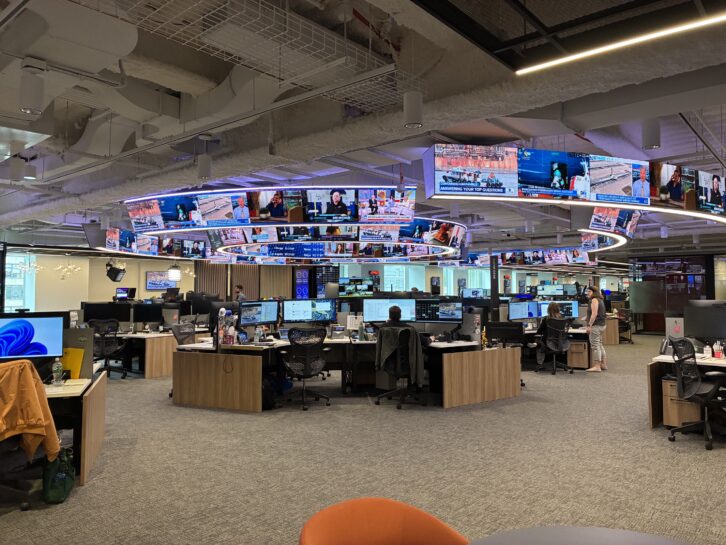
“It’s now very easy for people to move from show to show, and to do whatever they need to do,” says Strein. “They interface with the system in the same way as they do from home. [In terms of flexibility] it’s really good that has been baked into the design.”
Inevitably, the pandemic complicated the construction process, but ultimately no dates for specific ABC News programmes going live from the new site had to be pushed back. The migration began in the autumn of 2024, with flagship show Good Morning America being the last to transition to the new facility in summer 2025.
For Strein, who still plans to work part-time as a consultant, it’s been quite the finale to his near-four decade career at ABC News. “I’ve been lucky enough to work during this tremendous era of change,” he says. “To be able to use the knowledge I’ve built up on this greenfield project has been fantastic, and in many ways it has been the culmination of my career.”
This article was originally published in TVBEurope’s ebook, Reality Bytes: IP in the real world, which is available to download here.