Please explain what your Accelerator project is in as much detail as possible.
At its core, it’s about democratic access to wonder and awe. Most music festivals, and concerts, and live TV shows are expensive to attend, focused on able-bodied folks, and have a high cultural threshold to traverse if one isn’t used to that world. So how can you give people an experience they might not be able to access otherwise without compromising the fun of it?
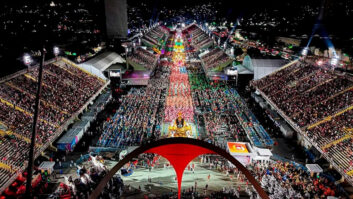
Right now, even our most sophisticated livestreams are pretty basic—it’s television with better bandwidth. There can be 80,000 people having this insane communal experience at a festival, and then millions of people at home watching that experience through a little rectangle. They can see the party, and see other people having fun, but they are not really at the party.
IFEL is trying to collapse that distance. We are building and testing an end-to-end system where someone participating remotely can enter a live festival spatially—through immersive video, VR, spatial audio and other forms of extended reality—while, importantly, people physically at the festival can also become aware of and interact with the people joining remotely. So this isn’t just about putting a 360 camera at a concert and letting someone look around. The real question is: how do we create presence in both directions?
Could someone in Detroit, Lagos, Amsterdam or a hospital bed in London actually feel socially present inside the same musical event? Could someone standing in the crowd look through AR glasses or another interface and see the remote audience represented around them? Could those two groups dance together, react to one another and actually affect the experience? That’s the part that excites me.
And one thing that is important to me historically is that IFEL didn’t suddenly appear when we entered the IBC Accelerator. I started experimenting with the underlying ideas behind this more than ten years ago in Detroit and through my research at MIT: using emerging technology not simply to make media more immersive, but to create new kinds of human connection and shared experience. Over the years, those experiments moved through VR, AR, festivals, hackathons, participatory performance and a lot of strange prototypes that occasionally worked.
What is beautiful about IFEL now is that an idea that began as a much smaller, fairly unruly experiment has attracted an extraordinary collection of people who can attack different pieces of the problem at an entirely different scale. The IBC Accelerator has allowed us to take that original question and surround it with serious broadcast engineering, immersive audio, standards, academic research and live-production expertise.
So in some ways, IFEL is a technology project. But to me it has always been a social experiment disguised as a technology project. We want to know whether media can make distance matter a little less.
REGISTER FOR IBC2026
Who is involved in the project?
A slightly absurd number of smart people. The project brings together broadcasters, universities, standards groups, artists and technology partners including BBC, ITV, EBU, SMPTE, King’s College London, University of Southampton, University of Galway, MIT Reality Hack, Shure and others.
I come into it through Street Cred Detroit and MIT and the earlier experiments that eventually became IFEL. What I love is that everyone is attacking a different piece of the problem. The engineers are thinking about scale and reliability. The audio people are thinking about presence. The artists are asking whether any of this actually feels good.
And I’m usually the person saying, “Yes, but do the people actually feel closer?”
Why do you believe the project is important to the media industry?
Because I think media is slowly moving from watching things to entering things. A concert is a perfect test. We already know how to transmit music. That’s not the hard part.

The hard part is transmitting the feeling of being surrounded by thousands of people who are all losing their minds at the same moment. If we can start transmitting some version of that presence, it changes entertainment, accessibility and probably the economics of live events too.
Someone who can’t travel, can’t afford a ticket or physically can’t attend shouldn’t automatically get the “lesser” version. That’s the part I’m really interested in.
What’s been the biggest challenge you’ve faced as part of your project?
Probably keeping the original idea from disappearing underneath all the technology. Once you get enough cameras, codecs, audio systems, headsets and very smart engineers involved, it is extremely easy for the machinery to become the story.
But the original question was always pretty simple: can two people who are nowhere near each other actually share a moment?
I’ve been trying to answer that question for more than a decade. The project is becoming much more sophisticated because of all the partners involved, which is great. I just want to make sure that underneath all that beautiful engineering, two strangers can still somehow dance together. Otherwise we kind of missed the point.
Why did you want to be part of this year’s IBC Accelerator programme?
Because eventually you have to stop talking about the future and actually build the damn thing. I love labs, hackathons and speculative prototypes, but there is a huge difference between making something interesting and making something that could actually work at scale.
IBC puts the project in front of people who understand broadcast infrastructure, standards, live production and all the unsexy things that suddenly become very sexy when your prototype has to work in the real world. For me, that was the attraction.
An idea I’ve been playing with for years finally had a chance to get stress-tested by people who could make it much bigger than I could make it alone.
What can IBC Show attendees expect to see from you in Amsterdam?
Hopefully some controlled chaos. We’ll be showing experiments around immersive video, spatial audio and remote participation—basically different ways of making the distance between the physical audience and the remote audience feel smaller.
But I don’t want people to walk away thinking, “Oh cool, VR concerts.” That’s actually the least interesting version of this. I want someone to experience it and start asking: “Wait… if people anywhere in the world can actually feel present here, then what exactly is a live event?”
That’s the question that started IFEL for me. And I’m still trying to answer it.