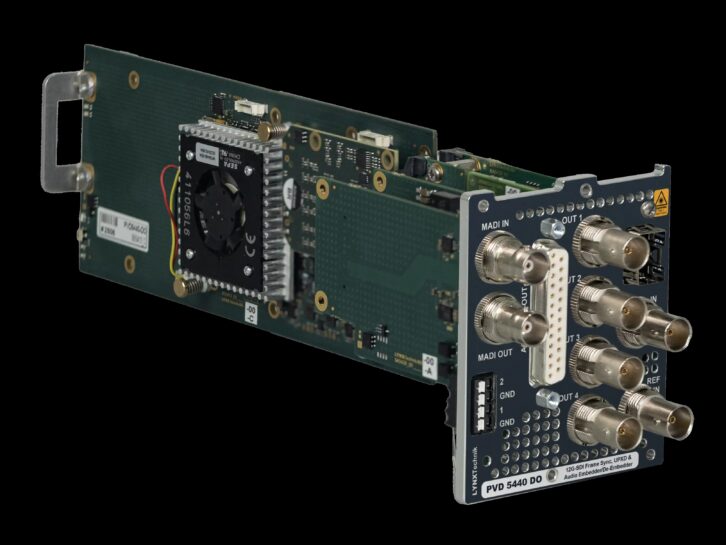
LYNX Technik has announced the launch of PVD 5000 DO, a high-performance frame synchronizer and multi-format video processor designed for demanding broadcast and production applications.
The card combines frame synchronisation, up/down/cross conversion, motion-adaptive de-interlacing, and comprehensive audio embedding and de-embedding, delivering signal processing capabilities in a single 12G-SDI Series 5000 card.
The Up/Down/Cross (UPXD) processing engine incorporates LYNX Technik’s high-quality motion-adaptive de-interlacing technology, which uses motion-adaptive processing followed by diagonal interpolation, delivering clean, detailed images while minimising common interlacing artefacts, particularly around diagonal edges and moving objects, said the company.
The processing engine also supports conversion between virtually all broadcast formats, including resolution and frame-rate conversion. Additional features include crop and zoom, horizontal flip, and a built-in test pattern generator with automatic failover when the input signal is lost.
The PVD 5440 DO also provides audio processing across 12G-SDI, MADI, and AES, including full embedding and de-embedding capabilities. A 136×200 audio crossbar provides flexibility for managing audio between all interfaces, added the company.
The card supports up to 64 audio channels over 12G-SDI, 64-channel MADI input and 64-channel MADI output, plus four AES audio channels in and four AES audio channels out. Channels can be routed, swapped, muted, mixed, and gain-adjusted, with automatic monitoring for audio presence, silence, and overload. Dolby audio can be passed through transparently as part of the SDI signal but is not decoded or processed by the card.
The card provides one 12G-SDI input and four 12G-SDI outputs, with one output configurable as loop-through. Optional fibre connectivity is available through a wide range of SFP modules supporting transmitter, receiver, and transceiver configurations, including single-mode, multi-mode, and CWDM operation with up to 18 wavelength options. Two GPI inputs provide remote control for functions including input switching, video freeze and test pattern activation.